Aldehydes, Ketones and Carboxylic Acids
Get insights from 93 questions on Aldehydes, Ketones and Carboxylic Acids, answered by students, alumni, and experts. You may also ask and answer any question you like about Aldehydes, Ketones and Carboxylic Acids
- 93
Questions
- 0
Discussions
- 0
Active Users
- 1
Followers
Have a question about Aldehydes, Ketones and Carboxylic Acids? Ask our experts
Keep it short & simple. Type complete word. Avoid abusive language.
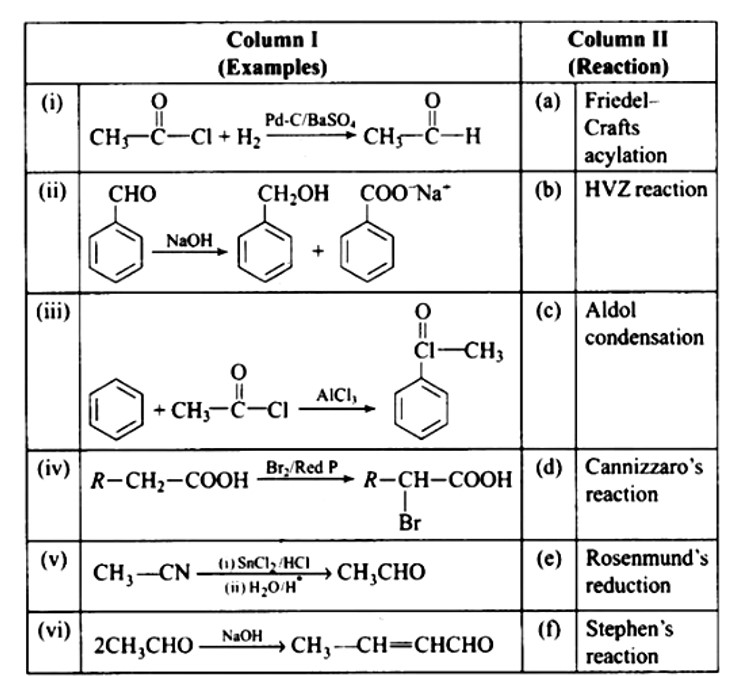
Match the example given in Column I with the name of the reaction in Column II.
This is a Matching Type Questions as classified in NCERT Exemplar
Ans: (i) — (e); (ii) — (d); (iii) — (a); (iv) — (b); (v) — (f); (vi) — (c)
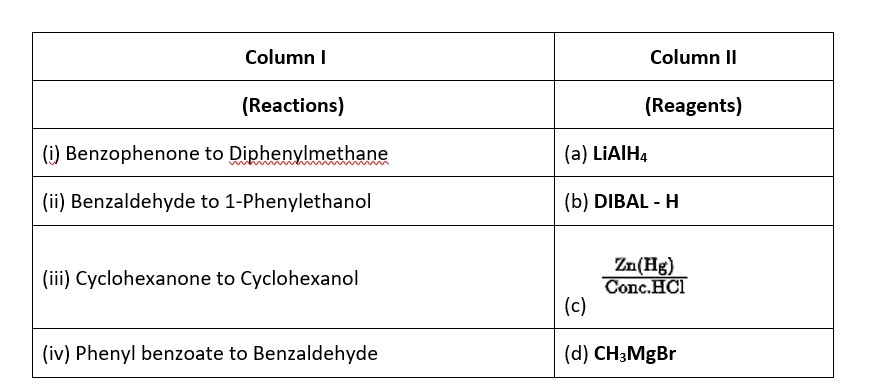
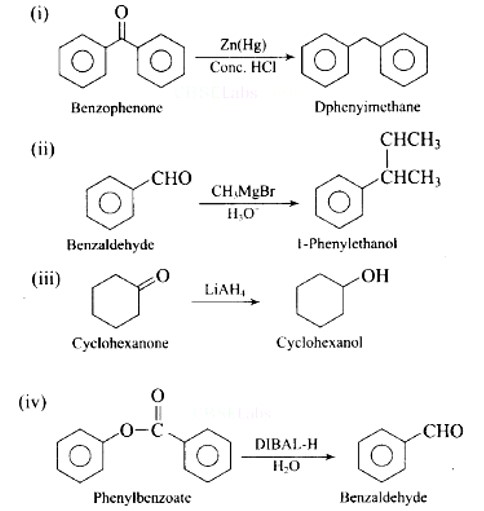
Match the reactions given in Column I with the suitable reagents given in Column II
This is a Matching Type Questions as classified in NCERT Exemplar
Ans: (i) → (c); (ii) → (d); (iii) → (a); (iv) → (b).

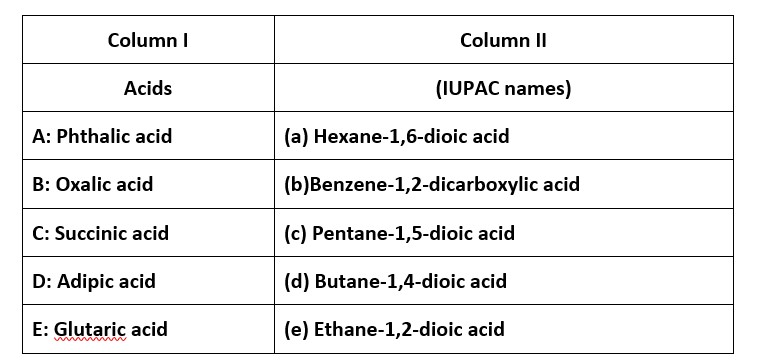
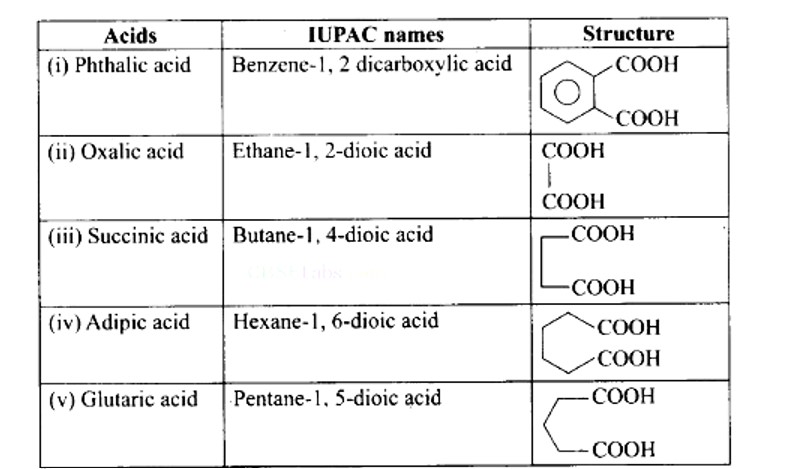
Match the acids given in Column I with their correct IUPAC names given in Column II
This is a Matching Type Questions as classified in NCERT Exemplar
Ans: (i) → (b); (ii) → (e); (iii) → (d); (iv) → (a); (v) → (c)
Note: Match the items of Column I and Column II in the following questions.
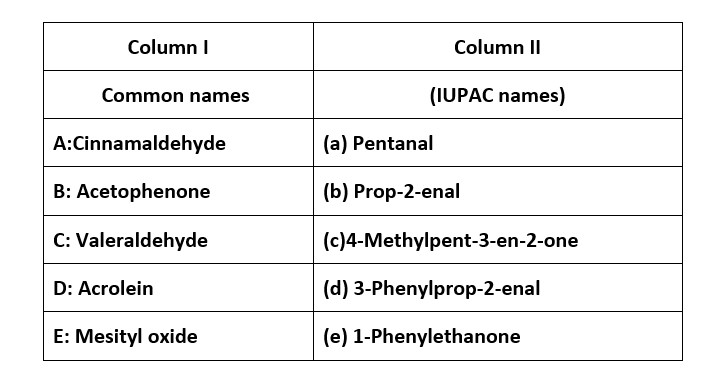
38. Match the common names given in Column I with the IUPAC names given in Column II.
Match the common names given in Column I with the IUPAC names given in Column II.
Note: Match the items of Column I and Column II in the following questions.
38. Match the common names given in Column I with the IUPAC names given in Column II.
Match the common names given in Column I with the IUPAC names given in Column II.
This is a Matching Type Questions as classified in NCERT Exemplar
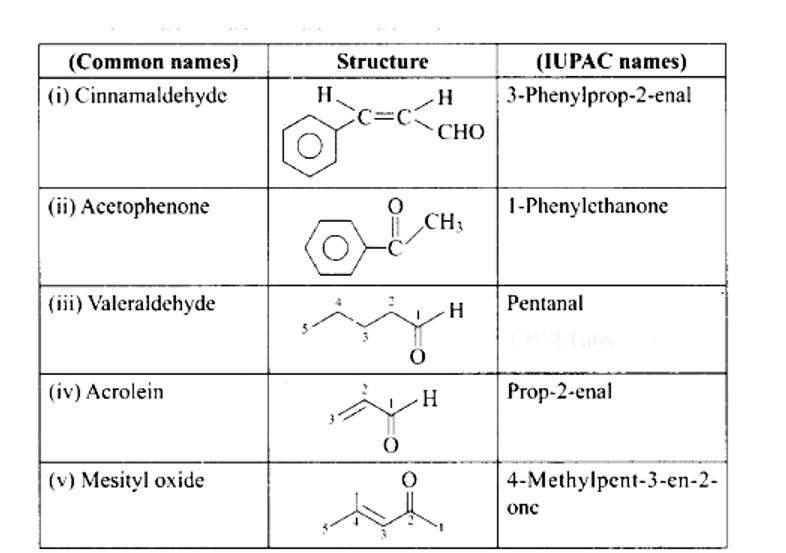
Ans: (i) → (d); (ii) → (e); (iii) → (a); (iv) → (b); (v) → (c)
Assertion: Aldehydes and ketones, both react with Tollen’s reagent to form a silver mirror.
Reason: Both, aldehydes and ketones contain a carbonyl group.
Assertion: Aldehydes and ketones, both react with Tollen’s reagent to form a silver mirror.
Reason: Both, aldehydes and ketones contain a carbonyl group.
This is a Assertion and Reason Type Questions as classified in NCERT Exemplar
Ans: D
The silver mirror test can be used to determine Tollen's. [Ag (NH3)2] + OH - . Only aldehydes, not ketones, react with Tollen's reagent to create silver.
A silver mirror test is not given with this
Assertion: Aromatic aldehydes and formaldehyde undergo Cannizaro reaction.
Reason: Aromatic aldehydes are almost as reactive as formaldehyde
Assertion: Aromatic aldehydes and formaldehyde undergo Cannizaro reaction.
Reason: Aromatic aldehydes are almost as reactive as formaldehyde
This is a Assertion and Reason Type Questions as classified in NCERT Exemplar
Ans: C
There is no alpha hydrogen atom in the Cannizaro process. Formaldehyde and aromatic aldehydes do not contain alpha hydrogen. It proceeds through the Cannizaro reaction. Formaldehyde is the most reactive of all aldehyd
Assertion: The α-hydrogen atom in carbonyl compounds is less acidic.
Reason: The anion formed after the loss of α-hydrogen atom is resonance stabilised.
Assertion: The α-hydrogen atom in carbonyl compounds is less acidic.
Reason: The anion formed after the loss of α-hydrogen atom is resonance stabilised.
This is a Assertion and Reason Type Questions as classified in NCERT Exemplar
Ans: D
Because of the presence of electron withdrawing carbonyl groups, the alpha hydrogen atom in carbonyl compounds is acidic. In nature, hydrogen is very acidic.
Because the cation is released in the form of H+ , the
Assertion: Compounds containing - CHO The group is easily oxidised to corresponding carboxylic acids.
Reason: Carboxylic acids can be reduced to alcohols by treatment with LiAlH4
Assertion: Compounds containing - CHO The group is easily oxidised to corresponding carboxylic acids.
Reason: Carboxylic acids can be reduced to alcohols by treatment with LiAlH4
This is a Assertion and Reason Type Questions as classified in NCERT Exemplar
Ans: E
The two reactions produce different products for different reasons. One involves the oxidation of aldehydes, while the other involves the reduction of carboxylic acids. Aldehydes are easily oxidised by mild oxidising
Note: In the following questions a statement of assertion followed by a statement of reason is given. Choose the correct Ans: out of the following choices
A: Assertion and reason both are correct, and reason is the correct of assertion.
B: Assertion and reason both are wrong statements
C: Assertion is correct statement, but reason is wrong statement.
D: Assertion is wrong statement, but reason is correct statement
E: Assertion and reason both are correct statements, but reason is not correct of assertion
Assertion: Formaldehyde is a planar molecule.
Reason: It contains sp2 hybridised carbon atom
This is a Assertion and Reason Type Questions as classified in NCERT Exemplar
Ans: A
The smallest aldehyde is formaldehyde. It features a triangular planar shape with two bond pairs and no lone pairings. C and O share one pair of electrons in their double bond. As a result, the C atom is sp2 hybridise
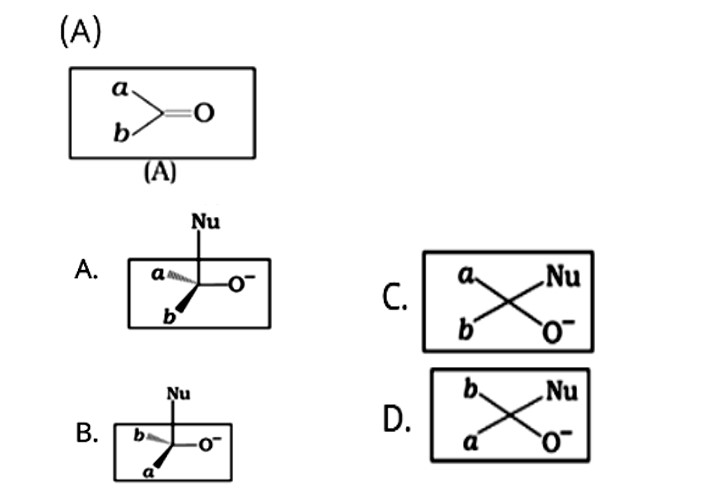
Which of the following is the correct representation for intermediate of nucleophilic addition reaction to the given carbonyl compound
This is a Multiple Choice Type Questions as classified in NCERT Exemplar
Correct options: A and B
The given compound is a planar molecule with sp2 hybridised carbon. Carbon atoms are attacked by nucleophiles. If the nucleophile approaches from the front, the A and B molecules shift to the front