
Amines
Get insights from 162 questions on Amines, answered by students, alumni, and experts. You may also ask and answer any question you like about Amines
- 162
Questions
- 0
Discussions
- 0
Active Users
- 0
Followers
Have a question about Amines? Ask our experts
Keep it short & simple. Type complete word. Avoid abusive language.
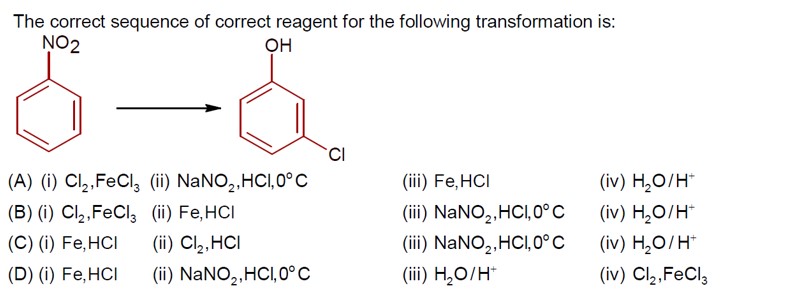

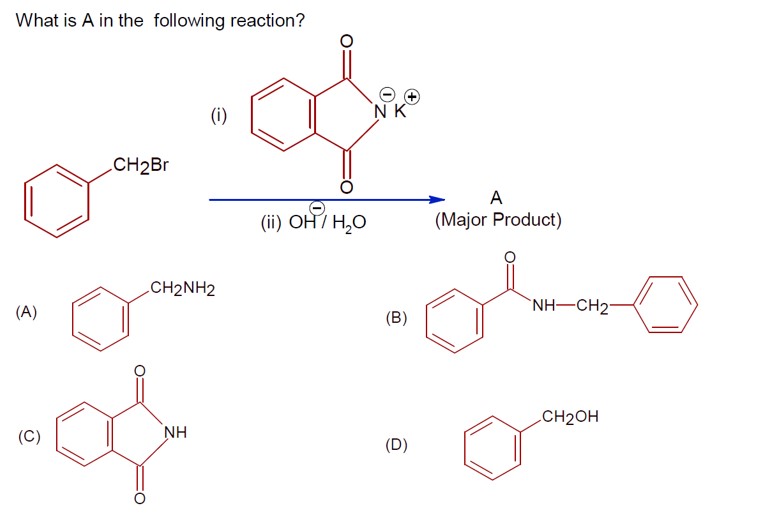
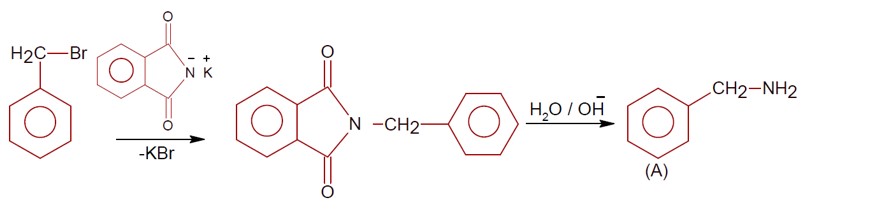
Consider the following statements about amines and select the incorrect one.
Consider the following statements about amines and select the incorrect one.
Diazonium salts of aromatic amines are more stable
 Upvote

Which statement is NOT correct for p- toluenesulphonyl chloride?
Which statement is NOT correct for p- toluenesulphonyl chloride?
p- toluenesulphonyl chloride
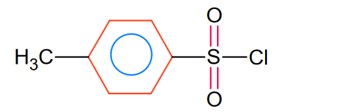
Only gives soluble product with alkali for 1° amine and for 2°- amine it gives insoluble product.
Upvote The final product ‘A’ in the following reaction sequence
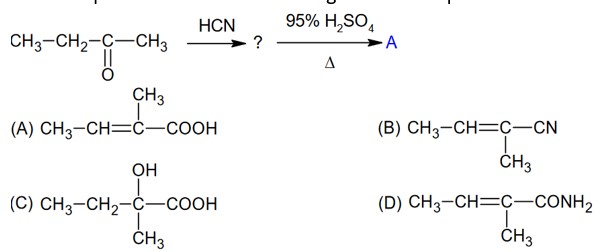
The final product ‘A’ in the following reaction sequence

The given compound is an example of
<!-- [if !supportLineBreakNewLine]-->
<!--[endif]-->
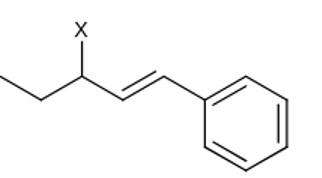
The given compound is an example of
<!-- [if !supportLineBreakNewLine]-->
<!--[endif]-->
Allylic halide have halogen bonded to sp³ carbon which is adjacent to > C = C <
Upvote Match List - I with List - II
<!-- [if !supportLineBreakNewLine]-->
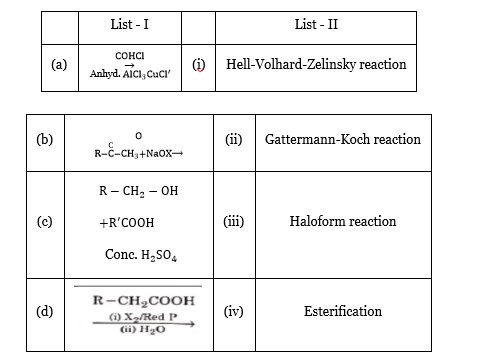
Choose the correct answer from the options given below.
<!--[endif]-->
Match List - I with List - II
<!-- [if !supportLineBreakNewLine]-->
Choose the correct answer from the options given below.
<!--[endif]-->
(a) List-I List-II
CO, HCl Anhydrous AlCl? /CuCl → (ii) Gattermann-Koch reaction
(b) R – C=O .
(c) R – CH? OH + R'COOH - (conc. H? SO? )-> (iv) Esterification
(d) R – CH? COOH - ( (i) X? /RedP (ii) H? O )-> (i) Hell-Volhard Zelinsky reaction
Upvote The major product of the following chemical reaction is :
CH₃CH(CH₃)CH=CH₂ + HBr --(C₆H₅CO)₂O₂--> ?
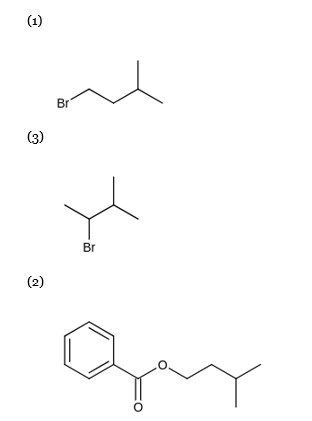
The major product of the following chemical reaction is :
CH₃CH(CH₃)CH=CH₂ + HBr --(C₆H₅CO)₂O₂--> ?
In the presence of peroxide, addition of HBr to unsymmetrical alkenes take place by anti-Markovnikov's rule/Peroxide effect/Kharash effect.
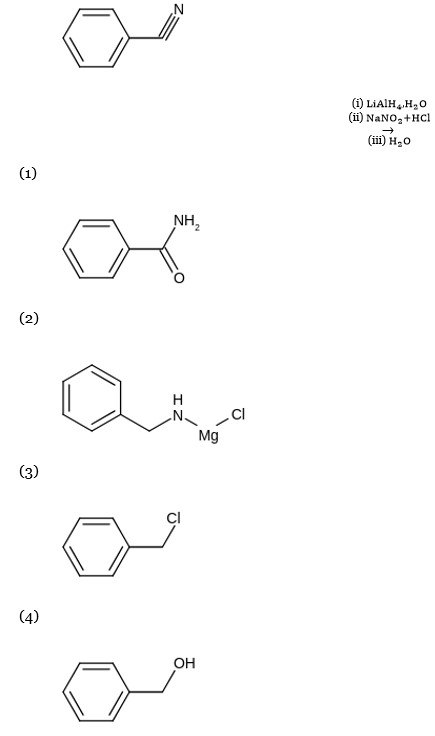
Upvote The product formed from the following reaction sequence is:
<!-- [if !supportLineBreakNewLine]-->
<!--[endif]-->
The product formed from the following reaction sequence is:
<!-- [if !supportLineBreakNewLine]-->
<!--[endif]-->
kc = [O? ]² / [O? ]³
3 × 10? = [O? ]² / [4 × 10? ²]³
[O? ]² = 192 × 10? ⇒ [O? ] = 4.38 × 10? ³²
Upvote The Kjeldahl's method for the estimation of nitrogen can be used to estimate the amount of nitrogen in which one of the following compounds?
<!-- [if !supportLineBreakNewLine]-->
<!--[endif]-->
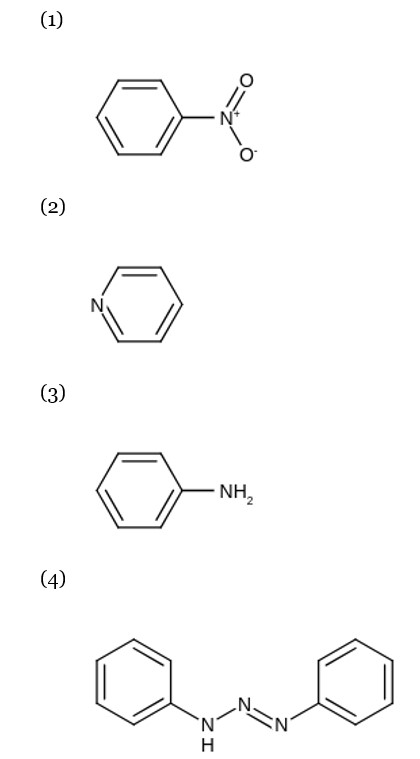
The Kjeldahl's method for the estimation of nitrogen can be used to estimate the amount of nitrogen in which one of the following compounds?
<!-- [if !supportLineBreakNewLine]-->
<!--[endif]-->
Kjeldahl's method does not work for heterocyclic and azo compounds.
Upvote