
Application of Derivatives
Get insights from 282 questions on Application of Derivatives, answered by students, alumni, and experts. You may also ask and answer any question you like about Application of Derivatives
- 282
Questions
- 0
Discussions
- 0
Active Users
- 0
Followers
Have a question about Application of Derivatives? Ask our experts
Keep it short & simple. Type complete word. Avoid abusive language.
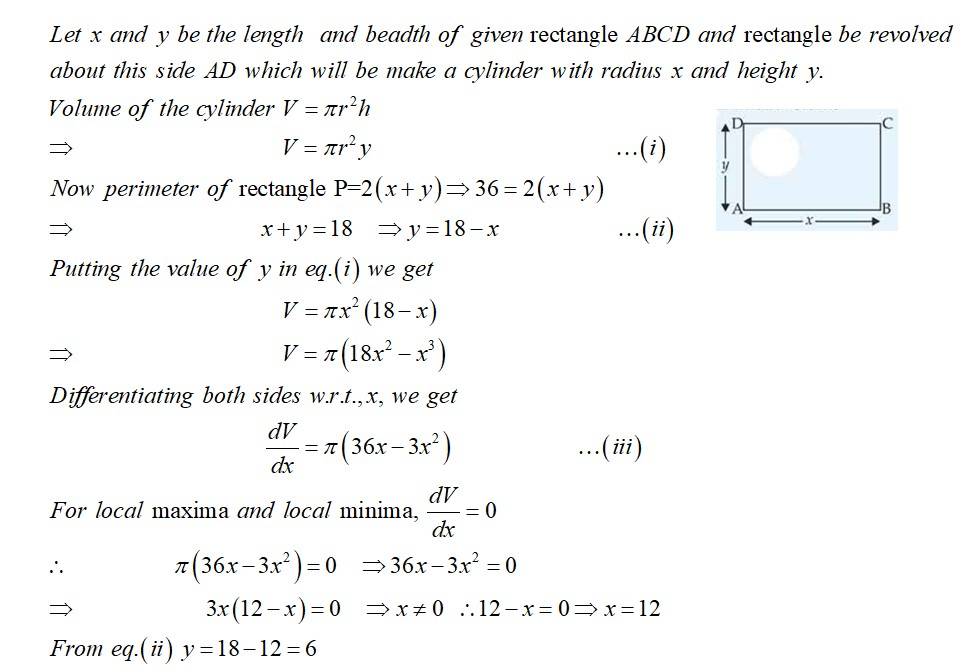
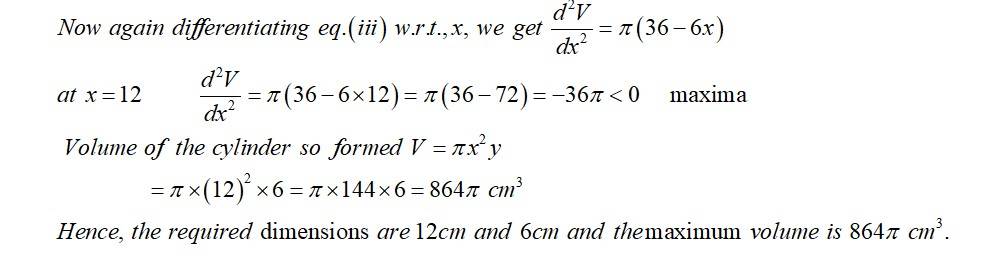
Find the dimensions of the rectangle of perimeter 36 cm which will sweep out a volume as large as possible when revolved about one of its sides. Also, find the maximum volume.
Find the dimensions of the rectangle of perimeter 36 cm which will sweep out a volume as large as possible when revolved about one of its sides. Also, find the maximum volume.
This is a Long Answer Type Question as classified in NCERT Exemplar
Sol:
 Upvote

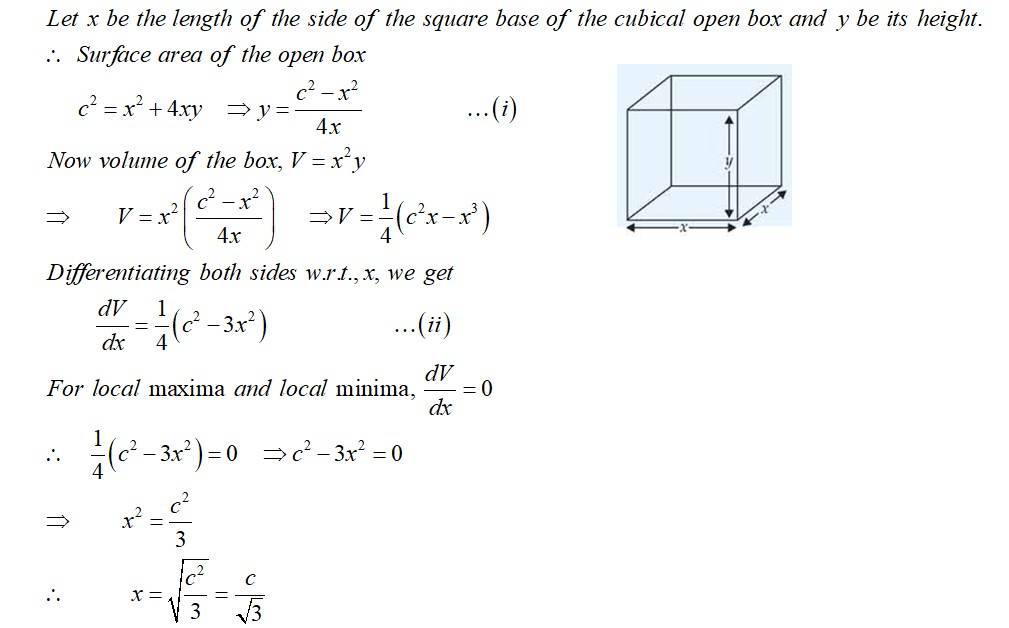
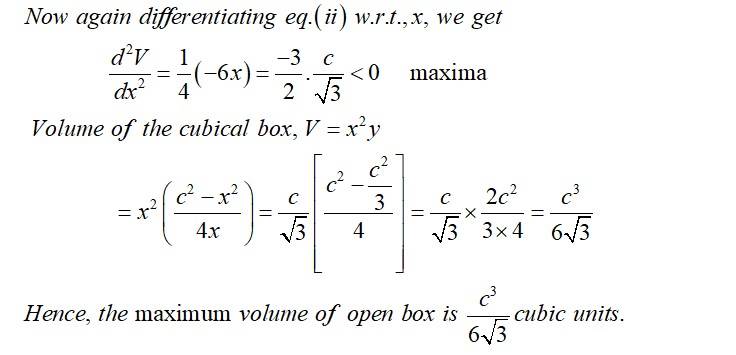
An open box with a square base is to be made of a given quantity of cardboard of area c². Show that the maximum volume of the box is cubic units.
An open box with a square base is to be made of a given quantity of cardboard of area c². Show that the maximum volume of the box is cubic units.
This is a Long Answer Type Question as classified in NCERT Exemplar
Sol:
 Upvote
If the straight-line x cosα + y sinα = p touches the curve, , then prove that a² cos²α + b² sin²α =p².
If the straight-line x cosα + y sinα = p touches the curve, , then prove that a² cos²α + b² sin²α =p².
This is a Long Answer Type Question as classified in NCERT Exemplar
Sol:
Upvote A telephone company in a town has 500 subscribers on its list and collects fixed charges of Rs 300/- per subscriber per year. The company proposes to increase the annual subscription, and it is believed that for every increase of Re 1/-, one subscriber will discontinue the service. Find what increase will bring maximum profit.
A telephone company in a town has 500 subscribers on its list and collects fixed charges of Rs 300/- per subscriber per year. The company proposes to increase the annual subscription, and it is believed that for every increase of Re 1/-, one subscriber will discontinue the service. Find what increase will bring maximum profit.
Sol:
Upvote Find the points of local maxima, local minima, and the points of inflection of the function f(x) = Also, find the corresponding local maximum and local minimum values.
Find the points of local maxima, local minima, and the points of inflection of the function f(x) = Also, find the corresponding local maximum and local minimum values.
This is a Long Answer Type Question as classified in NCERT Exemplar
Sol:
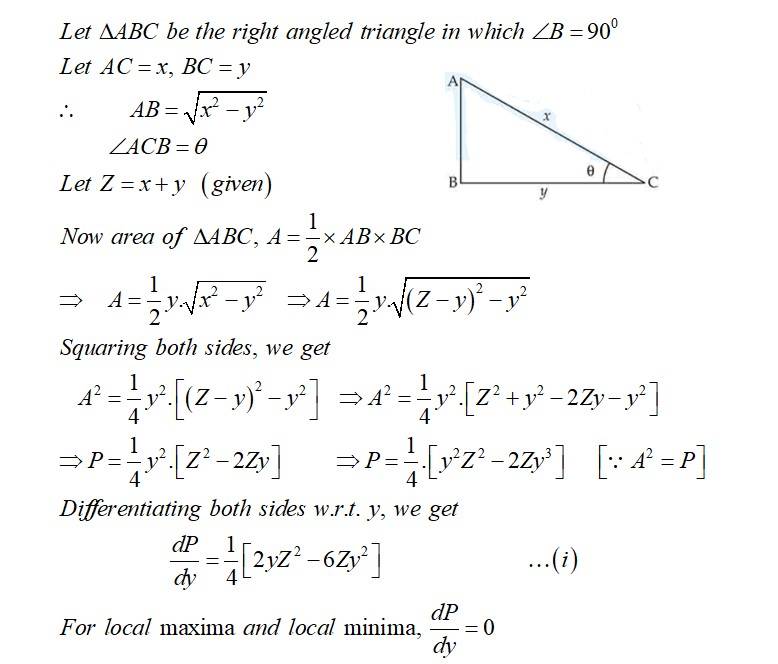
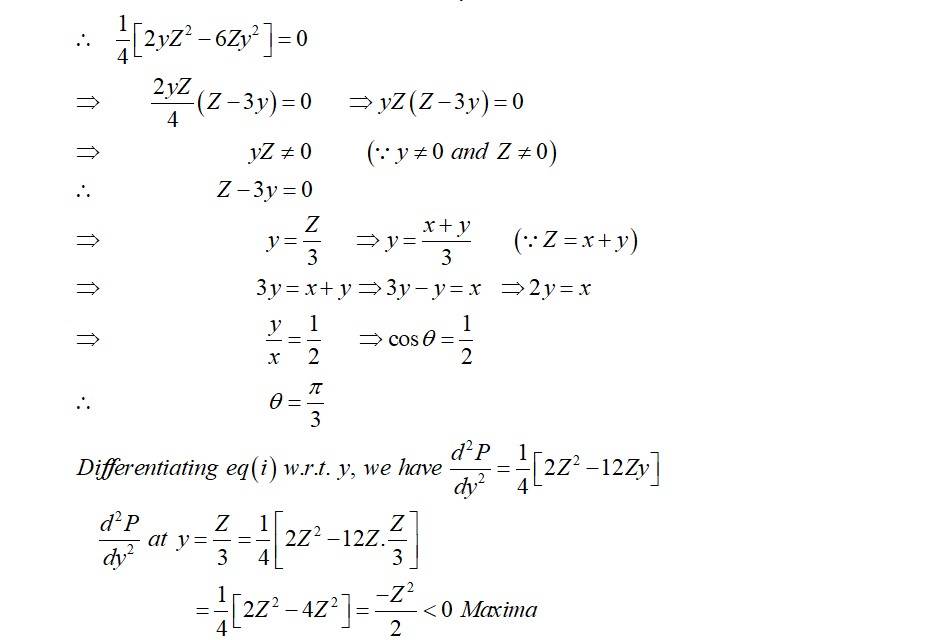
Upvote If the sum of the lengths of the hypotenuse and a side of a right-angled triangle is given, show that the area of the triangle is maximum when the angle between them is
If the sum of the lengths of the hypotenuse and a side of a right-angled triangle is given, show that the area of the triangle is maximum when the angle between them is
This is a Long Answer Type Question as classified in NCERT Exemplar
Sol:

Upvote 125. The points on the curve 9y2 = x3 , where the normal to the curve makes equal intercepts with the axes are
(A) (B) (C) (D)
125. The points on the curve 9y2 = x3 , where the normal to the curve makes equal intercepts with the axes are
(A) (B) (C) (D)
The equation of the given curve is
Differentiate with respect to x, we have:
The slope of the normal to the given curve at point is
The equation of the normal to the curve at is
It is given that the normal makes intercepts with the axes.
Therefore, we have:
Also, the poin
Upvote 124. The normal to the curve x2 = 4y passing (1,2) is (A) x + y = 3 (B) x – y = 3 (C) x + y = 1 (D) x – y = 1
124. The normal to the curve x2 = 4y passing (1,2) is (A) x + y = 3 (B) x – y = 3 (C) x + y = 1 (D) x – y = 1
The equation of the given curve is
Differentiating with respect to x, we have:
The slope of the normal to the given curve at point (h,k) is given by,
Equation of the normal at point (h,k) is given as:
Now, it is given that the normal passes through the point (1,2).
Therefore, we have:
Since (h
Upvote 123. The normal at the point (1,1) on the curve 2y + x2 = 3 is (A) x + y = 0 (B) x – y = 0 (C) x + y +1 = 0 (D) x – y = 1
123. The normal at the point (1,1) on the curve 2y + x2 = 3 is (A) x + y = 0 (B) x – y = 0 (C) x + y +1 = 0 (D) x – y = 1
The equation of the given curve is .
Differentiate with respect to x, we have:
The slope of the normal to the given curve at point (1,1) is
Hence, the equation of the normal to the given curve at (1,1) is given as:
Therefore, option (B) is correct.
Upvote 122. The line y = mx + 1 is a tangent to the curve y2 = 4x if the value of m is
(A) 1 (B) 2 (C) 3 (D)
122. The line y = mx + 1 is a tangent to the curve y2 = 4x if the value of m is
(A) 1 (B) 2 (C) 3 (D)
The equation of the tangent to the given curve is
Now, substituting in we get:
Since a tangent touches the curve at one point, the roots of equation (i) must be equal.
Therefore, we have:
Discriminant = 0
Hence, the required value of m is 1.
Therefore, option (A) is correct.
Upvote