Application of Derivatives

Get insights from 282 questions on Application of Derivatives, answered by students, alumni, and experts. You may also ask and answer any question you like about Application of Derivatives

  • 282

    Questions

  • 0

    Discussions

  • 0

    Active Users

  • 0

    Followers

Have a question about Application of Derivatives? Ask our experts

Ask Your Question

Keep it short & simple. Type complete word. Avoid abusive language.

New answer posted•a year ago
A
a year ago

This is a Short Answer Type Question as classified in NCERT Exemplar

Sol.

G i v e n     t h a t     L = 2 0 0 ( 1 0 − t ) 2 w h e r e     L     r e p r e s e n t s     t h e     n u m b e r     o f     l i t r e s     o f     w a t e r     i n     t h e     p o o l . D i f f e r e n t i a t i n g     b o t h     s i d e s     w . r . t . ,     t ,     w e     g e t                                           d L d t = 2 0 0 × 2 ( 1 0 − t ) ( − 1 ) = − 4 0 0 ( 1 0 − t ) B u t     t h e     r a t e     a t     w h i c h     t h e     w a t e r     i s     r u n n i n g     o u t                                                             = − d L d t = 4 0 0 ( 1 0 − t )                                                                                     … ( i ) Rate  at  which  the  water  is  running  after  5  seconds                                =400(10−5)=2000L/s(final  rate) F o r     i n i t i a l     r a t e     p u t     t = 0                                                                 = 4 0 0 ( 1 0 − 0 ) = 4 0 0 0 L / s T h e     a v e r a g e     r a t e     a t     w h i c h     t h e     w a t e r     i s     r u n n i n g     o u t       = I n i t i a l     r a t e + F i n a l     r a t e 2 = 4 0 0 0 + 2 0 0 0 2 = 6 0 0 0 2 = 3 0 0 0 L / s H e n c e ,     t h e     r e q u i r e d     r a t e = 3 0 0 0 L / s .

Thumbs Up IconUpvote Thumbs Down Icon
New answer posted•a year ago
A
a year ago

This is a Short Answer Type Question as classified in NCERT Exemplar

Sol: 
I n t e r n a l     r a d i u s     r = 3 c m E x t e r n a l     r a d i u s     R = r + Δ r = 3 . 0 0 0 5 c m ∴                                                                   Δ r = 3 . 0 0 0 5 − 3 = 0 . 0 0 0 5 c m L e t                                                             y = r 3 ⇒ y + Δ y = ( r + Δ r ) 3 = R 3 = ( 3 . 0 0 0 5 ) 3                                 … ( i ) D i f f e r e n t i a t i n g     b o t h     s i d e s     w . r . t . ,     r ,     w e     g e t                                           d y d x = 3 r 2 ∴                                     Δ y = ( d y d r ) . Δ r = 3 r 2 × 0 . 0 0 0 5                                                         = 3 × ( 3 ) 2 × 0 . 0 0 0 5 = 2 7 × 0 . 0 0 0 5 = 0 . 0 1 3 5 ∴           ( 3 . 0 0 0 5 ) 3 = y + Δ y                                                           [ F r o m     e q n ( i ) ]                                                           = ( 3 ) 3 + 0 . 0 1 3 5 = 2 7 + 0 . 0 1 3 5 = 2 7 . 0 1 3 5 V o l u m e     o f     t h e     s h e l l = 4 3 π [ R 3 − r 3 ]                                                                                           = 4 3 π [ 2 7 . 0 1 3 5 − 2 7 ] = 4 3 π × 0 . 0 1 3 5                                                                                             = 4 π × 0 . 0 0 4 5 = 4 × 3 . 1 4 × 0 . 0 0 4 5 = 0 . 0 1 8 π c m 3 H e n c e ,     a p p r o x i m a t e     V o l u m e     o f     t h e     m e t a l     i n     t h e     s h e l l     i s     0 . 0 1 8 π c m 3 .

Thumbs Up IconUpvote Thumbs Down Icon
New answer posted•a year ago
A
a year ago

This is a Short Answer Type Question as classified in NCERT Exemplar

Sol: 
          ( 1 . 9 9 9 ) 5 = ( 2 − 0 . 0 0 1 ) 5 L e t                     x = 2         a n d         Δ x = − 0 . 0 0 1 L e t                     y = x 5 D i f f e r e n t i a t i n g     b o t h     s i d e s     w . r . t . ,     x ,     w e     g e t                             d y d x = 5 x 4 = 5 ( 2 ) 4 = 8 0 N o w               Δ y = ( d y d x ) . Δ x = 8 0 . ( − 0 . 0 0 1 ) = − 0 . 0 8 0 ∴                         ( 1 . 9 9 9 ) 5 = y + Δ y                                                                   = x 5 − 0 . 0 8 0 = ( 2 ) 5 − 0 . 0 8 0 = 3 2 − 0 . 0 8 0 = 3 1 . 9 2 H e n c e ,     a p p r o x i m a t e     v a l u e     o f     ( 1 . 9 9 9 ) 5     i s     3 1 . 9 2 .

Thumbs Up IconUpvote Thumbs Down Icon
New answer posted•a year ago
A
a year ago

This is a Short Answer Type Question as classified in NCERT Exemplar

Sol: 
A s     p e r     t h e     g i v e n     c o n d i t i o n ,                                                           d θ d t = 2 d d t ( s i n θ ) ⇒                                                 d θ d t = 2 c o s θ d θ d t               ⇒ 1 = 2 c o s θ ∴                                               c o s θ = 1 2               ⇒ c o s θ = c o s π 3               ⇒ θ = π 3 H e n c e ,     t h e     r e q u i r e d     a n g l e     i s     π 3 .

Thumbs Up IconUpvote Thumbs Down Icon
New answer posted•a year ago
A
a year ago

This is a Short Answer Type Question as classified in NCERT Exemplar

Sol: 
W e     k n o w     t h a t                   A r e a     o f     c i r c l e ,     A = π r 2 ,     w h e r e     r =     r a d i u s     o f     t h e     c i r c l e     a n d     p e r i m e t e r = 2 π r As  per  Question,  dAdt=Κ,  where  K=constant ⇒                           d d t ( π r 2 ) = K ⇒                           π . 2 r . d r d t = K ∴                           d r d t = Κ 4 π r 2                                                                     … ( 1 ) N o w     P e r i m e t e r             c = 2 π r D i f f e r e n t i a t i n g     b o t h     s i d e s ?     w . r . t .     t ,     w e     g e t ⇒                           d c d t = d d t ( 2 π r ) ⇒                           d c d t = 2 π . d r d t ⇒                           d c d t = 2 π . K 2 π r = K r                       [ F r o m     e q n ( 1 ) ] ⇒                           d c d t ∝ 1 r Hence,  the   perimeter  of  the  circle  varies  inversely  as  the  radius  of  the  circle.

Thumbs Up IconUpvote Thumbs Down Icon
New answer posted•a year ago
A
a year ago

This is a Short Answer Type Question as classified in NCERT Exemplar

Sol.

B a l l     o f     s a l t     i s     s p h e r i c a l ∴                   V o l u m e     o f     b a l l ,     V = 4 3 π r 3 ,     w h e r e     r =     r a d i u s     o f     t h e     b a l l . A s     p e r     Q u e s t i o n ,     d V d t ∝ S ,     w h e r e     S = s u r f a c e     a r e a     o f     t h e     b a l l ⇒                           d d t ( 4 3 π r 3 ) ∝ 4 π r 2                   [ ? S = 4 π r 2 ] ⇒                           4 3 π . 3 r 2 . d d t ∝ 4 π r 2 ⇒                           4 π r 2 . d r d t = Κ . 4 π r 2                     [ K=constant  of  proportionality ] ⇒                           d r d t = Κ . 4 π r 2 4 π r 2 ⇒                           d r d t = Κ . 1 = K Hence,  the   radius  of  the  ball  is  decreasing  at  constant  rate.

Thumbs Up IconUpvote Thumbs Down Icon
New answer posted•a year ago
A
a year ago

This is a Long Answer Type Question as classified in NCERT Exemplar

Sol:
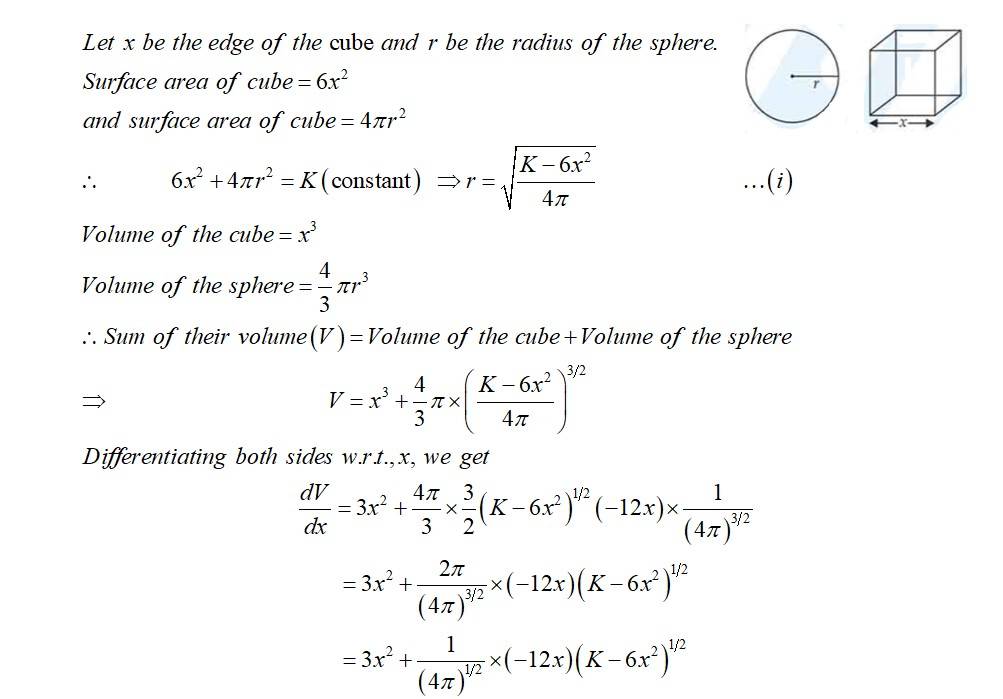
   

L e t     ' r '     b e     t h e     r a d i u s     o f     t h e     s p h e r e . ∴     S u r f a c e     a r e a     o f     t h e     s p h e r e = 4 π r 2 V o l u m e     o f     t h e     s p h e r e = 4 3 π r 3 T h e     s i d e s     o f     t h e     p a r a l l e l o p i p e d     a r e     x ,   2 x     a n d     x 3 ∴         I t s     s u r f a c e     a r e a = 2 [ x × 2 x + 2 x × x 3 + x × x 3 ]                                                                                       = 2 [ 2 x 2 + 2 x 2 3 + x 2 3 ] = 2 [ 2 x 2 + x 2 ]                                                                                         = 2 [ 3 x 2 ] = 6 x 2 V o l u m e     o f     t h e     p a r a l l e l o p i p e d = x × 2 x × x 3 = 2 3 x 3 A s     p e r     t h e     c o n d i t i o n s     o f     t h e     q u e s t i o n , surface  area  of  the  parallelopiped+surface  area  of  the  sphere=constant ⇒                       6 x 2 + 4 π r 2 = K ( constant )           ⇒ 4 π r 2 = K − 6 x 2 ∴                                                                 r 2 = K − 6 x 2 4 π                                                                                                                                           … ( i ) N o w     l e t                                     V = V o l u m e     o f     t h e     p a r a l l e l o p i p e d + V o l u m e     o f     t h e     s p h e r e ⇒                                                               V = 2 3 x 3 + 4 3 π r 3 ⇒                                                               V = 2 3 x 3 + 4 3 π [ K − 6 x 2 4 π ] 3 / 2                   [ F r o m     e q . ( i ) ] ⇒ &thi

S q u a r i n g     b o t h     s i d e s ,     w e     g e t ⇒               4 π x 2 = 9 ( K − 6 x 2 )                 ⇒ 4 π x 2 = 9 K − 5 4 x 2 ⇒                   4 π x 2 + 5 4 x 2 = 9 K ⇒                 K = 4 π x 2 + 5 4 x 2 9                                                                       ( i i ) ⇒                 2 x 2 ( 2 π + 2 7 ) = 9 K ∴                                                           x 2 = 9 K 2 ( 2 π + 2 7 ) = 3 N o w     f r o m     e q . ( i )     w e     h a v e                                                               r 2 = K − 6 x 2 4 π ⇒                                                     r 2 = 4 π x 2 + 5 4 x 2 9 − 6 x 2 4 π ⇒                                                     r 2 = 4 π x 2 + 5 4 x 2 − 5 4 x 2 9 × 4 π = 4 π x 2 9 × 4 π = x 2 9         ⇒ r = x 3         ∴ x = 3 r N o w     w e     h a v e               d V d x = 2 x 2 − 3 x ( K − 6 x 2 ) 1 / 2

                                          = 1 2 − 3 4 K π + 5 4 K − 1 0 8 K 4 π + 5 4                                           = 1 2 − 3 [ 4 K π − 5 4 K 4 π + 5 4 ]                                           = 1 2 − 3 [ 4 K π − 5 4 K . ]                                           = 1 2 − 6 [ 2 π − 2 7 . ]                                           = 1 2 + 6 K [ 2 7 − 2 π . ] > 0                           [ ? 2 7 − 2 π > 0 ] ∴  d2Vdx2>0  So,  it  is  minima. Hence,  the  sum  of  volume  is  min

...Read more

Thumbs Up IconUpvote Thumbs Down Icon
New answer posted•a year ago
A
a year ago

This is a Long Answer Type Question as classified in NCERT Exemplar

Sol:
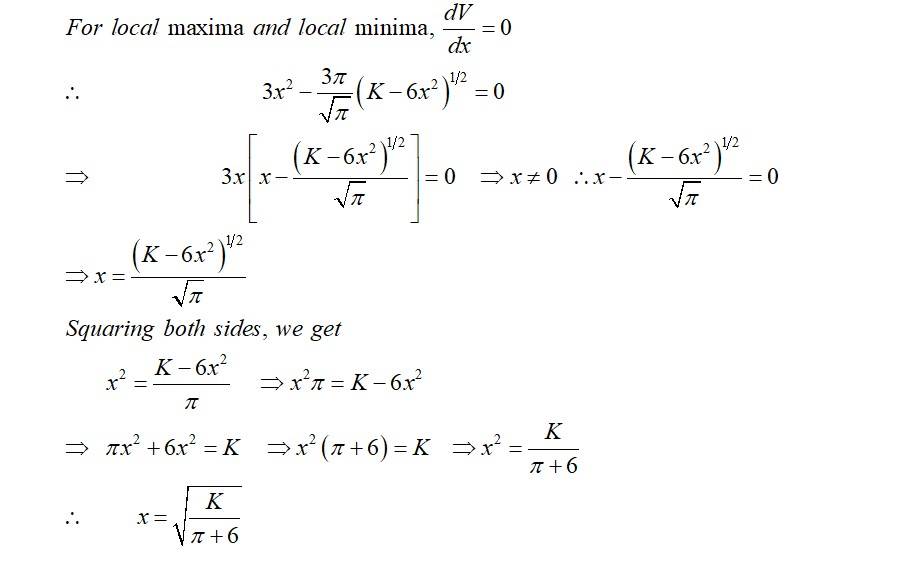
N o w     p u t t i n g     t h e     v a l u e     o f     K     i n     e q . ( i )     w e     g e t                                     6 x 2 + 4 π r 2 = x 2 ( π + 6 ) ⇒                             6 x 2 + 4 π r 2 = π x 2 + 6 x 2         ⇒ 4 π r 2 = π x 2         ⇒ 4 r 2 = x 2 ∴                                     2 r = x ∴                         x : 2 r = 1 : 1 N o w     d i f f e r e n t i a t i n g     e q . ( i i )     w . r . t . , x ,     w e     h a v e                     d 2 V d x 2 = 6 x − 3 d d x [ x ( K − 6 x 2 ) 1 / 2 ]                                           = 6 x − 3 [ x . 1 2 × ( − 1 2 x ) + ( K − 6 x 2 ) 1 / 2 . 1 ]                                           = 6 x − 3 [ − 6 x 2 + ]                                           = 6 x − 3 [ − 6 x 2 + K − 6 x 2 ] = 6 x + 3 [ 1 2 x 2 − K ]                                           = 6 + 3 [ 1 2 K π + 6 − K ]                                                                                     [ P u t           x = ]                                             = 6 + 3 [ 1 2 K − π K − 6 K ] = 6 + 3 [ 6 K − π K ]                         =6+3π[(6K−πK)]>0    so  it  is  minima. Hence,  the  required  ratio  is  1:1  when  the  combined  volume  is  minimum.

Minimum
 

...Read more

Thumbs Up IconUpvote Thumbs Down Icon