

Chemistry
Get insights from 6.9k questions on Chemistry, answered by students, alumni, and experts. You may also ask and answer any question you like about Chemistry
Follow Ask QuestionQuestions
Discussions
Active Users
Followers
New answer posted
a year agoContributor-Level 10
x + 4 * 0 – 2 * 1 = +1
x = +3
Fe+3 = 4s0 3d5
In presence of strong ligand, i.e, CO.
Spin only magnetic moment
New answer posted
a year ago
Contributor-Level 10
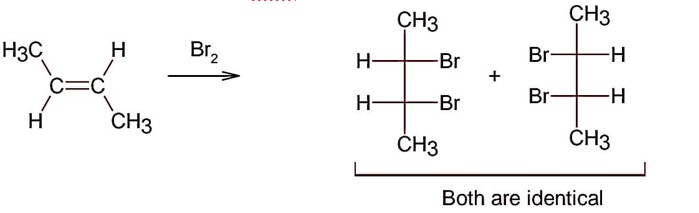
Electrophilic addition of bromine to an alkene is anti-addition, in which cis-alkene gives two enantiomers and trans – alkene gives meso form
Here; trans-but-2-ene will give meso products
New answer posted
a year agoContributor-Level 10
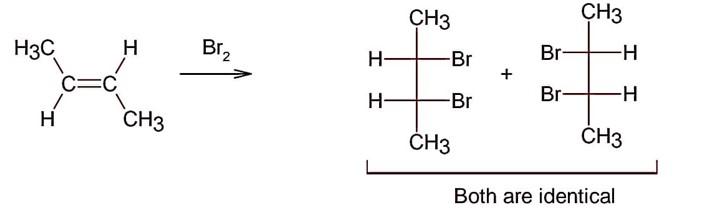
Electrophilic addition of bromine to an alkene is anti-addition, in which cis-alkene gives two enantiomers and trans – alkene gives meso form
Here; trans-but-2-ene will give meso products
New answer posted
a year ago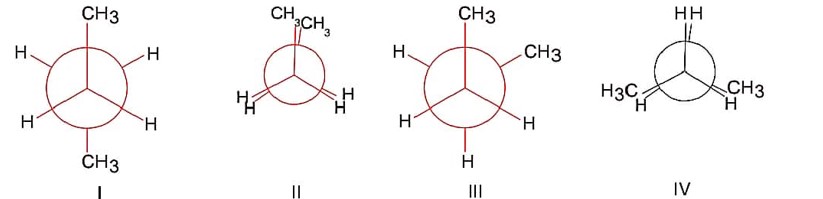
Contributor-Level 10
Structure (I) is anti conformer.
Structure (II) is fully eclipsed conformer.
Structure (III) is skew or gauche conformer.
Structure (IV) is partially eclipsed.
order of stability
(I) > (III) > (IV) > (II)
Order of P.E. is (II) > (IV) > (III) > (I).
New answer posted
a year agoContributor-Level 10
Na/H2 can not reduce a functional group as Na does not behaves as catalyst here.
New answer posted
a year agoContributor-Level 10
Stability order of oxides (X2O) is,
l2O > Cl2O > Br2O
Bonds of halogen & oxygen are covalent due to less EN difference.
Stability of (I - O) bond is higher due to less polarity and that of (Cl-O) bond is higher due to multiple bonding.
New answer posted
a year agoContributor-Level 10
(a) Cell constant =
(b) molar conductivity
= Scm2 mol-1
(c) Conductivity
(d) degree of dissociation =
New answer posted
a year ago
New answer posted
a year ago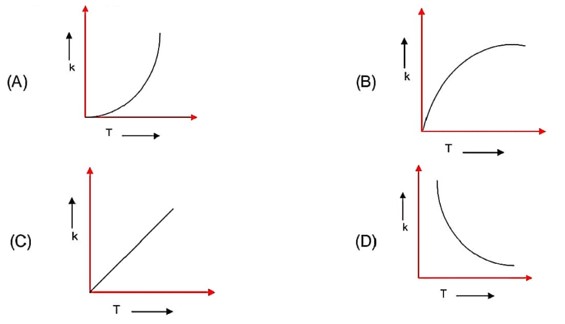
Contributor-Level 10
Rate constant depends on temperature as
Here; as T increases rate constant increases exponentially.
Taking an Exam? Selecting a College?
Get authentic answers from experts, students and alumni that you won't find anywhere else
Sign Up on ShikshaOn Shiksha, get access to
- 67k Colleges
- 1.2k Exams
- 716k Reviews
- 1850k Answers