

Chemistry
Get insights from 6.9k questions on Chemistry, answered by students, alumni, and experts. You may also ask and answer any question you like about Chemistry
Follow Ask QuestionQuestions
Discussions
Active Users
Followers
New answer posted
a year agoContributor-Level 10
t = 00.8 M
0 5 * 10-8 M 0.8M
Concentration of NH3 added =
Volume of solution = 2L
Moles of NH3 added = 2 * 2 mol = 4 mol.
New answer posted
a year agoContributor-Level 10
Millimoles of HCl = 200 * 0.2 = 40
Millimoles of NaOH = 300 * 0.1 = 30
Heat released =
Mass of solution = 500 * 1 g
= 500 g
Specific heat of water = 4.18 Jg-1 K-1
Ans. = 82
New answer posted
a year agoContributor-Level 10
Let molarity of KMnO4 = x
n = 5 n = 1 Ferric sulphate
equivalent of KMnO4 = equivalent of FeSO4
5 * x * 10 = 1 * 0.1 * 10
x = 0.02 M
Strength = (0.02 * 158) = 3.16g/L
= 316 * 10-2 g/L
Ans. = 316
New answer posted
a year agoContributor-Level 10
Dumas method,
Moles of N in N, N-dimethylaminopentane (C7H17N)
= 11.25 mol
= 1125 * 10-2 mol
Ans. = 1125
New answer posted
a year ago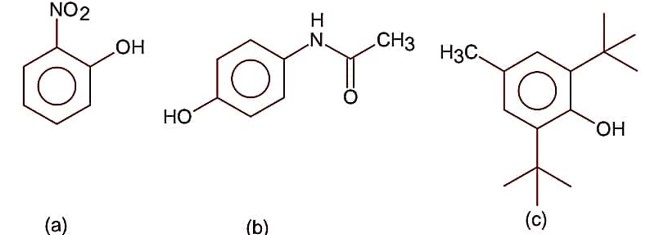
Contributor-Level 10
(a) Shows intra molecular H-bonding.
(b) Shows inter molecular H-bonding.
(c) It does not shows intermolecular H-bonding due to high steric hindrance at o-position of benzene ring.
New answer posted
a year agoContributor-Level 10
mvr =
(Bohr's kinetic energy)
Comparing with
x = 32π2 = 315.50
10x = 3155
New answer posted
a year agoContributor-Level 10
(1) Standard enthalpy of formation for alkali metal bromides becomes more negative on descending down the group.
(2) Standard enthalpy of formation for LiF is most negative among alkali metal fluorides.
(3) In case of Csl, lattice energy is less but Cs+ having less hydration energy due to which it is less soluble in water.
(4) For alkali metal fluorides, the solubility in water increases from Li to Cs. LiF is least soluble in water.
New answer posted
a year agoContributor-Level 10
Let mass of water initially = x gram
Mass of sucrose = (1000 – x) gram
Mole of sucrose =
0.75 molal Þ 0.75 mole solute in 1 kg of solvent
a = 0.2775kg or 277.5 gram
Ice separated = (795.86 – 277.5) gram
= 518.3 gram
Ans. = 518 (the nearest integer)
New answer posted
a year agoContributor-Level 10
In the lyophilic colloids, the colloidal particles are extremely solvated.
Taking an Exam? Selecting a College?
Get authentic answers from experts, students and alumni that you won't find anywhere else
Sign Up on ShikshaOn Shiksha, get access to
- 67k Colleges
- 1.2k Exams
- 716k Reviews
- 1850k Answers