Class 11th

Get insights from 8k questions on Class 11th, answered by students, alumni, and experts. You may also ask and answer any question you like about Class 11th

Follow Ask Question
8k

Questions

0

Discussions

0

Active Users

0

Followers

New answer posted

a year ago

0 Follower 2 Views

A
alok kumar singh

Contributor-Level 10

| z − 1 z | = 2

| z | m a x = ?

| z − 1 2 | ≥ | | z | − 1 | z | |

2 ≥ | r − 1 r |

0 ≤ r 2 + 2 r − 1 & r 2 − 2 r − 1 ≤ 0

r = − 2 ± 8 2 r = 2 ± 8 2

= − 1 ± 2 = 1 ± 2

r ≥ 2 − 1 & 0 ≤ r ≤ 1 + 2

2 − 1 ≤ r ≤ 2 + 1

New answer posted

a year ago

0 Follower 69 Views

P
Payal Gupta

Contributor-Level 10

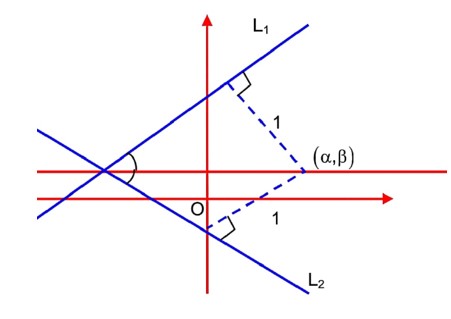
L1 : 3x – 4y + 12 = 0

L2 : 8x + 6y + 11 = 0

(α, β) lies on that angle which contain origin

∴ Equation of angle bisector of that angle which contain origin is

3x−4y+125=8x+6y+1110

⇒2x+14y−13=0

(α, β) lies on it

⇒2α+14β−13=0 …… (i)

⇒3α−4β+7=0 ……. (ii)

Solving (i) & (ii)

α=−2325&β=5350

∴α+β=750

⇒100 (α+β)=14

New answer posted

a year ago

0 Follower 1 View

V
Vishal Baghel

Contributor-Level 10

(a) Polluted water has low value of dissolved oxygen, but high value of B.O.D., because chemical and organic matter uses dissolved oxygen to decompose.

(b) Eutrophication is result of excessive growth of weed in water bodies, which consumes dissolved oxygen, thus decreases oxygen.

New answer posted

a year ago

0 Follower 2 Views

V
Vishal Baghel

Contributor-Level 10

Cu is least reactive metal and it lies below hydrogen in reactivity series.
New answer posted

a year ago

0 Follower 3 Views

V
Vishal Baghel

Contributor-Level 10

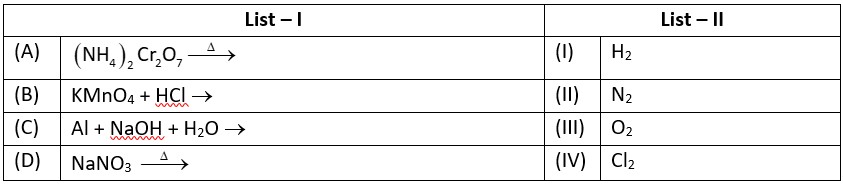
( N H 4 ) 2 C r 2 O 7 → Δ N 2 + C r 2 O 3 + 4 H 2 O

K M n O 4 + H C l → M n C l 2 + K C l + C l 2 + H 2 O

A l + N a O H + H 2 O → N a [ A l ( O H ) 4 ] + H 2

N a N O 3 → N a N O 2 + O 2

New answer posted

a year ago

0 Follower 2 Views

A
alok kumar singh

Contributor-Level 10

V r m s = 3 R T M A s .         v 1 = v 2

V r m s α T       η 2 = 4 n 1


T 1 = T 2 ⇒ V r m s − 1 = V r m s − 2

P 1 = n 1 R T v P z = n 2 R T v

P 1 P 2 = n 1 n 2 = 1 4


New answer posted

a year ago

0 Follower 4 Views

P
Payal Gupta

Contributor-Level 10

l=limn→x12n (11−12n+11−22n+11−32n+.....+11−2n−12n)

Let 2n = t and if n ∞ then t ∞

l=limn→x1t (∑r=1t=111+rt)

= [2x12]01=2

New answer posted

a year ago

0 Follower 3 Views

V
Vishal Baghel

Contributor-Level 10

(a) low solubility of LiF in H2O due to high lattice energy.

(b) O 2 −  has unpaired e- thus paramagnetic.

(c) Na in liq NH3 forms electronated ammonia thus conducting in nature.

(d) d K < d N a .

New answer posted

a year ago

0 Follower 2 Views

P
Payal Gupta

Contributor-Level 10

limx→x482− (cosx+sinx)72−2sin2x (00form)

=limx→x4−7 (cosx+sinx)6 (−sinx+cosx)−22cos2x Ltx→π4 (cosx+sinx)5 (cos2x−sin2x)22cos2x=7 (2)522=14

New answer posted

a year ago

0 Follower 4 Views

V
Vishal Baghel

Contributor-Level 10

In clark's method Ca (OH)2 is used for softening hard water.

C a ( H C O 3 ) 2 + C a ( O H ) 2 → 2 C a C O 3 + 2 H 2 O

M g ( H C O 3 ) 2 + 2 C a ( O H ) 2 → 2 C a C O 3 + M g ( O H ) 2 2 H 2 O    

Thus CaCO3 and Mg (OH)2 are formed in reaction.

Get authentic answers from experts, students and alumni that you won't find anywhere else

Sign Up on Shiksha

On Shiksha, get access to

  • 67k Colleges
  • 1.2k Exams
  • 717k Reviews
  • 1850k Answers

Share Your College Life Experience

×

This website uses Cookies and related technologies for the site to function correctly and securely, improve & personalise your browsing experience, analyse traffic, and support our marketing efforts and serve the Core Purpose. By continuing to browse the site, you agree to Privacy Policy and Cookie Policy.