

Class 12th
Get insights from 12k questions on Class 12th, answered by students, alumni, and experts. You may also ask and answer any question you like about Class 12th
Follow Ask QuestionQuestions
Discussions
Active Users
Followers
New answer posted
a year agoContributor-Level 10
This is a multiple choice answer as classified in NCERT Exemplar
(i) Mole fraction
Explanation: The mole fraction (x) is important for determining the relationship between a solution's concentration and its vapour pressure. Rault's law states that p1 = x1 po1 in a binary solution of two volatile liquids, where p1 is the vapour pressure of component 1, x1 is its mole fraction in solution, and po1 is the vapour pressure of pure solvent.
New answer posted
a year agoContributor-Level 10
The equation of the given curve is
Differentiate with respect to x, we have:
The slope of the normal to the given curve at point is
The equation of the normal to the curve at is
It is given that the normal makes intercepts with the axes.
Therefore, we have:
Also, the point lies on the curve, so we have
From (i) and (ii), we have:
From (ii), we have:
Hence, the required points are .
Therefore, option (A) is correct.
New answer posted
a year agoContributor-Level 10
The equation of the given curve is
Differentiating with respect to x, we have:
The slope of the normal to the given curve at point (h,k) is given by,
Equation of the normal at point (h,k) is given as:
Now, it is given that the normal passes through the point (1,2).
Therefore, we have:
Since (h,k) lies on the curve ,we have
From equation (i), we have:
Hence, the equation of the normal is given as:
Therefore, option (A) is correct.
New answer posted
a year agoContributor-Level 10
The equation of the given curve is .
Differentiate with respect to x, we have:
The slope of the normal to the given curve at point (1,1) is
Hence, the equation of the normal to the given curve at (1,1) is given as:
Therefore, option (B) is correct.
New answer posted
a year agoContributor-Level 10
The equation of the tangent to the given curve is
Now, substituting in we get:
Since a tangent touches the curve at one point, the roots of equation (i) must be equal.
Therefore, we have:
Discriminant = 0
Hence, the required value of m is 1.
Therefore, option (A) is correct.
New answer posted
a year agoContributor-Level 10
Let x be the depth of the wheat inside the cylindrical tank is with radius = 10 cm
Then, Volume V of the cylindrical tank is
V = π (10)2x = 100πpx m3
As
i e, rate of increasing of depth
option (A) is correct
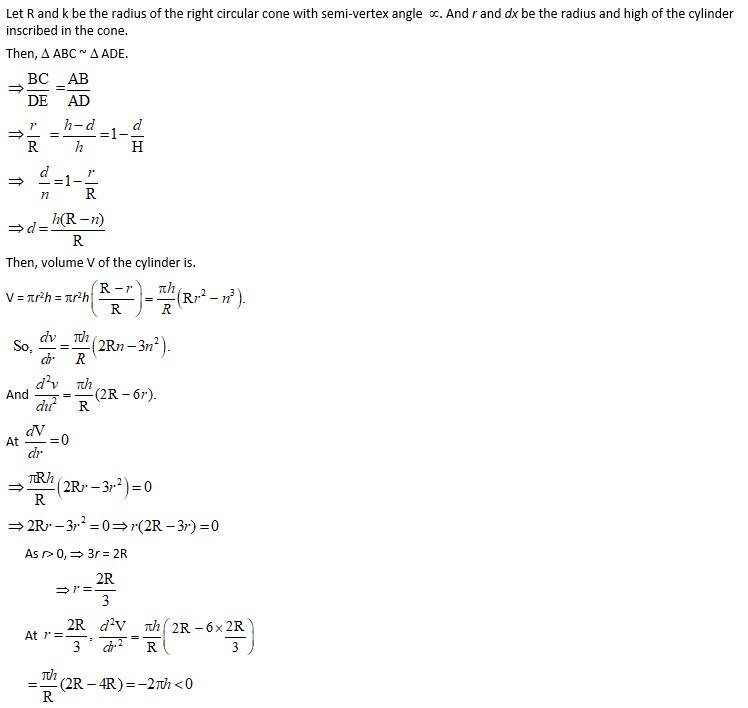
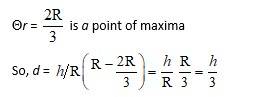
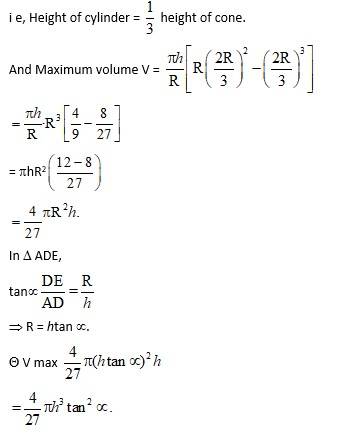
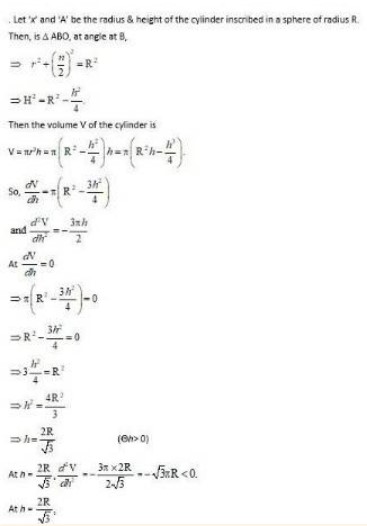
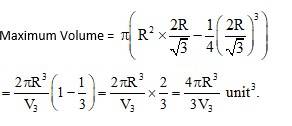
New answer posted
a year agoContributor-Level 10
We have,
f (x) defined on [a, b]
And f (x) > 0 ∀ x ∈ [a, b].
Let x1, x2 ∈ [a, b] and x2>x1
In the internal x1, x2], f (x) will also be continuous and differentiable.
Hence by mean value theorem, there exist c [x1, x2] such that
f (x) > 0 ∀ x ∈ [a, b].
Then, f (c) > 0.
i.e., f (x2) -f (x1) > 0
f (x2) >f (x1).
Hence, the function f (x) is always increasing on [a, b]
New answer posted
a year agoContributor-Level 10
This is a short answer type question as classified in NCERT Exemplar
"A sheet of cellulose acetate laid over a suitable support" is the material used to make a semipermeable membrane for reverse osmosis.
Taking an Exam? Selecting a College?
Get authentic answers from experts, students and alumni that you won't find anywhere else
Sign Up on ShikshaOn Shiksha, get access to
- 67k Colleges
- 1.2k Exams
- 718k Reviews
- 1850k Answers