

Class 12th
Get insights from 12k questions on Class 12th, answered by students, alumni, and experts. You may also ask and answer any question you like about Class 12th
Follow Ask QuestionQuestions
Discussions
Active Users
Followers
New answer posted
a year agoContributor-Level 10
The volume v of a cylinder of height h and radius r is
V = πr2h = 100
Let, s be the surface area then
S = 2r2hr(r + h) =
At,
At,
isa point of minimum
And
New answer posted
a year agoContributor-Level 10
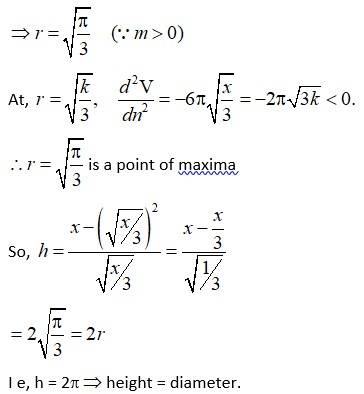
Let r and h be the radius and height of the cylinder
So, r, h > 0
The total surface area s is given by
S = 2πr(h + r) = content .
= content = x (say)
Then, the volume v of the cylinder
So,
For maximum,
New answer posted
a year agoContributor-Level 10
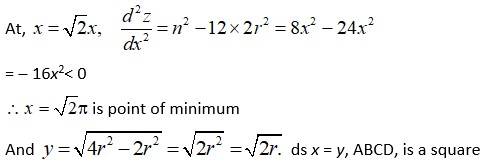
Let A.B.C.D.be the square increased in a given fixed circle with radius x
Let 'x' and 'y' be the length and breadth of the rectangle
∴x, y> 0
In ABC, right angle at B,
x2 + y2 = (2x)2
x2 + y2 = 4x2

New answer posted
a year agoContributor-Level 10
Let 'x' cm be the length of side of the square to be cut off from the rectangular surface
Then, the volume v of the box is v = (45 - 2x) (24 - 2x) x
= 1080x - 138x2 + 4x3
So,
At,
x2- 23x + 90 = 0
x2- 5x - 18x + 90 = 0
x (x - 5) - 18 (x - 5) = 0
(x- 5) (x- 18) = 0
x = 5 and x = 18
At x = 18, breadth = 24 - 2 (18) = 24 - 36 = -12 which is not possible
At,
Hence, x = 5 is the point of maximum
So, '5' cm length of square seeds to be cut from each corner of the secthgle
New answer posted
a year agoContributor-Level 10
Side of the tin square piece = 18 cm
Let x cm be the thought of the square to be cut from each corner.
The volume v of the box after cutting
v = length * breadth * height
= (18 - 2x) (18 - 2x) x x
= (18 - 2x)2x
= (324 + 4x2- 72x) x
= 4x3- 72x2 + 324x
So,
As
x2- 12x + 27 = 0
x2- 9x- 3x + 27 = 0
x (x - 9) - 3 (x - 9) = 0
(x - 9) (x - 3) = 0
x = 9 and x = 3
At x = 0, length of box = 18 - 2π9 = 18 - 18 = 0
Which is not possible
And at x = 3, = 24 (3) - 144 = -72 < 0
∴x = 3 is a point of maximum
Hence, '3' cm (square) is to be cut from each side of the square
So that volume of box is maximum
New answer posted
a year agoContributor-Level 10
Let, x and y be the two positive number
Then, x + y = 16 y = 16 - x
Let p be the sun of the cubes then
p = x3 + y3 = x3 + (16 -x)3 = x3 + (16)3-x3- 48x (16 -x)
p = 163 + 48x2- 76 8x
So,
At
96x - 768 = 0
∴at x = 8,
So, x = 8 is a point of local minima
So, y = 16 - 8 = 8
Hence, x = 8, y = 8
New answer posted
a year agoContributor-Level 10
We have, x + y = 35.
y = 35 - x
Let the product, P =x2 y5
P = x2 (35 -x)5
So, = x2 5 (35 -x)4 (1) + (35 -x)5 2x
= x (35 -x)4 [ - 5x + (35 -x) 2]
= x (35 -x)4 [ - 5x + 70 - 2x]
= x (35 -x)4 (70 - 7x)
= 7x (35 -x)4 (10 -x)
At
7x (35 -x)4 (10 -x) = 0
x = 0, 35, 10
As x is a (+) ve number we have only
x = 10, 35
And again (at x = 35) y = 35 = 0 but yis also a (+) ve number
we get, x = 10 (only)
whenx < 10,
and when x > 10,
changes from (+ ve) to ( -ve) as x increases while passing through 10
Hence, x = 10 is a point of local maxima
So, y = 35 - 10 = 25
∴x = 10 and y = 25
New answer posted
a year agoContributor-Level 10
We have, x + y = 60.where x, y > 0
x = 60 - y.
Let the product P = xy3 = (60 -y) y3 = 60y3-y4
= 4y2 (45 -y)
At
4y2 (45 -y) = 0
y = 0 and y = 45
As y > 0, y = 45
When, y > 45,
= ve < 0
Ad y < 45,
= (+ ve) > 0
∴p is maximum when y = 45 from + ve to- ve or y increases through 45.
So, x = 60 - y = 6Ø - 45 = 15.
Øx = 15 and y = 45.
New answer posted
a year agoContributor-Level 10
This is a long answer type question as classified in NCERT Exemplar
(i)Mass percentage : It is a weight by weight relationship. Thus mathematically ,
Mass % of a component =
where , W represents weight of the component or solution
(ii) Volume percentage :
Volume % of a component=
where , V represents volume
(iii) It is mass by volume percentage : Thus mathematically, where W is weight of solute in grams , but measures volume of solution in milliliters (ml).
=
(iv) Parts per million or ppm is a unit of measure of dissolved solids in solution, in terms of a ratio between the number of parts of solids/solute to a million parts o
New answer posted
a year agoContributor-Level 10
Let 'x' and 'y' be the two number
Then, x + y = 24 y = 24 - x
Let 'P' be their product then,
P = xy = x (24 - x) = 24x -x2
P (x) = 24x -x2
At
24 - 2x = 0
So, P (12)
x = 12 is a point of local maxima
Hence, y = 24 - 12 = 12.
The uqdtwno (x, y) is (12, 12).
Taking an Exam? Selecting a College?
Get authentic answers from experts, students and alumni that you won't find anywhere else
Sign Up on ShikshaOn Shiksha, get access to
- 67k Colleges
- 1.2k Exams
- 718k Reviews
- 1850k Answers