

Class 12th
Get insights from 12k questions on Class 12th, answered by students, alumni, and experts. You may also ask and answer any question you like about Class 12th
Follow Ask QuestionQuestions
Discussions
Active Users
Followers
New answer posted
a year ago
Contributor-Level 10
This is a Long Answer Type Questions as classified in NCERT Exemplar
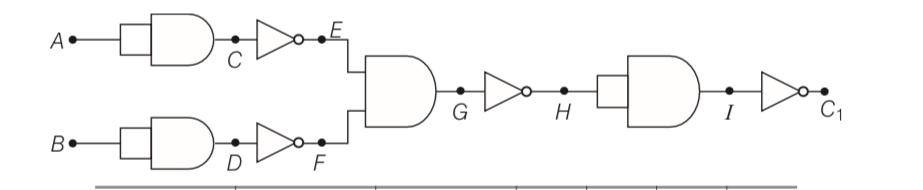
A B | C D | E F | G | H | I | C1 |
0 0 | 0 0 | 1 1 | 1 | 0 | 0 | 1 |
1 0 | 1 0 | 0 1 | 0 | 1 | 1 | 0 |
0 1 | 0 1 | 1 0 | 0 | 1 | 1 | 0 |
1 1 | 1 1 | 0 0 | 0 | 1 | 1 | 0 |
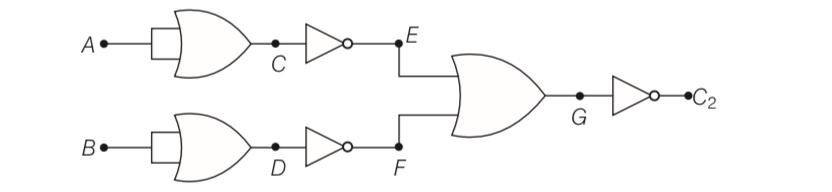
A B | C D | E F | G | C2 |
0 0 | 0 0 | 1 1 | 1 | 0 |
1 0 | 1 0 | 0 1 | 1 | 0 |
0 1 | 0 1 | 1 0 | 1 | 0 |
1 1 | 1 1 | 0 0 | 0 | 1 |
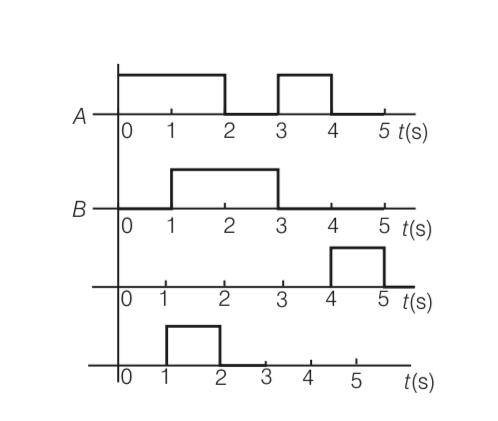
New answer posted
a year ago
Contributor-Level 10
This is a Long Answer Type Questions as classified in NCERT Exemplar
Explanation- voltage across RB= 10V
Resistance RB= 400kohm
VBE= 0, VCE= 0, Rc=3kohm
IB= voltage /RB= 10/400 103= 25 10-6A
Voltage across Rc= 10V
Ic=voltage/Rc= 10/3 103= 3.33 10-3
New answer posted
a year ago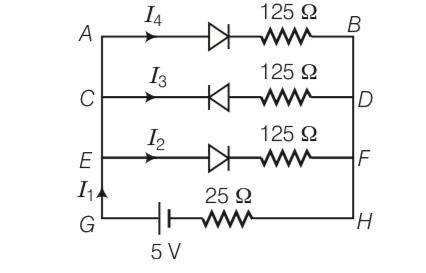
Contributor-Level 10
This is a Long Answer Type Questions as classified in NCERT Exemplar
forward biased resistance = 25ohm
Reverse biased resistance = infinity
As CD branch is reverse biased having infinite resistance.
So I3= 0
Resistance in branch AB= 25+125= 150 ohm (R1)
Resistance in branch EF= 25+125= 150 ohm (R2)
They both are in parallel
So
R= 75ohm
So total resistance = 25+75= 100ohm
Current = V/R= 5/100=0.05A
I1=I2+I3+I4
I1=I4+I2
Here the resistance R1 and R2 is same
I4=I2
I1= 2I2
I2= I1/2=0.05/2=0.025A
I4= 0.025A
New answer posted
a year agoContributor-Level 10
This is a Multiple Choice Questions as classified in NCERT Exemplar
Analog and digital signals are used to transmit information, usually through electric signals. In both these technologies, the information such as any audio or video is
transformed into electric signals.
The difference between analog and digital technologies is that in analog technology, information is translated into electric pulses of varying amplitude. In digital technology, translation of information is into binary formal (zero or one) where each bit is representative of two distinct amplitudes.
Thus, (a) and (b) would produce analog signal and (c) and (d) would produc
New answer posted
a year agoContributor-Level 10
This is a Multiple Choice Questions as classified in NCERT Exemplar
Answer- b, d
Explanation- modulation index m= Am/Ac
If m>1 then Am>Ac
maximum modulation frequency mf= frequency deviation / maximum frequency of modulating wave
here if m>1 then it means overlapping of both sides resulting loss of information.
New answer posted
a year ago
Contributor-Level 10
This is a Multiple Choice Questions as classified in NCERT Exemplar
Answer- a, b, c
Explanation- production of modulated wave is given by frequency of upper side band – frequency of lower side band so in first three cases it is clearly visible.
New answer posted
a year agoContributor-Level 10
This is a Multiple Choice Questions as classified in NCERT Exemplar
Answer-b, c, d
Explanation- height of tower= 240m
For line of sight communication maximum distance would be d=
So d= = 55.4km
So distance under this are communicable
New answer posted
a year agoContributor-Level 10
This is a Multiple Choice Questions as classified in NCERT Exemplar
Answer- b, d
Explanation- wm=3KHz
And wc= 1.5MHz= 1500KHz
By using these two 1500 3= 1503 and 1497
Bandwidth = 2wm= 2 = 6KHz
New answer posted
a year agoContributor-Level 10
This is a Multiple Choice Questions as classified in NCERT Exemplar
Answer- a, b, d
Explanation- frequency is given by Vm=15KHz
So wavelength is given by
Also we know that l = = 5km
The audio signals are of low frequency waves. Thus, they cannot be transmitted through sky
Waves as they are absorbed by atmosphere.
If the size of the antenna is less than 5 km, the effective power transmission would be very
Low because of deviation from resonance wavelength of wave and antenna length.
New answer posted
a year agoContributor-Level 10
This is a Multiple Choice Questions as classified in NCERT Exemplar
Explanation-equation of modulating wave is, m (t)= Amsinwmt
Carrier wave equation is Cm (t)= (Ac+Amsinwmt)sinwct
= Ac [1+ ]sinwct
Also = M
Cmt= (Ac+Ac )sinwct
Ac =K
Sinwmt= Vm
equation having phase
so equation is Ac+K2Vmt}+sinwct+ ]
Taking an Exam? Selecting a College?
Get authentic answers from experts, students and alumni that you won't find anywhere else
Sign Up on ShikshaOn Shiksha, get access to
- 67k Colleges
- 1.2k Exams
- 718k Reviews
- 1850k Answers