
Moving Charges and Magnetism
Get insights from 125 questions on Moving Charges and Magnetism, answered by students, alumni, and experts. You may also ask and answer any question you like about Moving Charges and Magnetism
- 125
Questions
- 0
Discussions
- 0
Active Users
- 0
Followers
Have a question about Moving Charges and Magnetism? Ask our experts
Keep it short & simple. Type complete word. Avoid abusive language.
In a two dimensional motion, instantaneous speed v0 is a positive constant. Then which of the following are necessarily true?
(a) The acceleration of the particle is zero.
(b) The acceleration of the particle is bounded.
(c) The acceleration of the particle is necessarily in the plane of motion.
(d) The particle must be undergoing a uniform circular motion.
This is a Multiple Choice Questions as classified in NCERT Exemplar
Answer-b, d
Explanation- as given motion is two-dimensional motion and given that instantaneous speed vo is positive constant. Acceleration is rate of change of velocity. hence it will also be in the plane of motion.
 Upvote

In a two dimensional motion, instantaneous speed v0 is a positive constant. Then which of the following are necessarily true?
(a) The average velocity is not zero at any time.
(b) Average acceleration must always vanish.
(c) Displacements in equal time intervals are equal.
(d) Equal path lengths are traversed in equal intervals.
This is a Multiple Choice Questions as classified in NCERT Exemplar
Answer- d
Explanation – speed = total distance travelled /time taken
Total distance travelled = path length
= speed time
We should be very careful with the fact, that speed is related with total distance covered not with displacement.
Upvote Consider the quantities, pressure, power, energy, impulse, gravitational potential, electrical charge, temperature, area. Out of these, the only vector quantities are
(a) Impulse, pressure and area
(b) Impulse and area
(c) Area and gravitational potential
(d) Impulse and pressure
Consider the quantities, pressure, power, energy, impulse, gravitational potential, electrical charge, temperature, area. Out of these, the only vector quantities are
(a) Impulse, pressure and area
(b) Impulse and area
(c) Area and gravitational potential
(d) Impulse and pressure
This is a Multiple Choice Questions as classified in NCERT Exemplar
Answer- b
Explanation – we know that impulse J= f. = , where F is force . is time duration and is change in momentum. As is a vector quantity, hence impulse is also a vector quantity. Sometimes area can also be tr
Upvote The horizontal range of a projectile fired at an angle of 15° is 50 m. If it is fired with the same speed at an angle of 45°, its range will be
(a) 60 m
(b) 71 m
(c) 100 m
(d) 141 m
The horizontal range of a projectile fired at an angle of 15° is 50 m. If it is fired with the same speed at an angle of 45°, its range will be
(a) 60 m
(b) 71 m
(c) 100 m
(d) 141 m
This is a Multiple Choice Questions as classified in NCERT Exemplar
Answer- c
Explanation - we know that =150 and R= 50m
Range, R=
50 =
So u2= 980

So u = m/s
So u= 14 = 31.304m/s
= 450, R=
R= = =
Upvote The component of a vector r along X-axis will have maximum value if
(a) r is along positive Y-axis
(b) r is along positive X-axis
(c) r makes an angle of 45° with the X-axis
(d) r is along negative Y-axis
The component of a vector r along X-axis will have maximum value if
(a) r is along positive Y-axis
(b) r is along positive X-axis
(c) r makes an angle of 45° with the X-axis
(d) r is along negative Y-axis
This is a Multiple Choice Questions as classified in NCERT Exemplar
Answer- b
Explanation – ler r makes an angle with positive x axis component if r along x-axis.
So rx= |r|cos
(rx)maximum= |r| (cos )maximum
= |r|cos = r
=00
R is along positive x-axis.
Upvote Shows the orientation of two vectors u and v in the XY plane. If u = aȋ + bĵ and
v=p ȋ + q ĵ . which of the following is correct?
(a) a and p are positive while b and q are negative.
(b) a, p and b are positive while q is negative.
(c) a, q and b are positive while p is negative.
(d) a, b, p and q are all positive.
Shows the orientation of two vectors u and v in the XY plane. If u = aȋ + bĵ and
v=p ȋ + q ĵ . which of the following is correct?
(a) a and p are positive while b and q are negative.
(b) a, p and b are positive while q is negative.
(c) a, q and b are positive while p is negative.
(d) a, b, p and q are all positive.
This is a Multiple Choice Questions as classified in NCERT Exemplar
Answer- b

Explanation – u= a? + b? as u in the first quadrant, hence both components a and b will be positive. For v= p? + q? , as it is positive x direction and located downward hence x component p will be positive and y compon
Upvote Which one of the following statements is true?
(a) A scalar quantity is the one that is conserved in a process.
(b) A scalar quantity is the one that can never take negative values.
(c) A scalar quantity is the one that does not vary from one point to another in space.
(d) A scalar quantity has the same value for observers with different orientations of the axes.
Which one of the following statements is true?
(a) A scalar quantity is the one that is conserved in a process.
(b) A scalar quantity is the one that can never take negative values.
(c) A scalar quantity is the one that does not vary from one point to another in space.
(d) A scalar quantity has the same value for observers with different orientations of the axes.
This is a Multiple Choice Questions as classified in NCERT Exemplar
Answer- d
Explanation- a scalar quantity is independent of direction hence has the same value for observers with different orientations of the axes.
Upvote The angle between A= ȋ + ĵ and B = ȋ - ĵ is
(a) 45° (b) 90° (c) –45° (d) 180°
The angle between A= ȋ + ĵ and B = ȋ - ĵ is
(a) 45° (b) 90° (c) –45° (d) 180°
This is a Multiple Choice Questions as classified in NCERT Exemplar
Answer- b
Explanation-A = i+j
B = i-j
A.B=|A|B|cos
(? +? ). (? -? ) = cos
Where is the angle between A and B
Cos = =
= 90o
Upvote If A = 2 and B = 4, then match the relations in column I with the angle θ between A B and in column II. Column I Column II °
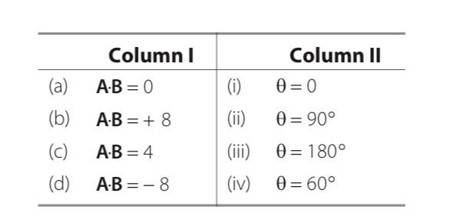
If A = 2 and B = 4, then match the relations in column I with the angle θ between A B and in column II. Column I Column II °

This is a Short Answer Type Questions as classified in NCERT Exemplar
Explanation- - given |A|=2 and |B|=4
a) |A |=AB cos = 0
so 2 cos =0
so so it matches with ii
b) |A B|= ABcos =8
2 cos =8
So = 0 so it matches with option i
c) |A B|= ABcos =4
so =60 so it matches with option iv
d)
Upvote If A = 2 and B = 4, then match the relations in column I with the angle θ between A B and in column II. Column I Column II °
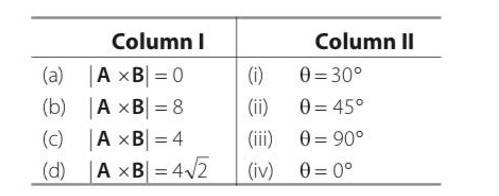
If A = 2 and B = 4, then match the relations in column I with the angle θ between A B and in column II. Column I Column II °

This is a Short Answer Type Questions as classified in NCERT Exemplar
Explanation- given |A|=2 and |B|=4
a)|A |=AB sin = 0
so 2 sin =0
so so it matches with iv
B) |A B|= ABsin =8
2 sin =8
So = 90 so it matches with option iii
c) |A B|= ABsin =4
so =30 so it matches with option i
d) |A B|
Upvote