
Moving Charges and Magnetism
Get insights from 125 questions on Moving Charges and Magnetism, answered by students, alumni, and experts. You may also ask and answer any question you like about Moving Charges and Magnetism
- 125
Questions
- 0
Discussions
- 0
Active Users
- 0
Followers
Have a question about Moving Charges and Magnetism? Ask our experts
Keep it short & simple. Type complete word. Avoid abusive language.
The I-V characteristics of p-n junction diode in forward bias is shown in the figure. The ration of dynamic resistance, corresponding to forward bias voltage of 2 V and 4 V respectively, is
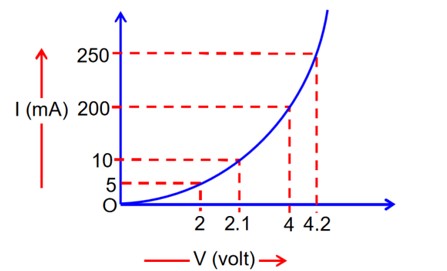
The I-V characteristics of p-n junction diode in forward bias is shown in the figure. The ration of dynamic resistance, corresponding to forward bias voltage of 2 V and 4 V respectively, is
Dynamic Resistance at 2v
=
Dynamic Resistance at 4 v
=
 Upvote

An infinitely long hollow conducting cylinder with radius R carries a uniform current along its surface. Choose the correct representation of magnetic field (B) as a function of radial distance (r) from the axis of cylinder.
An infinitely long hollow conducting cylinder with radius R carries a uniform current along its surface. Choose the correct representation of magnetic field (B) as a function of radial distance (r) from the axis of cylinder.
Using Ampere’s law for long hollow cylinder carrying current on its surface
Bin = 0
Upvote 
A deuteron and a proton moving with equal kinetic energy enter into to a uniform magnetic field at right angle to the field. If rd and rp are the radii of their circular paths respectively, then the ratio <!-- [if gte mso 9]><xml>
A deuteron and a proton moving with equal kinetic energy enter into to a uniform magnetic field at right angle to the field. If rd and rp are the radii of their circular paths respectively, then the ratio <!-- [if gte mso 9]><xml>
rd = (Radius of deuteron)
Upvote Two long parallel conductors S1 and S2 are separated by a distance 10 cm and carrying currents of 4A and 2A respectively. The conductors are placed along x-axis in X-Y plane. There is a point P located between the conductors (as shown in figure).
A charge particle of 3p coulomb is passing through the point P with velocity <!-- [if gte mso 9]><xml>
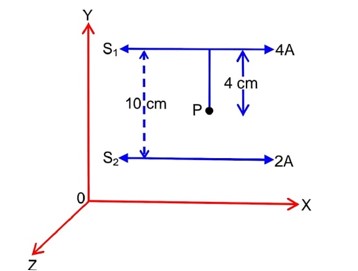
Two long parallel conductors S1 and S2 are separated by a distance 10 cm and carrying currents of 4A and 2A respectively. The conductors are placed along x-axis in X-Y plane. There is a point P located between the conductors (as shown in figure).
A charge particle of 3p coulomb is passing through the point P with velocity <!-- [if gte mso 9]><xml>
<p><span lang="EN-US" xml:lang="EN-US" data-contrast="auto">The bulk modulus of a liquid is 3 × 10</span><span lang="EN-US" xml:lang="EN-US" data-contrast="auto"><span data-fontsize="11">10</span></span><span lang="EN-US" xml:lang="EN-US" data-contrast="auto"> Nm</span><span lang="EN-US" xml:lang="EN-US" data-contrast="auto"><span data-fontsize="11">-</span></span><span lang="EN-US" xml:lang="EN-US" data-contrast="auto"><span data-fontsize="11">2</span></span><span lang="EN-US" xml:lang="EN-US" data-contrast="auto">. The pressure required to reduce the volume of liquid by 2% is</span></p>
Use (i) The Ampere’s law for H and (ii) Continuity of lines of B, to conclude that inside a bar magnet, (a) Lines of H run from the A-pole to S-pole, while (b) Lines of B must run from the S-pole to A-pole
Use (i) The Ampere’s law for H and (ii) Continuity of lines of B, to conclude that inside a bar magnet, (a) Lines of H run from the A-pole to S-pole, while (b) Lines of B must run from the S-pole to A-pole
This is a Short Answer Type Questions as classified in NCERT Exemplar
Explanation- in the given figure let C be the amperian loop then,

= .dl
between B and dl is less than 90 degree so
= . dl>0
So magnetic field from south pole to north pole inside the bar magnet
So according to ampere
Upvote