
Ncert Solutions Chemistry Class 11th
Get insights from 2k questions on Ncert Solutions Chemistry Class 11th, answered by students, alumni, and experts. You may also ask and answer any question you like about Ncert Solutions Chemistry Class 11th
- 2k
Questions
- 0
Discussions
- 1
Active Users
- 29
Followers
Have a question about Ncert Solutions Chemistry Class 11th? Ask our experts
Keep it short & simple. Type complete word. Avoid abusive language.
Match the quantum numbers with the information provided by these.
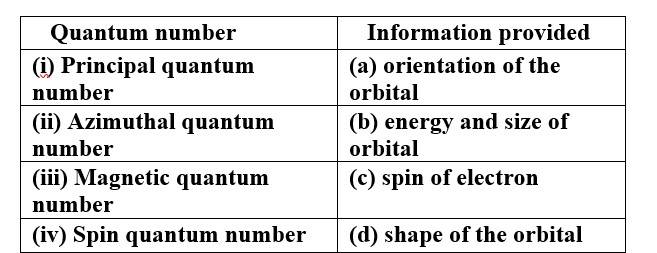
Match the quantum numbers with the information provided by these.

This is a Matching Type Questions as classified in NCERT Exemplar
Ans:
(i) Principal quantum number (b) energy and size of orbital
(ii) Azimuthal quantum number (d) shape of the orbital
(iii) Magnetic quantum number (a) orientation of the orbital
(iv) Spin quantum number (c) spin of electron
 Upvote
What will be the molality of the solution containing 18.25 g of HCl gas in 500 g of water?
(i) 0.1 m
(ii) 1 M
(iii) 0.5 m
(iv) 1 m
What will be the molality of the solution containing 18.25 g of HCl gas in 500 g of water?
(i) 0.1 m
(ii) 1 M
(iii) 0.5 m
(iv) 1 m
This is a Multiple Choice Questions as classified in NCERT Exemplar
Option (D)
The number of moles is given by the following formula,
Moles = …. (1)
The number of moles of HCl is calculated by using equation (1) as follows,
Moles of HCl 0.5 mol
The molality (m) is given by the formula:
m =
On
Upvote Match the following species with their corresponding ground state electronic configuration.

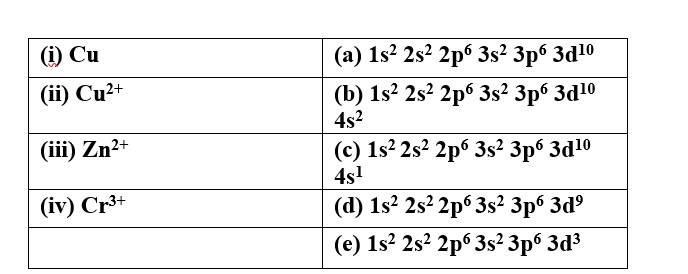
Match the following species with their corresponding ground state electronic configuration.

This is a Matching Type Questions as classified in NCERT Exemplar
Ans:
(i) Cu (c) 1s2 2s2 2p6 3s2 3p6 3d10 4s1
(ii) Cu2+ (d) 1s2 2s2 2p6 3s2 3p6 3d9
(iii) Zn2+ &n
Upvote If the concentration of glucose (C6H12O6) in blood is 0.9 g L–1, what will be the molarity of glucose in blood?
(i) 5 M
(ii) 50 M
(iii) 0.005 M
(iv) 0.5 M
If the concentration of glucose (C6H12O6) in blood is 0.9 g L–1, what will be the molarity of glucose in blood?
(i) 5 M
(ii) 50 M
(iii) 0.005 M
(iv) 0.5 M
This is a Multiple Choice Questions as classified in NCERT Exemplar
Option (C)
The molar mass of glucose is 180 g mol- . The molarity (M) is given by the formula:
M =
On substituting the value in the above equation, the mol can be calculated as
M = = 0.005M
Upvote The number of atoms present in one mole of an element is equal to Avogadro number. Which of the following element contains the greatest number of atoms?
(i) 4g He
(ii) 46g Na
(iii) 0.40g Ca
(iv) 12g He
The number of atoms present in one mole of an element is equal to Avogadro number. Which of the following element contains the greatest number of atoms?
(i) 4g He
(ii) 46g Na
(iii) 0.40g Ca
(iv) 12g He
This is a Multiple Choice Questions as classified in NCERT Exemplar
Option (D)
(A) The number of moles is given by the following formula,
Moles = ….(1)
The number of moles of He is calculated by using equation (1) as follows
Moles of O2 = =1 mol
The number of atoms can be calculated as, number o
Upvote Which of the following statements concerning the quantum numbers are correct?
(i) Angular quantum number determines the three dimensional shape of the orbital.
(ii) The principal quantum number determines the orientation and energy of the orbital.
(iii) Magnetic quantum number determines the size of the orbital.
(iv) Spin quantum number of an electron determines the orientation of the spin of electron relative to the chosen axis.
Which of the following statements concerning the quantum numbers are correct?
(i) Angular quantum number determines the three dimensional shape of the orbital.
(ii) The principal quantum number determines the orientation and energy of the orbital.
(iii) Magnetic quantum number determines the size of the orbital.
(iv) Spin quantum number of an electron determines the orientation of the spin of electron relative to the chosen axis.
This is a Multiple Choice Questions as classified in NCERT Exemplar
Ans: option (i)& (iv)
- Principal quantum number (n): It represents the size and energy of orbitals.
- Azimuthal quantum number (l): It represents the subshell and shape of orbitals.
- Magnetic quantum number (ml): It represents the ori
Upvote If 500 mL of a 5M solution is diluted to 1500 mL, what will be the molarity of the solution obtained?
(i) 1.5 M
(ii) 1.66 M
(iii) 0.017 M
(iv) 1.59 M
If 500 mL of a 5M solution is diluted to 1500 mL, what will be the molarity of the solution obtained?
(i) 1.5 M
(ii) 1.66 M
(iii) 0.017 M
(iv) 1.59 M
This is a Multiple Choice Questions as classified in NCERT Exemplar
Option (B)
The relation between molarity and volume is given as,
M1 V1= M2 V2
On substituting the value in the above equation, the political can be calculated as
5M* 500 mL = M2*1500 mL
M =1.66M
Upvote In which of the following pairs, the ions are iso-electronic?
(i) Na+, Mg2+
(ii) Al3+, O–
(iii) Na+ , O2–
(iv) N3–, Cl–
In which of the following pairs, the ions are iso-electronic?
(i) Na+, Mg2+
(ii) Al3+, O–
(iii) Na+ , O2–
(iv) N3–, Cl–
This is a Multiple Choice Questions as classified in NCERT Exemplar
Ans: option (i) & (iii)
Isoelectronic species are those species that possess the same number of electrons. Here both Na+, Mg2+ possess 10 electrons and both Na+, O2– possess 10 electrons.
Upvote Which of the following sets of quantum numbers are correct?
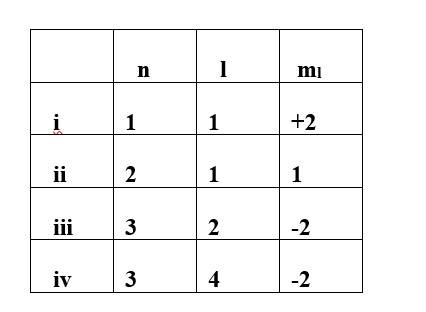
Which of the following sets of quantum numbers are correct?

This is a Multiple Choice Questions as classified in NCERT Exemplar
Ans: option (ii) & (iii)
For the given value of n (principal quantum number) the value of l (Azimuthal quantum number) varies from 0 to n-1. However for the given value of l the ml (magnetic quantum number) varies from -1 to +1.
Upvote Out of the following pairs of electrons, identify the pairs of electrons present in degenerate orbitals :
1. (a) n = 3, l = 2, ml = –2, ms=
(b) n = 3, l = 2, ml = –1, ms=
2. (a) n = 3, l = 1, ml = 1, ms = +
(b) n = 3, l = 2, ml = 1, ms = +
3. (a) n = 4, l = 1, ml = 1, ms = +
(b) n= 3, l = 2, ml = 1, ms = +
4. (a) n = 3, l = 2, ml = +2, ms = -
(b) n = 3, l = 2, ml = +2, ms = +
Out of the following pairs of electrons, identify the pairs of electrons present in degenerate orbitals :
1. (a) n = 3, l = 2, ml = –2, ms=
(b) n = 3, l = 2, ml = –1, ms=
2. (a) n = 3, l = 1, ml = 1, ms = +
(b) n = 3, l = 2, ml = 1, ms = +
3. (a) n = 4, l = 1, ml = 1, ms = +
(b) n= 3, l = 2, ml = 1, ms = +
4. (a) n = 3, l = 2, ml = +2, ms = -
(b) n = 3, l = 2, ml = +2, ms = +
This is a Multiple Choice Questions as classified in NCERT Exemplar
Ans: option (i) & (iv)
In a multielectron atomic system the energy of an electron depends not only on its principal quantum number (shell), but also on its azimuthal quantum number (subshell). Electrons having the same shells an
Upvote