
Ncert Solutions Chemistry Class 11th
Get insights from 2k questions on Ncert Solutions Chemistry Class 11th, answered by students, alumni, and experts. You may also ask and answer any question you like about Ncert Solutions Chemistry Class 11th
- 2k
Questions
- 0
Discussions
- 1
Active Users
- 29
Followers
Have a question about Ncert Solutions Chemistry Class 11th? Ask our experts
Keep it short & simple. Type complete word. Avoid abusive language.
Describe hybridisation in the case of PCl5 and SF6. The axial bonds are longer as compared to equatorial bonds in PCl5 whereas in SF6 both axial bonds and equatorial bonds have the same bond length. Explain.
Describe hybridisation in the case of PCl5 and SF6. The axial bonds are longer as compared to equatorial bonds in PCl5 whereas in SF6 both axial bonds and equatorial bonds have the same bond length. Explain.
This is a Long Answer Type Questions as classified in NCERT Exemplar
Ans: Hybridisation in the case of PCl5 :

The hybridisation of phosphorus PCl5 is sp3d and it has a trigonal bipyramidal geometry. The axial bonds in PCl5 are slightly longer as compared to the equatorial bonds because axial bonds exp
 Upvote

Use the molecular orbital energy level diagram to show that N2 would be expected to have a triple bond, F2, a single bond and Ne2, no bond.
Use the molecular orbital energy level diagram to show that N2 would be expected to have a triple bond, F2, a single bond and Ne2, no bond.
This is a Long Answer Type Questions as classified in NCERT Exemplar
Ans: Formation of N2 molecule: Electronic Configuration
σ1s2 σ* < 1s2 < σ2s2 < σ*2s2 < [ π2p2x = π2p2y] < σ2p2z
The bond order will be:
( 10-4)= 3.0
Bond order indicates the number of bonds in a diatomic molecule. Triple bond N=N.
Formation of F2 molecule: Ele
Upvote Assertion (A) : Combustion of 16 g of methane gives 18 g of water.
Reason (R) : In the combustion of methane, water is one of the products.
(i) Both A and R are true but R is not the correct explanation of A.
(ii) A is true but R is false.
(iii) A is false but R is true.
(iv) Both A and R are false.
Assertion (A) : Combustion of 16 g of methane gives 18 g of water.
Reason (R) : In the combustion of methane, water is one of the products.
(i) Both A and R are true but R is not the correct explanation of A.
(ii) A is true but R is false.
(iii) A is false but R is true.
(iv) Both A and R are false.
This is a Assertion and Reason Type Questions as classified in NCERT Exemplar
Option (C) The combustion reaction of methane is given below
CH4 + O2 -> CO2 + H2O
In this reaction, water and carbon dioxide are formed.
According to the reaction, 1 mole of methane gives 2 moles of water. So, 16 g of
Upvote Assertion (A) : Significant figures for 0.200 is 3 where as for 200 it is 1.
Reason (R) : Zero at the end or right of a number are significant provided they are not on the right side of the decimal point.
(i) Both A and R are true and R is correct explanation of A.
(ii) Both A and R are true but R is not a correct explanation of A.
(iii) A is true but R is false.
(iv) Both A and R are false.
Assertion (A) : Significant figures for 0.200 is 3 where as for 200 it is 1.
Reason (R) : Zero at the end or right of a number are significant provided they are not on the right side of the decimal point.
(i) Both A and R are true and R is correct explanation of A.
(ii) Both A and R are true but R is not a correct explanation of A.
(iii) A is true but R is false.
(iv) Both A and R are false.
This is a Assertion and Reason Type Questions as classified in NCERT Exemplar
Option (C)
In the decimal portion, only trailing or final zeros are significant. This is in accordance with the rules of significant figures.
The given number, 0.200 has 3 significant figures whereas the number, 200 has onl
Upvote Assertion (A) : One atomic mass unit is defined as one twelfth of the mass of one carbon-12 atom.
Reason (R) : Carbon-12 isotope is the most abundunt isotope of carbon and has been chosen as standard.
(i) Both A and R are true and R is the correct explanation of A.
(ii) Both A and R are true but R is not the correct explanation of A.
(iii) A is true but R is false.
(iv) Both A and R are false.
Assertion (A) : One atomic mass unit is defined as one twelfth of the mass of one carbon-12 atom.
Reason (R) : Carbon-12 isotope is the most abundunt isotope of carbon and has been chosen as standard.
(i) Both A and R are true and R is the correct explanation of A.
(ii) Both A and R are true but R is not the correct explanation of A.
(iii) A is true but R is false.
(iv) Both A and R are false.
This is a Assertion and Reason Type Questions as classified in NCERT Exemplar
Option (B)
Atomic mass unit is defined as a mass that is equal to accurately the mass of carbon-12 atom.
When scientists compare the relative atomic masses of the elements to the mass of carbon, they find that they are
Upvote In the following questions a statement of Assertion (A) followed by a statement of Reason (R) is given. Choose the correct option out of the choices given below each question.
Assertion (A): The empirical mass of ethene is half of its molecular mass.
Reason (R): The empirical formula represents the simplest whole number ratio of various atoms present in a compound.
(i) Both A and R are true and R is the correct explanation of A.
(ii) A is true but R is false.
(iii) A is false but R is true.
(iv) Both A and R are false
In the following questions a statement of Assertion (A) followed by a statement of Reason (R) is given. Choose the correct option out of the choices given below each question.
Assertion (A): The empirical mass of ethene is half of its molecular mass.
Reason (R): The empirical formula represents the simplest whole number ratio of various atoms present in a compound.
(i) Both A and R are true and R is the correct explanation of A.
(ii) A is true but R is false.
(iii) A is false but R is true.
(iv) Both A and R are false
This is a Assertion and Reason Type Questions as classified in NCERT Exemplar
(i) Both A and R are true and R is the correct explanation of A.
Explanation: The molecular formula gives the actual number of different atoms present in a molecule and the empirical formula gives a simple whole number rati
Upvote Match the following physical quantities with units.
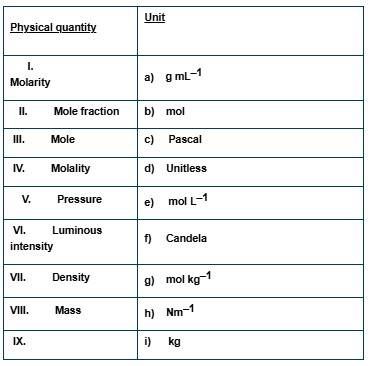
Match the following physical quantities with units.
This is a Matching Type Questions as classified in NCERT Exemplar
(i) → (e) (ii) → (d) (iii) → (b) (iv) → (g) (v) → (c), (h) (vi) → (f) (vii) → (a) (viii) → (i)
Explanation:
(i) It is defined as the number of moles of solute dissolved in 1 litre of solution. So, the unit of molarity is mol L-1
(ii) M
Upvote Match the following:
Column I
Column II
(i) 88 g of CO2
(a) 0.25 mol
(ii) 6.022×10²³ molecules of H2O
(b) 2 mol
(iii) 5.6 litres of O2 at STP
(c) 1 mol
(iv) 96 g of O2
(d) 6.022×10²³ molecules
(v) 1 mol of any gas
(e) 3 mol
Match the following:
|
Column I |
Column II |
|
(i) 88 g of CO2 |
(a) 0.25 mol |
|
(ii) 6.022×10²³ molecules of H2O |
(b) 2 mol |
|
(iii) 5.6 litres of O2 at STP |
(c) 1 mol |
|
(iv) 96 g of O2 |
(d) 6.022×10²³ molecules |
|
(v) 1 mol of any gas |
(e) 3 mol |
This is a Matching Type Questions as classified in NCERT Exemplar
(i)- (b); (ii) - (c); (iii) - (a); (iv) - (e); (v) - (d)
(i) 88 g of CO2
The number of moles is given by the following formula,
Moles = - (1)
So, the number of moles of CO2 is calculated by using equation (1) as follows
Moles of
Upvote One of the statements of Dalton’s atomic theory is given below: “Compounds are formed when atoms of different elements combine in a fixed ratio” Which of the following laws is not related to this statement?
(i) Law of conservation of mass
(ii) Law of definite proportions
(iii) Law of multiple proportions
(iv) Avogadro law
One of the statements of Dalton’s atomic theory is given below: “Compounds are formed when atoms of different elements combine in a fixed ratio” Which of the following laws is not related to this statement?
(i) Law of conservation of mass
(ii) Law of definite proportions
(iii) Law of multiple proportions
(iv) Avogadro law
This is a Multiple Choice Questions as classified in NCERT Exemplar
Option (A), (D)
Law of conservation of mass: According to this law, the mass is neither created nor destroyed during a chemical reaction in an isolated system. It can only be transformed from one form to another. Burning of wood is an
Upvote Which of the following terms are unitless?
(i) Molality
(ii) Molarity
(iii) Mole fraction
(iv) Mass percent
Which of the following terms are unitless?
(i) Molality
(ii) Molarity
(iii) Mole fraction
(iv) Mass percent
This is a Multiple Choice Questions as classified in NCERT Exemplar
Option (C), (D)
Molality: It is defined as the number of moles of solute divided by the mass of solvent in kg . It is denoted by m . The formula is expressed as
m =
The SI unit of molality is 1 mol/kg
Molarity: It is defined as the num
Upvote