
Ncert Solutions Chemistry Class 11th
Get insights from 2k questions on Ncert Solutions Chemistry Class 11th, answered by students, alumni, and experts. You may also ask and answer any question you like about Ncert Solutions Chemistry Class 11th
- 2k
Questions
- 0
Discussions
- 1
Active Users
- 29
Followers
Have a question about Ncert Solutions Chemistry Class 11th? Ask our experts
Keep it short & simple. Type complete word. Avoid abusive language.
Assertion (A) : All isotopes of a given element show the same type of chemical behaviour.
Reason (R) : The chemical properties of an atom are controlled by the number of electrons in the atom.
(i) Both A and R are true and R is the correct explanation of A.
(ii) Both A and R are true but R is not the correct explanation of A
(iii) A is true but R is false.
(iv) Both A and R are false.
This is a Assertion and Reason Type Questions as classified in NCERT Exemplar
Ans: option (i)
As the chemical properties depend upon the number of electrons present in the atom thus the isotopes resemble the same chemical properties as they have the same number of electrons i.e. atomic number.
 Upvote

Which of the following statements about a compound is incorrect?
(i) A molecule of a compound has atoms of different elements.
(ii) A compound cannot be separated into its constituent elements by physical methods of separation.
(iii) A compound retains the physical properties of its constituent elements.
(iv) The ratio of atoms of different elements in a compound is fixed.
This is a Multiple Choice Questions as classified in NCERT Exemplar
Option (C)
(A) The molecule of a compound is obtained when two or more atoms of different elements are combined together.
(B) A compound can be separated into its constituent elements by physical methods of separation.
(C) A compound
Upvote If the density of a solution is 3.12 g mL–1, the mass of 1.5 mL solution in significant figures is _______.
(i) 4.7g
(ii) 4680 × 10–3g
(iii) 4.680g
(iv) 46.80g
If the density of a solution is 3.12 g mL–1, the mass of 1.5 mL solution in significant figures is _______.
(i) 4.7g
(ii) 4680 × 10–3g
(iii) 4.680g
(iv) 46.80g
This is a Multiple Choice Questions as classified in NCERT Exemplar
Option (A)
The density (d ) is given by the formula:
d =
Here, m is the mass and v is the volume
On substituting the values in the above equation:
3.12 g mL-1 = M = 4.68 g
The mass will be 4.7 upto 2 significant figure.
Upvote Match species given in Column I with the electronic configuration given in Column II.
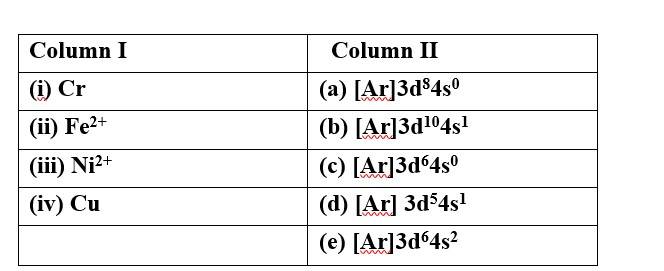
Match species given in Column I with the electronic configuration given in Column II.

This is a Matching Type Questions as classified in NCERT Exemplar
Ans:
(i) Cr (d) [Ar] 3d54s2
(ii) Fe2+ (c) [Ar]3d64s0
(
Upvote The empirical formula and molecular mass of a compound are CH2O and 180 g respectively. What will be the molecular formula of the compound?
(i) C9H18O9
(ii) CH2O
(iii) C6 H12O6
(iv) C2H4O2]
The empirical formula and molecular mass of a compound are CH2O and 180 g respectively. What will be the molecular formula of the compound?
(i) C9H18O9
(ii) CH2O
(iii) C6 H12O6
(iv) C2H4O2]
This is a Multiple Choice Questions as classified in NCERT Exemplar
Option (C)
The empirical formula mass of CH2O is 30 g
The relation between empirical and molecular formula is given as,
n = …. (1)
On substituting the values in equation (1)
n = = 6
Thus, the molecular formula of the compo
Upvote 
This is a Matching Type Questions as classified in NCERT Exemplar
Ans:
(i) Photon (d) Exhibits both momentum and wavelength
(ii) Electron (d) Exhibits both momentum and wavelength
(iii) ψ 2 (b) Probability density
Upvote What is the mass percent of carbon in carbon dioxide?
(i) 0.034%
(ii) 27.27%
(iii) 3.4%
(iv) 28.7%
What is the mass percent of carbon in carbon dioxide?
(i) 0.034%
(ii) 27.27%
(iii) 3.4%
(iv) 28.7%
This is a Multiple Choice Questions as classified in NCERT Exemplar
Option (B)
The molar mass of carbon is 44 g mol-1
44 g of carbon dioxide contains 12 g of carbon
The percentage composition is given as, % composition
=
On substituting the values in the above equation,
% of carbon =
= 27.27%
Upvote 
This is a Matching Type Questions as classified in NCERT Exemplar
Ans:
(i) X-rays (d) ν = 1018Hz
(ii) UV (c) ν = 1016Hz
(iii) Long radio waves (a) ν = 10 -104 Hz
(iv)Microwave (b) ν = 1010 Hz
Upvote One mole of any substance contains 6.022 × 10²³ atoms/molecules. Number of molecules of H2SO4 present in 100 mL of 0.02M H2SO4 solution is ______
(i) 12.044 × 10²⁰ molecules
(ii) 6.022 × 10²³ molecules
(iii) 1 × 10²³ molecules
(iv) 12.044 × 10²³ molecules
One mole of any substance contains 6.022 × 10²³ atoms/molecules. Number of molecules of H2SO4 present in 100 mL of 0.02M H2SO4 solution is ______
(i) 12.044 × 10²⁰ molecules
(ii) 6.022 × 10²³ molecules
(iii) 1 × 10²³ molecules
(iv) 12.044 × 10²³ molecules
This is a Multiple Choice Questions as classified in NCERT Exemplar
Option (A)
The molarity (M) is given by the formula:
M
On substituting the values in the above equation:
0.02M =
n = 0.002 mol
The number of molecules can be calculated as, number of moles
=
On substituting the values in the above
Upvote 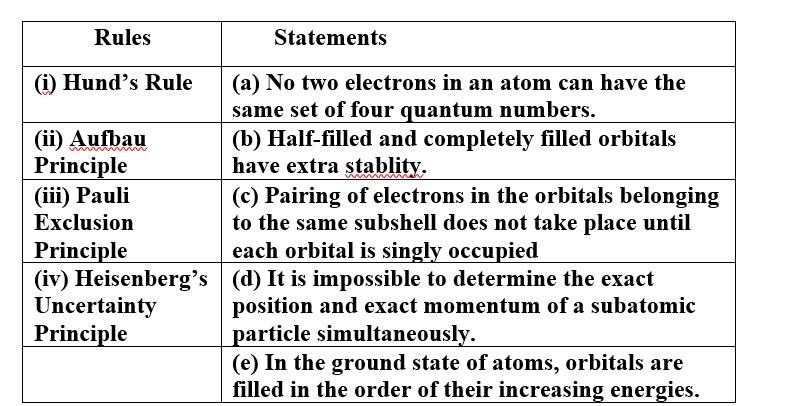
This is a Matching Type Questions as classified in NCERT Exemplar
Ans:
(i) Hund's Rule (c) Pairing of electrons in the orbitals belonging to the same subshell does not take place until each
&nbs
Upvote