
Ncert Solutions Chemistry Class 11th
Get insights from 2k questions on Ncert Solutions Chemistry Class 11th, answered by students, alumni, and experts. You may also ask and answer any question you like about Ncert Solutions Chemistry Class 11th
- 2k
Questions
- 0
Discussions
- 1
Active Users
- 29
Followers
Have a question about Ncert Solutions Chemistry Class 11th? Ask our experts
Keep it short & simple. Type complete word. Avoid abusive language.
What is the symbol for SI unit of mole? How is the mole defined?
What is the symbol for SI unit of mole? How is the mole defined?
This is a Short Answer Type Questions as classified in NCERT Exemplar
SI unit of the mole is mol. The amount of a substance that contains as many particles or entities as there are atoms in exactly
12 g (0.012 kg) of the C-12 isotope is defined as a mole. One mole is defined as follows:
1 mole =&
 Upvote

How many significant figures should be present in the answer of the following calculations?
How many significant figures should be present in the answer of the following calculations?
This is a Short Answer Type Questions as classified in NCERT Exemplar
On solving the above equation, the result is 5.4. All non-zeroes digits are significant. The significant figure is 2.
Upvote What will be the mass of one atom of C-12 in grams?
What will be the mass of one atom of C-12 in grams?
This is a Short Answer Type Questions as classified in NCERT Exemplar
Mass of 1 mole of C-12 = 12g
1 mole contains 6.022×10²³ atoms.
Thus, mass of 6.022×10²³ atoms=12g
Mass of 1 atom of carbon =126.022×10²³ g
&n
Upvote Hydrogen atom has only one electron, so mutual repulsion between electrons is absent. However, in multielectron atoms mutual repulsion between the electrons is significant. How does this affect the energy of an electron in the orbitals of the same principal quantum number in multielectron atoms?
Hydrogen atom has only one electron, so mutual repulsion between electrons is absent. However, in multielectron atoms mutual repulsion between the electrons is significant. How does this affect the energy of an electron in the orbitals of the same principal quantum number in multielectron atoms?
This is a Short Answer Type Questions as classified in NCERT Exemplar
Ans: The energy of electrons is determined by the value of n in the hydrogen atom and by n + l in the multielectron atom. Thus for a given principal quantum number the electrons of different orbitals would have different energy.
Upvote A box contains some identical red coloured balls, labelled as A, each weighing 2 grams. Another box contains identical blue coloured balls, labelled as B, each weighing 5 grams. Consider the combinations AB, AB2, A2B and A2B3 and show that law of multiple proportions is applicable.
A box contains some identical red coloured balls, labelled as A, each weighing 2 grams. Another box contains identical blue coloured balls, labelled as B, each weighing 5 grams. Consider the combinations AB, AB2, A2B and A2B3 and show that law of multiple proportions is applicable.
This is a Long Answer Type Questions as classified in NCERT Exemplar
In AB, 2 g of A combines with 5 g of B.
So, 4 g of A combines with 10 g of B.
In AB2, 2g of B combines with 10 g of B, So 4g of A combines with 20 g of B.
In A2B3 , 4G of B combines with 5 g of B.
In A2B3 4 g of B combined with 15 g
Upvote The effect of uncertainty principle is significant only for motion of microscopic particles and is negligible for the macroscopic particles. Justify the statement with the help of a suitable example.
The effect of uncertainty principle is significant only for motion of microscopic particles and is negligible for the macroscopic particles. Justify the statement with the help of a suitable example.
This is a Short Answer Type Questions as classified in NCERT Exemplar
Ans: The uncertainty principle is significantly only for the microscopic particles and not for the macroscopic particles can be concluded by considering the following example. Let us consider a particle or an object of mass 1 milli
Upvote Table-tennis ball has a mass 10 g and a speed of 90 m/s. If speed can be measured within an accuracy of 4% what will be the uncertainty in speed and position?
Table-tennis ball has a mass 10 g and a speed of 90 m/s. If speed can be measured within an accuracy of 4% what will be the uncertainty in speed and position?
This is a Short Answer Type Questions as classified in NCERT Exemplar
Ans: Given, m (mass) = 10g, v (speed) = 90 m/s and accuracy = 4%
Uncertainty in speed = 3.6 ms-1
Uncertainty in position = h/4 πmΔv = 6.626 × 10⁻³⁴/4 × 3.14 × 10 × 3.6
=1.36 × 10⁻³³m
Upvote Define the law of multiple proportions. Explain it with two examples. How does this law point to the existance of atoms?
Define the law of multiple proportions. Explain it with two examples. How does this law point to the existance of atoms?
This is a Long Answer Type Questions as classified in NCERT Exemplar
According to the law of multiple proportions, when two elements react to form two or more than two chemical compounds, the ratio between different masses of one of the elements combining with a fixed mass of the other is always in t
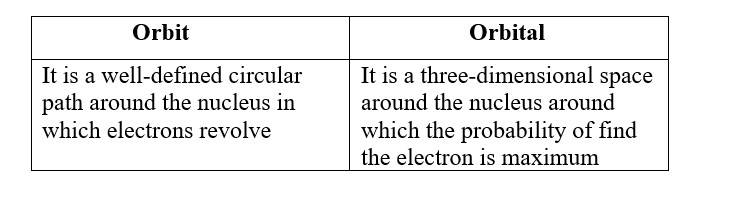
Upvote What is the difference between the terms orbit and orbital?
What is the difference between the terms orbit and orbital?
This is a Short Answer Type Questions as classified in NCERT Exemplar
Ans:

 Upvote
Calcium carbonate reacts with aqueous HCl to give CaCl2 and CO2 according to the reaction given below:
CaCO3 (s) + 2HCl (aq) → CaCl2(aq) + CO2(g) + H2O(l)
What mass of CaCl2 will be formed when 250 mL of 0.76 M HCl reacts with 1000 g of CaCO3? Name the limiting reagent. Calculate the number of moles of CaCl2 formed in the reaction.
This is a Long Answer Type Questions as classified in NCERT Exemplar
The volume of HCl solution is 250 mL and its molarity is 0.76M.
The number of moles of HCl as follows,
Moles of HCl Molarity Volume (in L)
= 0.76M 0.250 L
= 0.19 mol
The molar mass of CaCO3 is 100 g / gQl and the mass of CaCO3 is given
Upvote