
Ncert Solutions Chemistry Class 11th
Get insights from 2k questions on Ncert Solutions Chemistry Class 11th, answered by students, alumni, and experts. You may also ask and answer any question you like about Ncert Solutions Chemistry Class 11th
- 2k
Questions
- 0
Discussions
- 0
Active Users
- 29
Followers
Have a question about Ncert Solutions Chemistry Class 11th? Ask our experts
Keep it short & simple. Type complete word. Avoid abusive language.
Given below are two statements.
Statement I: Hydrogen peroxide can act as an oxidizing agent in both acidic and basic conditions.
Statement II: Density of hydrogen peroxide at 298 K is lower than that of D2O.
In the light of the above statements, choose the correct answer from the options given below.
Given below are two statements.
Statement I: Hydrogen peroxide can act as an oxidizing agent in both acidic and basic conditions.
Statement II: Density of hydrogen peroxide at 298 K is lower than that of D2O.
In the light of the above statements, choose the correct answer from the options given below.
Depending on the nature of reducing agent H2O2 can act as oxidizing agent in both acidic as well as basic medium.
Density of D2O = 1.1 gm/cc
Den
 Upvote
The reason why bond angle is larger in than are given below.
- In , there is one lone pair on the nitrogen atom increases repulsion, while the lone pair on phosphorus is in a higher energy orbital and causes less repulsion.
- Nitrogen is a small and electronegative atom whereas phosphorus is larg
Upvote Given below are two statements.
Statement I: In polluted water values of both dissolved oxygen and BOD are very low.
Statement II: Eutrophication results in decrease in the amount of dissolved oxygen.
In the light of the above statements, choose the most appropriate answer from the options given below.
Given below are two statements.
Statement I: In polluted water values of both dissolved oxygen and BOD are very low.
Statement II: Eutrophication results in decrease in the amount of dissolved oxygen.
In the light of the above statements, choose the most appropriate answer from the options given below.
(a) Polluted water has low value of dissolved oxygen, but high value of B.O.D., because chemical and organic matter uses dissolved oxygen to decompose.
(b) Eutrophication is result of excessive growth of weed in water bodies, which consumes dissolved oxygen, thus decreases oxygen.
Upvote Which of the following has least tendency to liberate H2 from mineral acids?
Which of the following has least tendency to liberate H2 from mineral acids?
Cu is least reactive metal and it lies below hydrogen in reactivity series.
Upvote Match List-I with List-II match the gas evolved during each reaction.
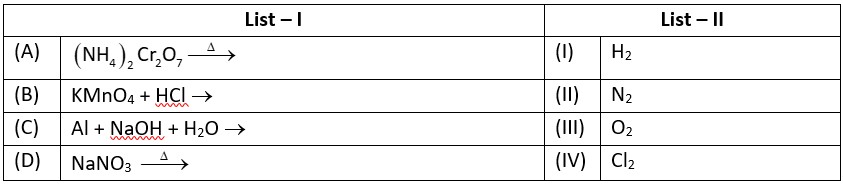
Choose the correct answer from the options given below
Match List-I with List-II match the gas evolved during each reaction.
Choose the correct answer from the options given below
(a) low solubility of LiF in H2O due to high lattice energy.
(b)
(c) Na in liq NH3 forms electronated ammonia thus conducting in nature.
(d)
Upvote The metal salts formed during softening of hardwater using Clark’s method are:
The metal salts formed during softening of hardwater using Clark’s method are:
In clark’s method Ca (OH)2 is used for softening hard water.
Thus CaCO3 and Mg (OH)2 are formed in reaction.
Upvote 200mL of 0.01 M HCl is mixed with 400mL of 0.01 M H2SO4. The pH of the mixture is___________.
Given: log2 = 0.30, log 3 = 0.48, log5 = 0.70, log7 = 0.84, log11 = 1.04
200mL of 0.01 M HCl is mixed with 400mL of 0.01 M H2SO4. The pH of the mixture is___________.
Given: log2 = 0.30, log 3 = 0.48, log5 = 0.70, log7 = 0.84, log11 = 1.04
Total concentration of H+ after the mixing of HCl and H2SO4
Upvote C(s) + O2(g) ® CO2(g) + 400 kJ
C(s) + <!-- [if gte mso 9]><xml>
When coal of purity 60% is allowed to burn in presence of insufficient oxygen, 60% of carbon is converted into ‘CO’ and the remaining is converted into ‘CO2’.
The heat generated when 0.6 kg of coal is burnt is___________.
C(s) + O2(g) ® CO2(g) + 400 kJ
C(s) + <!-- [if gte mso 9]><xml>
When coal of purity 60% is allowed to burn in presence of insufficient oxygen, 60% of carbon is converted into ‘CO’ and the remaining is converted into ‘CO2’.
The heat generated when 0.6 kg of coal is burnt is___________.
Mass of pure carbon in coal = 0.6 × 1000gm ×
Mass of carbon converted into CO = 6
Mass of carbon converted into CO2 = 360 – 216 = 144gm Þ Mole =
C (s) + O2 (g) -> CO2 (g) + 400KJ
Mole – 12 for CO2 production, Hence total energy produced = 400
Upvote