
Ncert Solutions Chemistry Class 11th
Get insights from 2k questions on Ncert Solutions Chemistry Class 11th, answered by students, alumni, and experts. You may also ask and answer any question you like about Ncert Solutions Chemistry Class 11th
- 2k
Questions
- 0
Discussions
- 0
Active Users
- 29
Followers
Have a question about Ncert Solutions Chemistry Class 11th? Ask our experts
Keep it short & simple. Type complete word. Avoid abusive language.
14.4 Assertion: As insect resistance of DDT increased, other organic toxins such as Aldrin and Dieldrin were introduced in the market by pesticide industry.
Reason: The repeated use of the same or similar pesticides give rise to pests that are resistant to that group of pesticides thus making the pesticides ineffective.
14.9. What are the reactions involved for ozone layer depletion in the stratosphere?
14.9. What are the reactions involved for ozone layer depletion in the stratosphere?
12.41. Assertion: In general, π bonds provide the most reactive centres in the molecules containingmultiple bonds.
Reason: The electron charge cloud of the π bond is located above and below the plane of bonding atoms. The electrons being easily available to the attacking reagents.
12.41. Assertion: In general, π bonds provide the most reactive centres in the molecules containingmultiple bonds.
Reason: The electron charge cloud of the π bond is located above and below the plane of bonding atoms. The electrons being easily available to the attacking reagents.
12.36. In the organic compound CH2 = CH – CH2 – CH2 – C ≡ CH, the pair of hybridised orbitals involved in the formation of: C2 – C3 bond is:
(a) sp – sp2 (b) sp – sp3 (c) sp2 – sp3 (d) sp3 – sp3
<!-- [if !supportLineBreakNewLine]-->
<!--[endif]-->
12.36. In the organic compound CH2 = CH – CH2 – CH2 – C ≡ CH, the pair of hybridised orbitals involved in the formation of: C2 – C3 bond is:
(a) sp – sp2 (b) sp – sp3 (c) sp2 – sp3 (d) sp3 – sp3
<!-- [if !supportLineBreakNewLine]-->
<!--[endif]-->
Kindly go through the solution
(c) sp2 – sp3
 Upvote

12.16. For the following bond cleavages, use curved-arrows to show the electron flow and classify each as homolysis or heterolysis. Identify reactive intermediate produced as free radical, carbocation and carbanion.
<!-- [if !supportLineBreakNewLine]--><!--[endif]-->
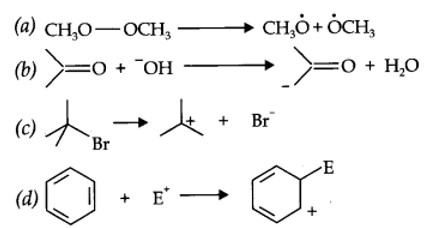
12.16. For the following bond cleavages, use curved-arrows to show the electron flow and classify each as homolysis or heterolysis. Identify reactive intermediate produced as free radical, carbocation and carbanion.
<!-- [if !supportLineBreakNewLine]--><!--[endif]-->
<p><strong><span lang="EN-IN">12.11. Draw the resonance structures for the following compounds. Show the electron shift using curved-arrow notation. (a) C<sub>6</sub>H<sub>5</sub>OH (b) C<sub>6</sub>H<sub>5</sub>NO<sub>2</sub> (c) CH<sub>3</sub>CH=CHCHO (d) C<sub>6</sub>H<sub>5</sub>—CHO (e) C<sub>6</sub>H<sub>5</sub>—CH<sub>2 </sub>(f) CH<sub>3</sub>CH=CHCH<sub>2</sub></span></strong><span lang="EN-IN"><br><!-- [if !supportLineBreakNewLine]--><br><!--[endif]--></span></p>
Identify the functional groups in the following compounds
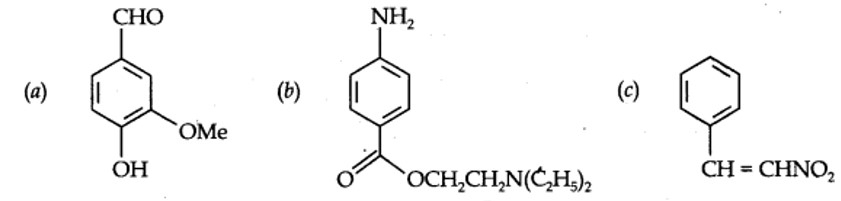
Identify the functional groups in the following compounds