
Ncert Solutions Chemistry Class 11th
Get insights from 2k questions on Ncert Solutions Chemistry Class 11th, answered by students, alumni, and experts. You may also ask and answer any question you like about Ncert Solutions Chemistry Class 11th
- 2k
Questions
- 0
Discussions
- 0
Active Users
- 29
Followers
Have a question about Ncert Solutions Chemistry Class 11th? Ask our experts
Keep it short & simple. Type complete word. Avoid abusive language.
Assertion (A): A liquid crystallises into a solid and is accompanied by decrease in entropy.
Reason (R): In crystals, molecules organise in an ordered manner.
(i) Both A and R are true and R is the correct explanation of A.
(ii) Both A and R are true but R is not the correct explanation of A.
(iii) A is true but R is false.
(iv) A is false but R is true.
This is a Assertion and Reason Type Questions as classified in NCERT Exemplar
option (i)
Explanation: The entropy of a liquid reduces as it crystallises. Because the molecules are more organised in crystalline form.
 Upvote

Assertion (A): Spontaneous process is an irreversible process and may be reversed by some external agency.
Reason (R): Decrease in enthalpy is a contributory factor for spontaneity.
(i) Both A and R are true and R is the correct explanation of A.
(ii) Both A and R is true but R is not the correct explanation of A.
(iii) A is true but R is false.
(iv) A is false but R is true
This is a Assertion and Reason Type Questions as classified in NCERT Exemplar
Ans: (ii)
Explanation: The energy factor for a spontaneous process should be favourable (i.e., -ve) and the randomness should be positive.
Upvote Assertion (A): Combustion of all organic compounds is an exothermic reaction.
Reason (R) : The enthalpies of all elements in their standard state are zero.
(i) Both A and R are true and R is the correct explanation of A.
(ii) Both A and R are true but R is not the correct explanation of A.
(iii) A is true but R is false.
(iv) A is false but R is true.
Assertion (A): Combustion of all organic compounds is an exothermic reaction.
Reason (R) : The enthalpies of all elements in their standard state are zero.
(i) Both A and R are true and R is the correct explanation of A.
(ii) Both A and R are true but R is not the correct explanation of A.
(iii) A is true but R is false.
(iv) A is false but R is true.
This is a Assertion and Reason Type Questions as classified in NCERT Exemplar
option (ii)
Explanation: The enthalpy of the reactants is always greater than the enthalpy of the product in a combustion reaction.
Upvote 
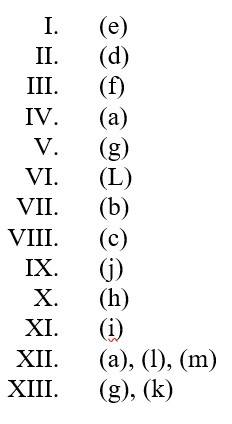
This is a Matching Type Questions as classified in NCERT Exemplar
(i)- (b), (d)
(ii)- (b)
(iii)- (c)
(iv)- (a)
Upvote Match the following parameters with description for spontaneity:
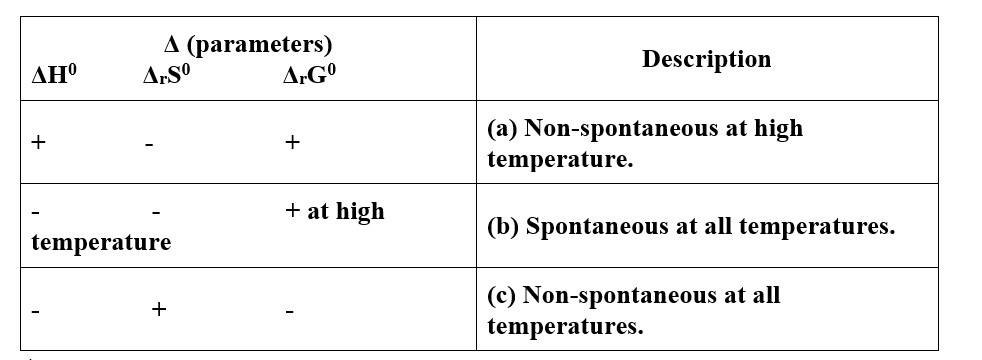
Match the following parameters with description for spontaneity:
This is a Matching Type Questions as classified in NCERT Exemplar
(i)- (c)
(ii)- (a)
(iii)- (b)
Upvote Match the following processes with entropy change:
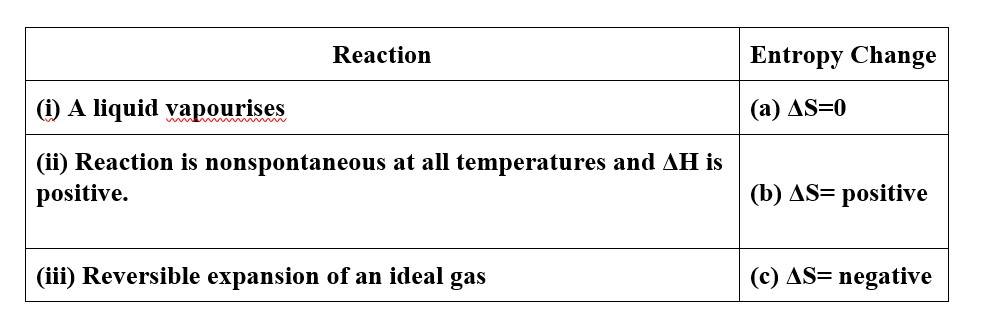
Match the following processes with entropy change:

This is a Matching Type Questions as classified in NCERT Exemplar
(i) (b)
(ii) (c)
(iii) (a)
Upvote 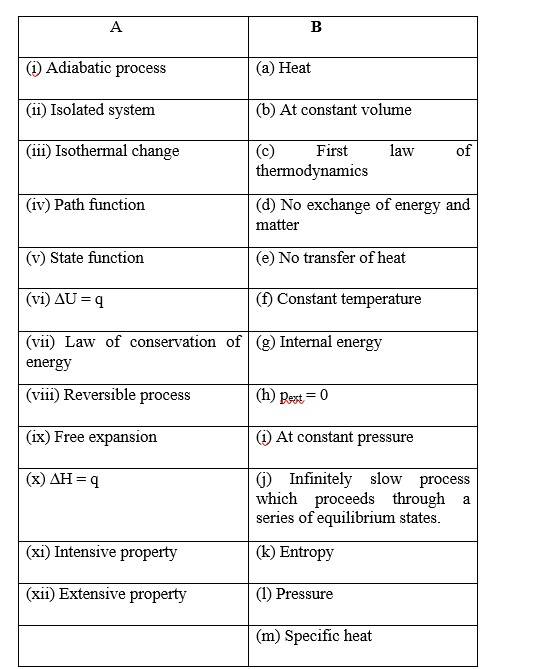
Consider the following reaction between zinc and oxygen and choose the correct options out of the options given below:
2Zn(s) + O2(g) → 2ZnO (s) ; ∆H = – 693.8 kJ/mol
(i) The enthalpy of two moles of ZnO is less than the total enthalpy of two moles of Zn and one mole of oxygen by 693.8 kJ.
(ii) The enthalpy of two moles of ZnO is more than the total enthalpy of two moles of Zn and one mole of oxygen by 693.8 kJ.
(iii) 8 kJ mol–1 energy is evolved in the reaction.
(iv) 8 kJ mol–1 energy is absorbed in the reaction.
This is a Multiple Choice Questions as classified in NCERT Exemplar
option (i) and (iii)
 Upvote
For an ideal gas, the work of reversible expansion under isothermal condition can be calculated by using the expression w= -nRTln
A sample containing 1.0 mol of an ideal gas is expanded isothermally and reversibly to ten times of its original volume, in two separate experiments. The expansion is carried out at 300 K and at 600 K respectively. Choose the correct option.
(i) Work done at 600 K is 20 times the work done at 300 K.
(ii) Work done at 300 K is twice the work done at 600 K.
(iii) Work done at 600 K is twice the work done at 300 K.
(iv) ∆U = 0 in both cases.
This is a Multiple Choice Questions as classified in NCERT Exemplar
option (iv)
For
isothermal reversible change
q= -w = nRTln =2.303nRTlog
= = =2
For
isothermal expansion of ideal gases, ? U = 0
Since,
temperature is constant this means there is no change in internal energy.
Upvote