
Ncert Solutions Chemistry Class 12th
Get insights from 2.6k questions on Ncert Solutions Chemistry Class 12th, answered by students, alumni, and experts. You may also ask and answer any question you like about Ncert Solutions Chemistry Class 12th
- 2.6k
Questions
- 0
Discussions
- 0
Active Users
- 79
Followers
Have a question about Ncert Solutions Chemistry Class 12th? Ask our experts
Keep it short & simple. Type complete word. Avoid abusive language.
Write down functional isomers of a carbonyl compound with molecular formula C3H6O. Which isomer will react faster with HCN and why? Explain the mechanism of the reaction also. Will the reaction lead to the completion with the conversion of whole reactant into product at reaction conditions? If a strong acid is added to the reaction mixture what will be the effect on concentration of the product and why?
Write down functional isomers of a carbonyl compound with molecular formula C3H6O. Which isomer will react faster with HCN and why? Explain the mechanism of the reaction also. Will the reaction lead to the completion with the conversion of whole reactant into product at reaction conditions? If a strong acid is added to the reaction mixture what will be the effect on concentration of the product and why?
This is a Long Answer Type Questions as classified in NCERT Exemplar
Ans: Functional isomers

Compound I will react faster with HCN due to less steric hindrance and greater positive charge on carbon atom of carbonyl group. Two methyl groups increase electron density on carbonyl carbon in com
 Upvote

An aromatic compound ‘A’ (Molecular formula C8H8O]) gives a positive 2, 4-DNP test. It gives a yellow precipitate of compound ‘B’ on treatment with iodine and sodium hydroxide solution. Compound ‘A’ does not give Tollen’s or Fehling’s test. On drastic oxidation with potassium permanganate it forms a carboxylic acid ‘C’ (Molecular formula C7H6O2), which is also formed along with the yellow compound in the above reaction. Identify A, B and C and write all the reactions involved.
An aromatic compound ‘A’ (Molecular formula C8H8O]) gives a positive 2, 4-DNP test. It gives a yellow precipitate of compound ‘B’ on treatment with iodine and sodium hydroxide solution. Compound ‘A’ does not give Tollen’s or Fehling’s test. On drastic oxidation with potassium permanganate it forms a carboxylic acid ‘C’ (Molecular formula C7H6O2), which is also formed along with the yellow compound in the above reaction. Identify A, B and C and write all the reactions involved.
This is a Long Answer Type Questions as classified in NCERT Exemplar
Ans: The aromatic compound 'A' does not give Tollen's reagent test, it is not an aromatic aldehyde. As it responds to an iodoform test called methyl ketone.
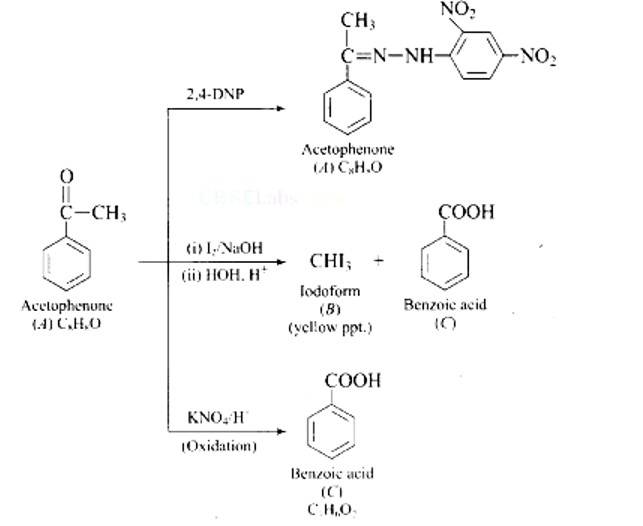 Upvote
An alkene ‘A’ (Mol. formula C5H10 on ozonolysis gives a mixture of two compounds ‘B’ and ‘C’. Compound ‘B’ gives positive Fehling’s test and forms an iodoform on treatment with I2 and NaOH. Compound ‘C’ does not give Fehling’s test but forms an iodoform. Identify the compounds A, B and C. Write the reaction for ozonolysis and formation of iodoform from B and C.
An alkene ‘A’ (Mol. formula C5H10 on ozonolysis gives a mixture of two compounds ‘B’ and ‘C’. Compound ‘B’ gives positive Fehling’s test and forms an iodoform on treatment with I2 and NaOH. Compound ‘C’ does not give Fehling’s test but forms an iodoform. Identify the compounds A, B and C. Write the reaction for ozonolysis and formation of iodoform from B and C.
This is a Long Answer Type Questions as classified in NCERT Exemplar
Ans:
Fehling's test is positive when compound 'B' is used. It gives an iodoform test and proves that it is an aldehyde. Because it fails Fehling's test, compound 'C' is a ketone.
 Upvote
Assertion: [Fe(CN)6]3- ion shows magnetic moment corresponding to two unpaired electrons.
Reason: Because it has d2sp3 type hybridisation.
Assertion: [Fe(CN)6]3- ion shows magnetic moment corresponding to two unpaired electrons.
Reason: Because it has d2sp3 type hybridisation.
This is a Assertion and Reason Type Questions as classified in NCERT Exemplar
Ans: Correct option: D
[Fe (CN)6]3- ion shows magnetic moment corresponding to one unpaired electron. (CN) is a ligand with a strong field that couples electrons, resulting in hybridisation. d2sp3 and it has one unpai
Upvote Assertion: Complexes of MX6 and MX5L type (X and L are unidentate) do not show geometrical isomerism.
Reason: Geometrical isomerism is not shown by complexes of coordination number 6.
Assertion: Complexes of MX6 and MX5L type (X and L are unidentate) do not show geometrical isomerism.
Reason: Geometrical isomerism is not shown by complexes of coordination number 6.
This is a Assertion and Reason Type Questions as classified in NCERT Exemplar
Ans: Correct option: B
From the Cis and Trans forms, geometrical isomerism forms compounds. All of the valences in the MX6 ligand are the same, resulting in an identical molecule. L is a distinct ligand in MX5L, and it can b
Upvote Assertion: Linkage isomerism arises in coordination compounds containing ambidentate ligand.
Reason: Ambidentate ligand has two different donor atoms.
Assertion: Linkage isomerism arises in coordination compounds containing ambidentate ligand.
Reason: Ambidentate ligand has two different donor atoms.
This is a Assertion and Reason Type Questions as classified in NCERT Exemplar
Ans: Correct option: A
The term "linkage isomerism" refers to two molecules that have similar ligands but differ in the donating site of the ligand. Ambidentate is made up of two different types of donor atoms.
Example [Fe (N
Upvote Assertion : [Cr(H2O)6]Cl2 and [Fe(H2O)6]Cl2 are reducing in nature.
Reason: Unpaired electrons are present in their d-orbitals.
Assertion : [Cr(H2O)6]Cl2 and [Fe(H2O)6]Cl2 are reducing in nature.
Reason: Unpaired electrons are present in their d-orbitals.
This is a Assertion and Reason Type Questions as classified in NCERT Exemplar
Ans: Correct option: B
[Cr (H2O)6]Cl2 and [Fe (H2O)6]Cl2
Due to the creation of a more stable complex ion after obtaining ion, [Cr (H2O)6]Cl2 and [Fe (H2O)6]Cl2 are reduced in nature. Both compounds have a coordination
Upvote In the following questions a statement of assertion followed by a statement of reason is given. Choose the correct answer out of the following choices.
A: Assertion and reason both are true, reason is correct of assertion.
B: Assertion and reason both are true, but reason is not the correct of assertion.
C: Assertion is true, reason is false.
D: Assertion is false, reason is true
1. Assertion: Toxic metal ions are removed by the chelating ligands.
Reason: Chelate complexes tend to be more stable.
In the following questions a statement of assertion followed by a statement of reason is given. Choose the correct answer out of the following choices.
A: Assertion and reason both are true, reason is correct of assertion.
B: Assertion and reason both are true, but reason is not the correct of assertion.
C: Assertion is true, reason is false.
D: Assertion is false, reason is true
1. Assertion: Toxic metal ions are removed by the chelating ligands.
Reason: Chelate complexes tend to be more stable.
This is a Assertion and Reason Type Questions as classified in NCERT Exemplar
Ans: Correct option: A
Toxic metal ions are removed by the chelating ligands. Chelate complexes tend to be more stable. When a solution of the chelating ligand is added to a solution containing toxic metals ligands chelates
Upvote Match the compounds given in Column I with the oxidation state of cobalt present in it (given in Column II) and assign the correct code.
Column I (Compound)
Column II (Oxidation state of Co)
A. [Co(NCS)(NH3)5(SO3)]
1. + 4
B. [Co(NH3)4Cl2]SO4
2. 0
C. Na4[Co(S2O3)3]
3. +1
D. [Co2(CO)8]
4. +2
5. +3
Code
(i) A (1) B (2) C (4) D (5)
(ii) A (4) B (3) C (2) D (1)
(iii) A (5) B (1) C (4) D (2)
(iv) A (4) B (1) C (2) D (3)
Match the compounds given in Column I with the oxidation state of cobalt present in it (given in Column II) and assign the correct code.
|
Column I (Compound) |
Column II (Oxidation state of Co) |
|
A. [Co(NCS)(NH3)5(SO3)] |
1. + 4 |
|
B. [Co(NH3)4Cl2]SO4 |
2. 0 |
|
C. Na4[Co(S2O3)3] |
3. +1 |
|
D. [Co2(CO)8] |
4. +2 |
|
5. +3 |
Code
(i) A (1) B (2) C (4) D (5)
(ii) A (4) B (3) C (2) D (1)
(iii) A (5) B (1) C (4) D (2)
(iv) A (4) B (1) C (2) D (3)
This is a Matching Type Questions as classified in NCERT Exemplar
Ans: Correct option: (i)
Upvote Match the complex species given in Column I with the possible isomerism given in Column II and assign the correct code
Column I (Complex species)
Column II (Isomerism)
A. [Co(NH3)4Cl2]+
1. Optical
B. cis - [Co(en)2Cl2]+
2. Ionisation
C. [Co(NH3)5(NO2)]Cl2
3. Coordination
D. [Co(NH3)6][Cr(CN)6]
4. geometrical
5. linkage
Code :
(i) A (1) B (2) C (4) D (5)
(ii) A (4) B (3) C (2) D (1)
(iii) A (4) B (1) C (5) D (3)
(iv) A (4) B (1) C (2) D (3)
Match the complex species given in Column I with the possible isomerism given in Column II and assign the correct code
|
Column I (Complex species) |
Column II (Isomerism) |
|
A. [Co(NH3)4Cl2]+ |
1. Optical |
|
B. cis - [Co(en)2Cl2]+ |
2. Ionisation |
|
C. [Co(NH3)5(NO2)]Cl2 |
3. Coordination |
|
D. [Co(NH3)6][Cr(CN)6] |
4. geometrical |
|
5. linkage |
Code :
(i) A (1) B (2) C (4) D (5)
(ii) A (4) B (3) C (2) D (1)
(iii) A (4) B (1) C (5) D (3)
(iv) A (4) B (1) C (2) D (3)
This is a Matching Type Questions as classified in NCERT Exemplar
Ans: Correct option: (iv)
Upvote