

Ncert Solutions Chemistry Class 12th
Get insights from 2.6k questions on Ncert Solutions Chemistry Class 12th, answered by students, alumni, and experts. You may also ask and answer any question you like about Ncert Solutions Chemistry Class 12th
Follow Ask QuestionQuestions
Discussions
Active Users
Followers
New answer posted
a year agoContributor-Level 10
This is a Multiple Choice Questions as classified in NCERT Exemplar
Ans: Correct Option: Option (i, iii)
In the electrolysis of sulphuric acid, the following reactions occur
2SO42− (aq)→S2O82− (aq) + 2e− E? Cell =1.96V
2H2O (l)→O2 (g)+4H+ (aq) + 4e− E? Cell =1.23V
The reaction will lower the value of E? Cell is preferred at anode so the second reaction is feasible.
H+ + e− → H2 E? Cell = 0.00V
At the cathode, reduction of water occurs. Therefore, in dilute sulphuric acid solution, hydrogen will be reduced at the cathode.
New answer posted
a year ago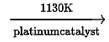 KN2(g) + 3H2(g)
Contributor-Level 10
This is a Multiple Choice Questions as classified in NCERT Exemplar
Correct options: A, C and D
The pressure in this reaction is extremely high, and it becomes independent of the ammonia concentration. The metal surface becomes saturated with gas molecules when the rate of reaction=Rate constant. The rate of a zero-order reaction is independent of the concentration of reactants in the reaction.
New answer posted
a year agoContributor-Level 10
This is a Multiple Choice Questions as classified in NCERT Exemplar
Ans: Correct Option: (ii, iv)
The lesser the E? value of the redox couple higher is the reducing power
For Cu2+ + 2e−→Cu; E? =0.34V
For 2H+ + 2e−→H2 E? =0.00V
Since the second redox couple has less standard reduction potential than the first so it can be concluded that the redox couple is a stronger oxidizing agent than H+/H2 and copper cannot displace H2 from acid.
New answer posted
a year agoContributor-Level 10
This is a Multiple Choice Questions as classified in NCERT Exemplar
Correct options: A and D
A complex reaction is one that does not happen in a single step.
The total number of molecules involved in the slowest step of the reaction determines the overall reaction rate.
New answer posted
a year agoContributor-Level 10
This is a Multiple Choice Questions as classified in NCERT Exemplar
Ans: Correct Option: (iv)
The electrolysis of aqueous sodium chloride is as follows
NaCl→Na+ + Cl−
H2O→H+ + OH−
At the cathode, the reaction goes this way,
H2O + e− → H2 + OH−
At the anode, the reaction goes this way,
Cl− (aq)→ Cl2 (g)+ e− E? Cell =1.36V
2H2O (g)→O2 (g) + 4H+ (aq) + 4e− E? Cell =1.23V
At the anode, the reaction with a lower E? value will be preferred and oxidation of oxygen is a slow process and requires high voltage so the first reaction will take place.
New answer posted
a year agoContributor-Level 10
This is a Multiple Choice Questions as classified in NCERT Exemplar
Ans: Correct Option: (ii)
Given: Salt ammonium hydroxide
Apply Kohlrausch Law
Kohlrausch law of states that limiting molar conductivity of any salt species is equal to the sum of the limiting molar conductivity of cations and anions of the electrolyte
Λ0m (NaOH) = Λ0m (NH4+) + Λ0m (OH-) + Λ0m (Na+) + Λ0m (OH-) - Λ0m (Na+)- Λ0m (Cl-)
Λ0m (NH4OH) = Λ0m (NH4OH) + Λ0m (NaOH) – Λ0 (NaCl)
New answer posted
a year agoContributor-Level 10
Correct options: A and B
This is a Multiple Choice Questions as classified in NCERT Exemplar
Unimolecular reaction: Unimolecular means relating to a single molecular reaction that describes decomposition of a single reactant.
If product A→ (B)
rate = k [A]
Example Na2O4 (g)→2No2 (g)
Order = 1
Molecularity = 1
The slowest step is the rate determining which determines the Order and Molecularity.
New answer posted
a year agoContributor-Level 10
This is a Multiple Choice Questions as classified in NCERT Exemplar
Ans: Correct Option: (i)
In the lead storage battery, a reverse reaction occurs and lead sulfate is formed at the anode, and at the cathode, it is converted into lead and lead oxide respectively. The reaction is as follows
At the cathode, the reaction goes this way,
PbSO4 (s)+2e−→Pb (s)+SO42− (aq), Reduction process
At the anode, the reaction goes this way,
PbSO4 (s)+2H2O→PbO2 (s)+SO42−+2H+ +2e, oxidation process
The overall reaction is as follows;
2PbSO4 (s)+2H2O→Pb (s)+PbO2 (s)+4H+ (aq)+2SO42− (aq)
Therefore, at anode lead sulfate is reduced to lead.
New answer posted
a year agoContributor-Level 10
This is a Multiple Choice Questions as classified in NCERT Exemplar
Ans: Correct Option: (iv)
The cell constant is described as the ratio of the length of the object and the area of cross-section. It can be written as follow
G=
As l and A remains constant for an object it can be inferred that the cell constant for a conductivity cell remains constant for a cell.
New answer posted
a year agoContributor-Level 10
This is a Multiple Choice Questions as classified in NCERT Exemplar
Correct options: A and D
Elementary reaction: It is a reaction that occurs in a single step.
Here we must understand about the Order and Molecularity.
Molecularity of a reaction = number of reacting species (collide to bring a chemical reaction).
Discussing about the Order, Rate law is used in Order and how do we equate shall be seen in the next step
rate = k [A] α [B] β
For a balanced chemical equation of an elementary reaction Order and Molecularity is same and can never be 0.
Taking an Exam? Selecting a College?
Get authentic answers from experts, students and alumni that you won't find anywhere else
Sign Up on ShikshaOn Shiksha, get access to
- 67k Colleges
- 1.2k Exams
- 718k Reviews
- 1850k Answers