
Ncert Solutions Chemistry Class 12th
Get insights from 2.6k questions on Ncert Solutions Chemistry Class 12th, answered by students, alumni, and experts. You may also ask and answer any question you like about Ncert Solutions Chemistry Class 12th
- 2.6k
Questions
- 0
Discussions
- 0
Active Users
- 79
Followers
Have a question about Ncert Solutions Chemistry Class 12th? Ask our experts
Keep it short & simple. Type complete word. Avoid abusive language.
The quantity of charge required to obtain one mole of aluminium from Al2O3 is ___________.
(i) 1F
(ii) 6F
(iii) 3F
(iv) 2F
The quantity of charge required to obtain one mole of aluminium from Al2O3 is ___________.
(i) 1F
(ii) 6F
(iii) 3F
(iv) 2F
This is a Multiple Choice Questions as classified in NCERT Exemplar
Correct Option: (iii)
Ans: Given: One mole of aluminium
Calculate the number of electrons required to convert Al2O3 to Al
It is the charge required to obtain one mole of aluminium from Al2O3
The dissociation of aluminium oxide is a
 Upvote

Use the data of Q.8 and find out the most stable oxidised species.
(i) Cr3+
(ii) MnO4–
(iii) Cr2O72–
(iv) Mn2+
Use the data of Q.8 and find out the most stable oxidised species.
(i) Cr3+
(ii) MnO4–
(iii) Cr2O72–
(iv) Mn2+
This is a Multiple Choice Questions as classified in NCERT Exemplar
Ans: Correct Option: (i)
According to the given table, 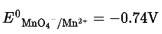 has the most negative value among the given species. So
Cr3+ is the most stable oxidized species.
Upvote Rate law cannot be determined from balanced chemical equation if _______.
A. Reverse reaction is involved.
B. It is an elementary reaction.
C. It is a sequence of elementary reactions.
D. Any of the reactants is in excess
Rate law cannot be determined from balanced chemical equation if _______.
A. Reverse reaction is involved.
B. It is an elementary reaction.
C. It is a sequence of elementary reactions.
D. Any of the reactants is in excess
This is a Multiple Choice Questions as classified in NCERT Exemplar
Correct options : A, C and D.
Rate law = Experimental rate of the reaction
Suppose aA + bB→cC + dD
Then rate = k [A] α [B] β
Here instead of using complex reaction we use elementary reaction which gets solved in one step
Upvote Use the data given in Q.8 and find out the most stable ion in its reduced form.
(i) Cl–
(ii) Cr3+
(iii) Cr
(iv) Mn2+
Use the data given in Q.8 and find out the most stable ion in its reduced form.
(i) Cl–
(ii) Cr3+
(iii) Cr
(iv) Mn2+
This is a Multiple Choice Questions as classified in NCERT Exemplar
Ans: Correct Option: (iv)
 Upvote
Using the data given in Q.8 find out in which option the order of reducing power is correct.
(i) Cr3+ < Cl– < Mn2+ < Cr
(ii) Mn2+ < Cl– < Cr3+ < Cr
(iii) Cr3+ < Cl– < Cr2O72– < MnO4 –
(iv) Mn2+ < Cr3+ < Cl– < Cr
Using the data given in Q.8 find out in which option the order of reducing power is correct.
(i) Cr3+ < Cl– < Mn2+ < Cr
(ii) Mn2+ < Cl– < Cr3+ < Cr
(iii) Cr3+ < Cl– < Cr2O72– < MnO4 –
(iv) Mn2+ < Cr3+ < Cl– < Cr
This is a Multiple Choice Questions as classified in NCERT Exemplar
Ans: Correct Option: (iii)
According to the electrochemical series, the lower the reduction potential higher is the reducing power.
Therefore, the order of reducing power is Mn2+ < Cl– < Cr3+ < Cr
Upvote Use the data given in Q.8 and find out which of the following is the strongest oxidizing agent.
(i) Cl–
(ii) Mn2+
(iii) MnO4–
(iv) Cr3+
Use the data given in Q.8 and find out which of the following is the strongest oxidizing agent.
(i) Cl–
(ii) Mn2+
(iii) MnO4–
(iv) Cr3+
This is a Multiple Choice Questions as classified in NCERT Exemplar
Ans: Correct Option: (iii)
According to the electrochemical series higher the positive value of standard reduction potential of metal ion, the higher is the oxidizing power
Therefore, MnO4− is the strongest oxidizing agent.
Upvote Why can we not determine the order of a reaction by taking into consideration the balanced chemical equation?
Why can we not determine the order of a reaction by taking into consideration the balanced chemical equation?
This is a Short Answer Type Question as classified in NCERT Exemplar
Incorrect order results from a balanced chemical equation. KClO3 + 6FeSO4 + 3H2SO4→KCl + 3H2O + 3Fe2 (SO4)3
This reaction is complex and occurs in several steps. The order is determined by the slowest in the reactions
Upvote Using the data given below find out the strongest reducing agent
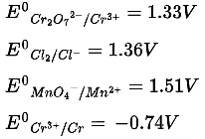
(i) Cl–
(ii) Cr
(iii) Cr3+
(iv) Mn2+
Using the data given below find out the strongest reducing agent
(i) Cl–
(ii) Cr
(iii) Cr3+
(iv) Mn2+
This is a Multiple Choice Questions as classified in NCERT Exemplar
Ans: Correct Option: (ii)
According to the electrochemical series and standard reduction potential of metal, the higher the negative value of standard reduction potential stronger will be the reducing agent
In the given options, the st
Upvote Why molecularity is applicable only for elementary reactions and order is applicable for elementary as well as complex reactions?
Why molecularity is applicable only for elementary reactions and order is applicable for elementary as well as complex reactions?
This is a Short Answer Type Question as classified in NCERT Exemplar
Simple reactions occur in a single stage, whereas complicated reactions occur in multiple steps. Each phase in a multi-step process has its own molecularity, which is not added together. There is no molecularity in complex reactions
Upvote