
Ncert Solutions Chemistry Class 12th
Get insights from 2.6k questions on Ncert Solutions Chemistry Class 12th, answered by students, alumni, and experts. You may also ask and answer any question you like about Ncert Solutions Chemistry Class 12th
- 2.6k
Questions
- 0
Discussions
- 0
Active Users
- 79
Followers
Have a question about Ncert Solutions Chemistry Class 12th? Ask our experts
Keep it short & simple. Type complete word. Avoid abusive language.
11.51 Write the reactions of Williamson synthesis of 2-ethoxy-3-methylpentane starting from ethanol and 3-methylpentan-2-ol.
11.51 Write the reactions of Williamson synthesis of 2-ethoxy-3-methylpentane starting from ethanol and 3-methylpentan-2-ol.
11.51
During Williamson synthesis of ethers, an alkyl halide reacts with an alkoxide (ion with –ve charge on the oxygen of alcohol and + ve charge on alkali metal like Na) ion. it is an SN2 reaction. In the reaction, alkyl halides should be least hindered. Hence, an alkyl halide is obtained from eth
 Upvote

11.50 Write the equations involved in the following reactions: (i) Reimer - Tiemann reaction (ii) Kolbe’s reaction
11.50 Write the equations involved in the following reactions: (i) Reimer - Tiemann reaction (ii) Kolbe’s reaction
11.50
1. Phenol on mixing with chloroform and NaOH at 340K followed by Acidic hydrolysis, salicyl aldehyde is formed. When carbon tetrachloride (CCl4) is used at the place of chloroform salicylic acid is This type of reaction is known as Reimer - Tiemann reaction.
2. The sodium phenoxide reacts
Upvote 11.49 Ortho and para nitrophenols are more acidic than phenol. Draw the resonance structures of the corresponding phenoxide ions.
11.49 Ortho and para nitrophenols are more acidic than phenol. Draw the resonance structures of the corresponding phenoxide ions.
11.49.
Resonating structures of o-nitrophenoxide ions that are formed by the loss of a proton from o-nitrophenol are as follows:
Resonating structures of p-nitrophenoxide ions that are formed by the loss of a proton from p- nitrophenol are as follows:
Resonating structures of phenoxide ions that are fo
Upvote 11.47 Give structures of the products you would expect when each of the following Methylbutan alcohol reacts with (a) HCl –ZnCl2 (b) HBr and (c) SOCl2.
11.47 Give structures of the products you would expect when each of the following Methylbutan alcohol reacts with (a) HCl –ZnCl2 (b) HBr and (c) SOCl2.
11.47
(a) (i) Primary alcohols do no react appreciably with Lucas' reagent (HCl –ZnCl2) at room temperature.
(ii) Tertiary alcohol reacts immediately with Lucas 'reagent.
Upvote 11.46 Write structures of the products of the following reactions:
11.46 Write structures of the products of the following reactions:
11.46 In this reaction, when propene reacts with the given reagent then the double bond of propene breaks down with charges on them. So, H+ gets placed on the carbon which already has two hydrogen atom and OH- gets substituted on center carbon because it has the more positive charge which attr
Upvote 11.45 When 3-methylbutan-2-ol is treated with HBr, the following reaction takes place: Give a mechanism for this reaction. (Hint : The secondary carbocation formed in step II rearranges to a more stable tertiary carbocation by a hydride ion shift from 3rd carbon atom.
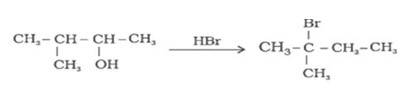
Give a mechanism for this reaction. (Hint : The secondary carbocation formed in step II rearranges to a more stable tertiary carbocation by a hydride ion shift from 3rd carbon atom.
11.45 When 3-methylbutan-2-ol is treated with HBr, the following reaction takes place: Give a mechanism for this reaction. (Hint : The secondary carbocation formed in step II rearranges to a more stable tertiary carbocation by a hydride ion shift from 3rd carbon atom.
Give a mechanism for this reaction. (Hint : The secondary carbocation formed in step II rearranges to a more stable tertiary carbocation by a hydride ion shift from 3rd carbon atom.
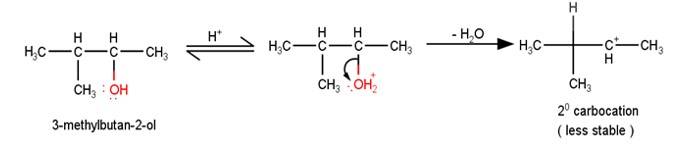 A
The next step is a rearrangement of the 20 carbocations formed in the above step is less stable it rearranges by a 1,2-hydride shift to form more stable
Upvote 11.43
Write equations of the following reactions:
(i) Friedel-Crafts reaction – alkylation of anisole.
(ii) Nitration of anisole.
(iii) Bromination of anisole in ethanoic acid medium.
(iv) Friedel-Craft’s acetylation of anisole.
11.43
Write equations of the following reactions:
(i) Friedel-Crafts reaction – alkylation of anisole.
(ii) Nitration of anisole.
(iii) Bromination of anisole in ethanoic acid medium.
(iv) Friedel-Craft’s acetylation of anisole.
11.43
The driving force of all the reactions given to the question is that the alkoxy group is an ortho and para directing group because it exerts its +R effect in the benzene ring. Para position being comparatively more stable than the ortho position is usually preferred because ortho position lead
Upvote