
Ncert Solutions Chemistry Class 12th
Get insights from 2.6k questions on Ncert Solutions Chemistry Class 12th, answered by students, alumni, and experts. You may also ask and answer any question you like about Ncert Solutions Chemistry Class 12th
- 2.6k
Questions
- 0
Discussions
- 0
Active Users
- 79
Followers
Have a question about Ncert Solutions Chemistry Class 12th? Ask our experts
Keep it short & simple. Type complete word. Avoid abusive language.
Pumice stone is an example of:
<!-- [if !supportLineBreakNewLine]-->
<!--[endif]-->
Pumice stone is an example of:
<!-- [if !supportLineBreakNewLine]-->
<!--[endif]-->
Pumice stone is an example of solid sol. In this type of colloid, the dispersion medium is solid and the dispersion phase is gas.
 Upvote

Given below are two statements:
Statement I: The nutrient deficient water bodies lead to eutrophication.
Statement II: Eutrophication leads to decrease in the level of oxygen in water bodies.
In the light of the above statements, choose the correct answer from the options given below:
<!-- [if !supportLineBreakNewLine]-->
<!--[endif]-->
Eutrophication occurs when the water body becomes overly enriched with nutrients. Eutrophication leads to decrease in the level of dissolved oxygen (DO) in water bodies.
Upvote The number of compounds/species which obey Huckel's rule is
<!-- [if !supportLineBreakNewLine]-->
<!--[endif]-->
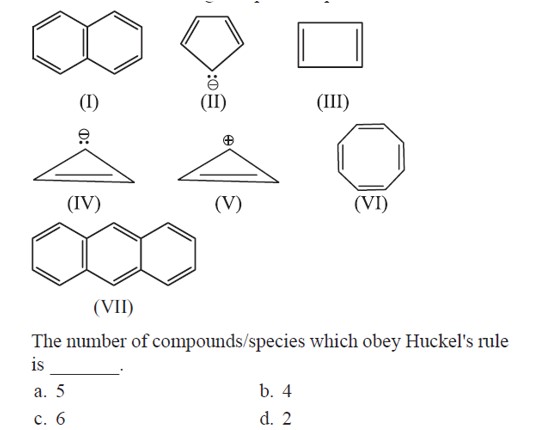
The number of compounds/species which obey Huckel's rule is
<!-- [if !supportLineBreakNewLine]-->
<!--[endif]-->
Acc. to Huckel rule, A compond/molecule is said to be aromatic if it have cyclic conjugate and [4n + 2]π electron system
⇒ Molecule must be sp² hybridised
⇒ Molecule must be planar.
Upvote On balancing the given redox reaction, aCr₂O₇²⁻(aq) + bSO₃²⁻(aq) + cH⁺(aq) → 2aCr³⁺(aq) + bSO₄²⁻(aq) + c/2H₂O(l) the coefficients a, b and c are found to be, respectively:
On balancing the given redox reaction, aCr₂O₇²⁻(aq) + bSO₃²⁻(aq) + cH⁺(aq) → 2aCr³⁺(aq) + bSO₄²⁻(aq) + c/2H₂O(l) the coefficients a, b and c are found to be, respectively:
Reduction half reaction.
Cr? O? ²? + 14H? + 6e? → 2Cr? ³ + 7H? O
Oxidation half reaction
SO? ²? + H? O → SO? ²? + 2e? ] × 3
Oxygen is balanced by adding water and hydrogen is balanced by adding H? and the charge is balanced by electrons.
Add ( eq. (i) + (3 × eq. (ii) )
Cr? O? ²? + 3SO? ²? + 8H? → 2Cr? ³ +
Upvote The equilibrium concentrations of the species in the reaction A + B ? C + D are 2, 3, 10 and 6 mol L-1 respectively at 300 K. ΔG° for the reaction is (R = 2cal/molK)
<!-- [if !supportLineBreakNewLine]-->
<!--[endif]-->
The equilibrium concentrations of the species in the reaction A + B ? C + D are 2, 3, 10 and 6 mol L-1 respectively at 300 K. ΔG° for the reaction is (R = 2cal/molK)
<!-- [if !supportLineBreakNewLine]-->
<!--[endif]-->
Keq. = ( [C] [D])/ ( [A] [B])
Keq = (10 × 6)/ (2 × 3) = 10
ΔG° = −2.303RTlog Keq. = −2.303 (2) (300) (log 10)
= −1381.8cal (? R = 2cal/molk)
Upvote Which amongst the following options is the correct relation between change in enthalpy and change in internal Energy?
Which amongst the following options is the correct relation between change in enthalpy and change in internal Energy?
Kindly go through the answer
ΔH = ΔU + Δn_gRT
Upvote Which amongst the following options is the correct relation between change in enthalpy and change in internal Energy?
<!-- [if !supportLineBreakNewLine]-->
<!--[endif]-->
Which amongst the following options is the correct relation between change in enthalpy and change in internal Energy?
<!-- [if !supportLineBreakNewLine]-->
<!--[endif]-->
Kindly go through the answers
? H =? U +? n_gRT
Upvote Some tranquilizers are listed below. Which one from the following belongs to barbiturates?
<!-- [if !supportLineBreakNewLine]-->
<!--[endif]-->
Some tranquilizers are listed below. Which one from the following belongs to barbiturates?
<!-- [if !supportLineBreakNewLine]-->
<!--[endif]-->
Veronal is a barbiturate drug and it constitutes an important class of tranquilizers.
Upvote Which amongst the following molecules on polymerization produces neoprene?
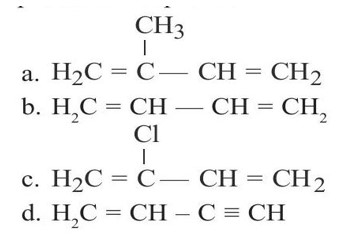
Which amongst the following molecules on polymerization produces neoprene?
Chloroprene is the monomer of neoprene.
2-chlorobuta-1,3-diene (chloroprene)
Upvote Which of the following reactions will NOT give primary amine as the product?
<!-- [if !supportLineBreakNewLine]-->
<!--[endif]-->
Which of the following reactions will NOT give primary amine as the product?
<!-- [if !supportLineBreakNewLine]-->
<!--[endif]-->
CH? CONH? - (i) LiAlH? , (ii) H? O? )-> CH? NH?
CH? CONH? - (Br? /KOH)-> CH? NH?
CH? CN - (i) LiAlH? , (ii) H? O? )-> CH? NH?
CH? NC - (i) LiAlH? , (ii) H? O)-> CH? NHCH?
Methyl isocyanide gives a secondary amine, CH? NHCH? upon reduction.
Upvote