
Ncert Solutions Chemistry Class 12th
Get insights from 2.6k questions on Ncert Solutions Chemistry Class 12th, answered by students, alumni, and experts. You may also ask and answer any question you like about Ncert Solutions Chemistry Class 12th
- 2.6k
Questions
- 0
Discussions
- 0
Active Users
- 79
Followers
Have a question about Ncert Solutions Chemistry Class 12th? Ask our experts
Keep it short & simple. Type complete word. Avoid abusive language.
Which statement is NOT correct for p- toluenesulphonyl chloride?
Which statement is NOT correct for p- toluenesulphonyl chloride?
p- toluenesulphonyl chloride
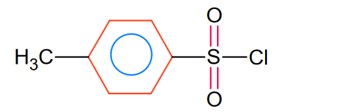
Only gives soluble product with alkali for 1° amine and for 2°- amine it gives insoluble product.
 Upvote

The final product ‘A’ in the following reaction sequence
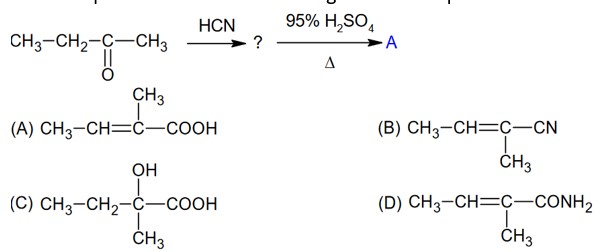
The final product ‘A’ in the following reaction sequence

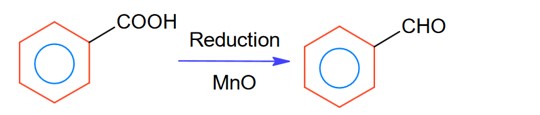
The reagent, from the following, which converts benzoic acid to benzaldehyde in one step is

The reagent, from the following, which converts benzoic acid to benzaldehyde in one step is
Halogenation of which one of the following will yield m-substituted product with respect to methyl group as a major product?
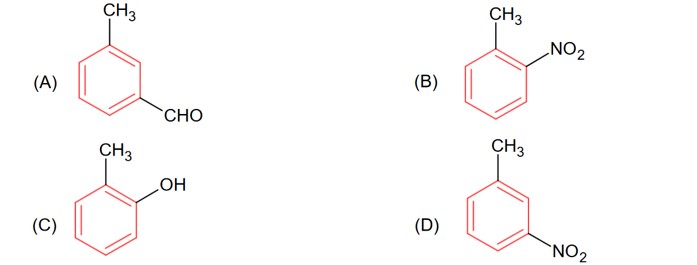
Halogenation of which one of the following will yield m-substituted product with respect to methyl group as a major product?
OH group is the more activating group and ortho-para director, hence ortho position attach will provide meta substituted product with respect to – CH3 in option (C).
Upvote Identify the major product obtained in the following reaction:
<!-- [if !supportLineBreakNewLine]-->
<!--[endif]-->
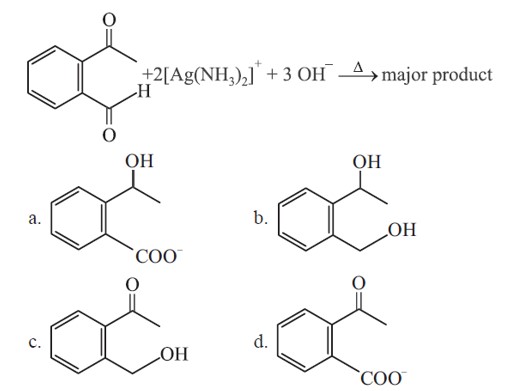
Identify the major product obtained in the following reaction:
<!-- [if !supportLineBreakNewLine]-->
<!--[endif]-->
Tollen's reagent oxidises aldehydes into carboxylate ion whereas ketone is not oxidised by tollen's reagent.
Upvote Which amongst the following will be most readily dehydrated under acidic conditions?
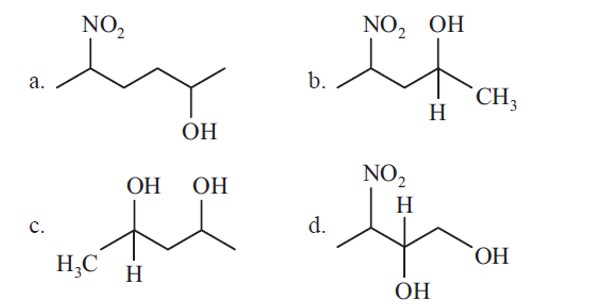
Which amongst the following will be most readily dehydrated under acidic conditions?
Formation of Conjugated diene in option 3 make the given reactant most reactive towards dehydration in acidic conditions.
Upvote Which complex compound is most stable?
<!-- [if !supportLineBreakNewLine]-->
<!--[endif]-->
Which complex compound is most stable?
<!-- [if !supportLineBreakNewLine]-->
<!--[endif]-->
Ethylene diamine, en is bidentate, chelating ligand. Chelating ligands increase stability due to higher entropy factor.
Upvote Which of the following statements are INCORRECT?
A. All the transition metals except scandium form MO oxides which are ionic.
B. The highest oxidation number corresponding to the group number in transition metal oxides is attained in Sc₂O₃ to Mn₂O₇.
C. Basic character increases from V₂O₃ to V₂O₄ to V₂O₅.
D. V₂O₄ dissolves in acids to give VO₄³⁻ salts.
E. CrO is basic but Cr₂O₃ is amphoteric.
Choose the correct answer from the options given below:
Which of the following statements are INCORRECT?
A. All the transition metals except scandium form MO oxides which are ionic.
B. The highest oxidation number corresponding to the group number in transition metal oxides is attained in Sc₂O₃ to Mn₂O₇.
C. Basic character increases from V₂O₃ to V₂O₄ to V₂O₅.
D. V₂O₄ dissolves in acids to give VO₄³⁻ salts.
E. CrO is basic but Cr₂O₃ is amphoteric.
Choose the correct answer from the options given below:
The highest oxidation number corresponding to the group number in transition metal oxides is attained in Sc? O? to Mn? O? CrO is basic but Cr? O? is amphoteric.
Note: All the transition metals except scandium form MO oxides which are ionic (Only for 3d series, this statement is true)
Hence, (A), (C) a
Upvote Match List-I with List-II:
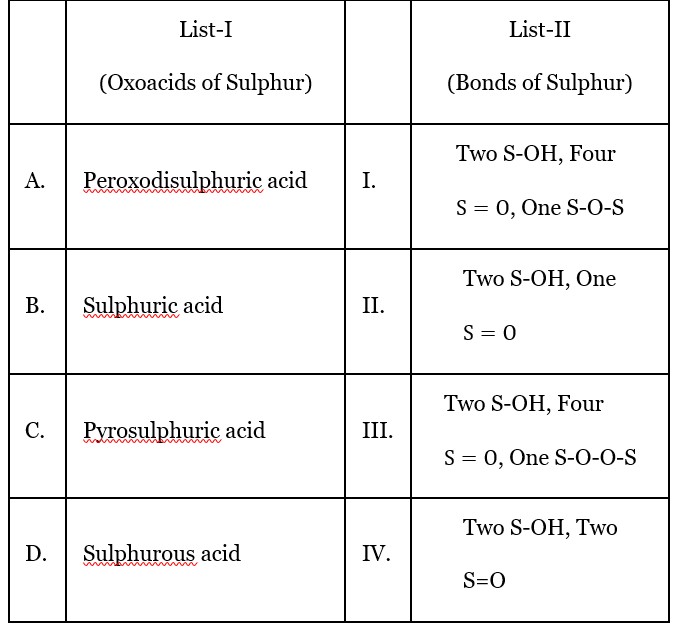
<!-- [if !supportLineBreakNewLine]--><!--[endif]-->Choose the correct answer from the options given below :
Match List-I with List-II:
<!-- [if !supportLineBreakNewLine]--><!--[endif]-->Choose the correct answer from the options given below :
H? S? O? , peroxodisulphuric acid (Two S-OH, Four S = O, One S – O – O – S )
H? SO? , sulphurous acid (Two S-OH, One S = O bond)
H? S? O? , pyrosulphuric acid (Two S-OH, Four S=O, One S-O-S bond)
H? SO? , sulphuric acid (Two S – OH, Two S = O )
Upvote The reaction that does not take place in blast furnace between 900 K to 1500 K in temperature range during extraction of iron is:
<!-- [if !supportLineBreakNewLine]-->
<!--[endif]-->
The reaction that does not take place in blast furnace between 900 K to 1500 K in temperature range during extraction of iron is:
<!-- [if !supportLineBreakNewLine]-->
<!--[endif]-->
Fe? O? + CO → 2FeO + CO?
The above reaction takes place at 500 – 800 K in blast furnace.
Upvote