
Ncert Solutions Chemistry Class 12th
Get insights from 2.6k questions on Ncert Solutions Chemistry Class 12th, answered by students, alumni, and experts. You may also ask and answer any question you like about Ncert Solutions Chemistry Class 12th
- 2.6k
Questions
- 0
Discussions
- 0
Active Users
- 79
Followers
Have a question about Ncert Solutions Chemistry Class 12th? Ask our experts
Keep it short & simple. Type complete word. Avoid abusive language.
The Kjeldahl's method for the estimation of nitrogen can be used to estimate the amount of nitrogen in which one of the following compounds?
<!-- [if !supportLineBreakNewLine]-->
<!--[endif]-->
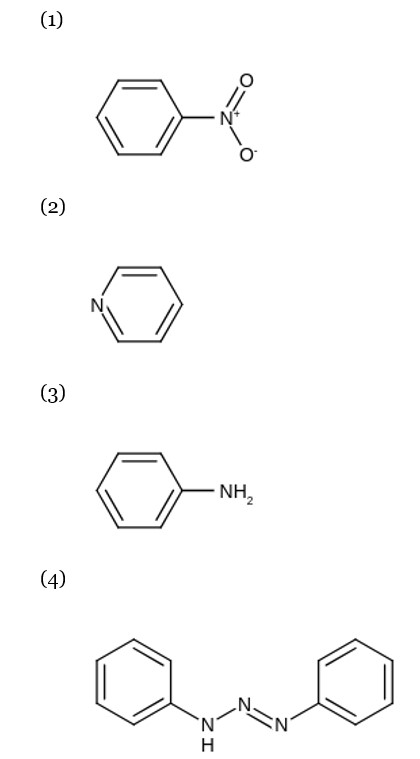
The Kjeldahl's method for the estimation of nitrogen can be used to estimate the amount of nitrogen in which one of the following compounds?
<!-- [if !supportLineBreakNewLine]-->
<!--[endif]-->
Kjeldahl's method does not work for heterocyclic and azo compounds.
 Upvote

The incorrect statement regarding chirality is:
<!-- [if !supportLineBreakNewLine]-->
<!--[endif]-->
The incorrect statement regarding chirality is:
<!-- [if !supportLineBreakNewLine]-->
<!--[endif]-->
A racemic mixture shows zero optical rotation.
Upvote Given below are two statements:
Statement I:
In the coagulation of a negative sol, the flocculating power of the three given ions is in the order- Al³⁺ > Ba²⁺ > Na⁺
Statement II:
In the coagulation of a positive sol, the flocculating power of the three given salts is in the order NaCl > Na₂SO₄ > Na₃PO₄
In the light of the above statements, choose the most appropriate answer from the options given below:
Given below are two statements:
Statement I:
In the coagulation of a negative sol, the flocculating power of the three given ions is in the order- Al³⁺ > Ba²⁺ > Na⁺
Statement II:
In the coagulation of a positive sol, the flocculating power of the three given salts is in the order NaCl > Na₂SO₄ > Na₃PO₄
In the light of the above statements, choose the most appropriate answer from the options given below:
For the coagulation of a negative sol flocculating power is
Al³? > Ba²? > Na?
But for coagulating a positive sol the flocculating power will be
PO? ³? > SO? ²? > Cl?
Upvote Given below are two statements:
Statement I:
Primary aliphatic amines react with HNO₂ to give unstable diazonium salts.
Statement II:
Primary aromatic amines react with HNO₂ to form diazonium salts which are stable even above 300 K.
In the light of the above statements, choose the most appropriate answer from the options given below:
Given below are two statements:
Statement I:
Primary aliphatic amines react with HNO₂ to give unstable diazonium salts.
Statement II:
Primary aromatic amines react with HNO₂ to form diazonium salts which are stable even above 300 K.
In the light of the above statements, choose the most appropriate answer from the options given below:
Aliphatic diazonium salts are not stable. Aromatic diazonium salts exist at low temp of 0 – 4°C.
Upvote Match List -I with List -II.
List -I
(Drug class)
(a) Antacids
(b) Antihistamines
(c) Analgesics
(d) Antimicrobials
List-II
(Drug molecule)
(i) Salvarsan
(ii) Morphine
(iii) Cimetidine
(iv) Seldane
Choose the correct answer from the options given below:
Match List -I with List -II.
List -I
(Drug class)
(a) Antacids
(b) Antihistamines
(c) Analgesics
(d) Antimicrobials
List-II
(Drug molecule)
(i) Salvarsan
(ii) Morphine
(iii) Cimetidine
(iv) Seldane
Choose the correct answer from the options given below:
Cimetidine is an antacid. Seldane is an antihistaminic drug.
Upvote Given below are two statements:
Statement I:
The boiling points of aldehydes and ketones are higher than hydrocarbons of comparable molecular masses because of weak molecular association in aldehydes and ketones due to dipole-dipole interactions.
Statement II:
The boiling points of aldehydes and ketones are lower than the alcohols of similar molecular masses due to the absence of H-bonding.
In the light of the above statements, choose the most appropriate answer from the options given below:
<!-- [if !supportLineBreakNewLine]-->
<!--[endif]-->
Given below are two statements:
Statement I:
The boiling points of aldehydes and ketones are higher than hydrocarbons of comparable molecular masses because of weak molecular association in aldehydes and ketones due to dipole-dipole interactions.
Statement II:
The boiling points of aldehydes and ketones are lower than the alcohols of similar molecular masses due to the absence of H-bonding.
In the light of the above statements, choose the most appropriate answer from the options given below:
<!-- [if !supportLineBreakNewLine]-->
<!--[endif]-->
As compared to hydrocarbons of similar mass aldehydes and ketones will have greater dipole-dipole interactions.
Upvote Given below are two statements: one is labelled as Assertion (A) and the other is labelled as Reason (R).
Assertion (A): In a particular point defect, an ionic solid is electrically neutral, even if few of its cations are missing from it unit cells.
Reason (R): In an ionic solid, Frenkel defect arises due to dislocation of cation from its lattice site to interstitial site, maintaining overall electrical neutrality.
In the light of the above statements, choose the most appropriate answer from the options given below:
<!-- [if !supportLineBreakNewLine]-->
<!--[endif]-->
Given below are two statements: one is labelled as Assertion (A) and the other is labelled as Reason (R).
Assertion (A): In a particular point defect, an ionic solid is electrically neutral, even if few of its cations are missing from it unit cells.
Reason (R): In an ionic solid, Frenkel defect arises due to dislocation of cation from its lattice site to interstitial site, maintaining overall electrical neutrality.
In the light of the above statements, choose the most appropriate answer from the options given below:
<!-- [if !supportLineBreakNewLine]-->
<!--[endif]-->
Both statements are correct independently but the reason is not the correct reason of the assertion.
Upvote Given below are two statements: one is labelled as Assertion (A) and the other is labelled as Reason (R).
Assertion (A): ICl is more reactive than I?.
Reason (R): I-Cl bond is weaker than I-I bond.
In the light of the above statements, choose the most appropriate answer from the options given below:
<!-- [if !supportLineBreakNewLine]-->
<!--[endif]-->
Given below are two statements: one is labelled as Assertion (A) and the other is labelled as Reason (R).
Assertion (A): ICl is more reactive than I?.
Reason (R): I-Cl bond is weaker than I-I bond.
In the light of the above statements, choose the most appropriate answer from the options given below:
<!-- [if !supportLineBreakNewLine]-->
<!--[endif]-->
I - Cl bond is stronger than I-I bond due to additional electrostatic force between I and Cl.
Upvote When light of wavelength 248 nm falls on a metal of threshold energy 3.0eV, the de-Broglie wavelength of emitted electrons is__________ Angstrom.
When light of wavelength 248 nm falls on a metal of threshold energy 3.0eV, the de-Broglie wavelength of emitted electrons is__________ Angstrom.
K.E = φ - φ?
φ? = 3 eV = 3 × 1.6 × 10? ¹? J = 4.8 × 10? ¹? J
φ = hc/λ = (6.63 × 10? ³? × 3 × 10? ) / (248 × 10? ) J = 8 × 10? ¹? J
K.E = 8 × 10? ¹? - 4.8 × 10? ¹? = 3.2 × 10? ¹? J
Now using, λ = h / √ (2 K.E m)
λ = (6.63 × 10? ³? ) / √ (2 × 3.2 × 10? ¹? × 9.1 × 10? ³¹) m
λ = (6.63 × 10? ³? ) / (7.63 × 10
Upvote AB2 is 10% dissociated in water to A2+ and B-. The boiling point of a 10.0 molal aqueous solution of AB2 is_________ °C. (Round off to the nearest Integer).
[Given : Molal elevation constant of water Kb = 0.5 K kg mol-1, boiling point of pure water = 100°C]
AB2 is 10% dissociated in water to A2+ and B-. The boiling point of a 10.0 molal aqueous solution of AB2 is_________ °C. (Round off to the nearest Integer).
[Given : Molal elevation constant of water Kb = 0.5 K kg mol-1, boiling point of pure water = 100°C]
m = 10 molal
K_b = 0.5 K kg mol? ¹
Using: ΔT_b = I K_b m
and α = (i - 1) / (n - 1)
n for AB? is 3; α = 0.1
0.1 = (i - 1) / (3 - 1) ⇒ I = 1.2
ΔT_b = 1.2 × 0.5 × 10 = 6 °C
So, boiling point of solution = 100 + 6 = 106 °C
Upvote