
Ncert Solutions Chemistry Class 12th
Get insights from 2.6k questions on Ncert Solutions Chemistry Class 12th, answered by students, alumni, and experts. You may also ask and answer any question you like about Ncert Solutions Chemistry Class 12th
- 2.6k
Questions
- 0
Discussions
- 0
Active Users
- 79
Followers
Have a question about Ncert Solutions Chemistry Class 12th? Ask our experts
Keep it short & simple. Type complete word. Avoid abusive language.
Match List - I with List - II
<!-- [if !supportLineBreakNewLine]-->
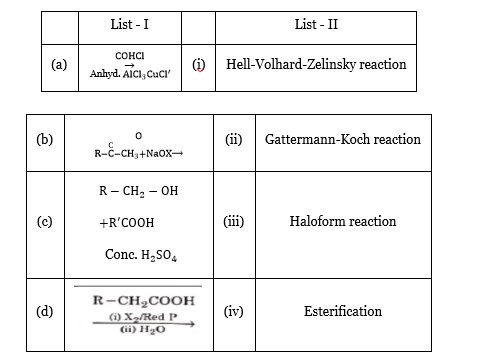
Choose the correct answer from the options given below.
<!--[endif]-->
Match List - I with List - II
<!-- [if !supportLineBreakNewLine]-->
Choose the correct answer from the options given below.
<!--[endif]-->
(a) List-I List-II
CO, HCl Anhydrous AlCl? /CuCl → (ii) Gattermann-Koch reaction
(b) R – C=O .
(c) R – CH? OH + R'COOH - (conc. H? SO? )-> (iv) Esterification
(d) R – CH? COOH - ( (i) X? /RedP (ii) H? O )-> (i) Hell-Volhard Zelinsky reaction
 Upvote

CH₃CH₂COO⁻Na⁺ --NaOH,+? Heat--> CH₃CH₃ + Na₂CO₃
Consider the above reaction and identify the missing reagent/chemical.
CH₃CH₂COO⁻Na⁺ --NaOH,+? Heat--> CH₃CH₃ + Na₂CO₃
Consider the above reaction and identify the missing reagent/chemical.
CH? – CH? – COO? Na? - (NaOH, CaO, Heat)-> CH? – CH? + Na? CO?
Decarboxylation takes place by soda-lime (NaOH + CaO)
Upvote The incorrect statement among the following is :
<!-- [if !supportLineBreakNewLine]-->
<!--[endif]-->
The incorrect statement among the following is :
<!-- [if !supportLineBreakNewLine]-->
<!--[endif]-->
Most of the trivalent lanthanoid ions are coloured in the solid state.
Upvote Which one of the following polymers is prepared by addition polymerization?
<!-- [if !supportLineBreakNewLine]-->
<!--[endif]-->
Which one of the following polymers is prepared by addition polymerization?
<!-- [if !supportLineBreakNewLine]-->
<!--[endif]-->
Teflon are prepared by addition polymerization from tetrafluroethene.
CF? = CF? - (catalyst, High pressure)-> [–CF? – CF? –]? Teflon
Nylon-66, Novolac, Dacron are prepared by condensation polymerisation.
Upvote The pKa of dimethylamine and pKa of acetic acid are 3.27 and 4.77 respectively at T(K). The correct option for the pH of dimethylammonium acetate solution is :
<!-- [if !supportLineBreakNewLine]-->
<!--[endif]-->
The pKa of dimethylamine and pKa of acetic acid are 3.27 and 4.77 respectively at T(K). The correct option for the pH of dimethylammonium acetate solution is :
<!-- [if !supportLineBreakNewLine]-->
<!--[endif]-->
Dimethylammonium acetate is a weak acid & weak base type of salt.
pH = 7 + ½ pK? – ½ pK?
= 7 + ½ × 4.77 – ½ × 3.27
= 7.75
Upvote An organic compound contains 78% (b wt.) carbon and remaining percentage of hydrogen. The right option for the empirical formula of this compound is : [Atomic wt. of C is 12, H is 1]
<!-- [if !supportLineBreakNewLine]-->
<!--[endif]-->
An organic compound contains 78% (b wt.) carbon and remaining percentage of hydrogen. The right option for the empirical formula of this compound is : [Atomic wt. of C is 12, H is 1]
<!-- [if !supportLineBreakNewLine]-->
<!--[endif]-->
Element % At. Weight (% / At.weight) the simplest ratio
C 78 12 6.5 1
H 22 1 22 ≈ 3
Upvote Given below are two statements :
Statement I : Aspirin and Paracetamol belong to the class of narcotic analgesics.
Statement II : Morphine and Heroin are non-narcotic analgesics.
In the right of the above statements, choose the correct answer from the options given below.
<!-- [if !supportLineBreakNewLine]-->
<!--[endif]-->
Given below are two statements :
Statement I : Aspirin and Paracetamol belong to the class of narcotic analgesics.
Statement II : Morphine and Heroin are non-narcotic analgesics.
In the right of the above statements, choose the correct answer from the options given below.
<!-- [if !supportLineBreakNewLine]-->
<!--[endif]-->
Aspirin and paracetamol belongs to the class of non-narcotic analgesic.
Morphine and heroin are narcotic analgesics.
Upvote The major product of the following chemical reaction is :
CH₃CH(CH₃)CH=CH₂ + HBr --(C₆H₅CO)₂O₂--> ?
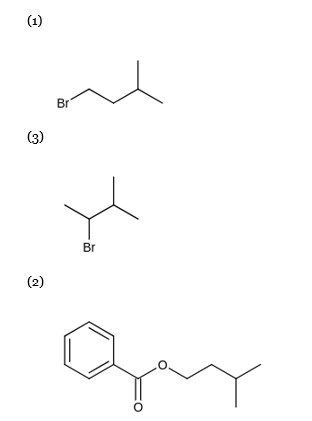
The major product of the following chemical reaction is :
CH₃CH(CH₃)CH=CH₂ + HBr --(C₆H₅CO)₂O₂--> ?
In the presence of peroxide, addition of HBr to unsymmetrical alkenes take place by anti-Markovnikov's rule/Peroxide effect/Kharash effect.
Upvote The following solutions were prepared by dissolving 10 g of glucose (C₆H₁₂O₆) in 250ml of water (P₁), 10 g of urea (CH₄N₂O) in 250ml of water (P₂) and 10 g of sucrose (C₁₂H₂₂O₁₁) in 250ml of water (P₃). The right option for the decreasing order of osmotic pressure of these solutions is :
The following solutions were prepared by dissolving 10 g of glucose (C₆H₁₂O₆) in 250ml of water (P₁), 10 g of urea (CH₄N₂O) in 250ml of water (P₂) and 10 g of sucrose (C₁₂H₂₂O₁₁) in 250ml of water (P₃). The right option for the decreasing order of osmotic pressure of these solutions is :
π = iCRT
P? = 1 × (10/180) × R × T (For Glucose)
P? = 1 × (10/60) × R × T (For Urea)
P? = 1 × (10/342) × R × T (For Sucrose)
∴ P? > P? > P?
Upvote Identify the compound that will react with Hingsberg's reagent to give a solid which dissolves in alkali.
<!-- [if !supportLineBreakNewLine]--><!--[endif]-->
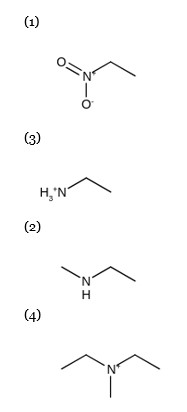
Identify the compound that will react with Hingsberg's reagent to give a solid which dissolves in alkali.
<!-- [if !supportLineBreakNewLine]--><!--[endif]-->
10amines react with Hingsberg's reagent to give a solid, which dissolve in alkali.
Upvote