Physics

Get insights from 5.6k questions on Physics, answered by students, alumni, and experts. You may also ask and answer any question you like about Physics

Follow Ask Question
5.6k

Questions

0

Discussions

24

Active Users

0

Followers

New answer posted

a year ago

0 Follower 6 Views

A
alok kumar singh

Contributor-Level 10

Using conversation of momentum in direction perpendicular to the original direction of motion,

mv1 sin 30° = mv2 sin 30°
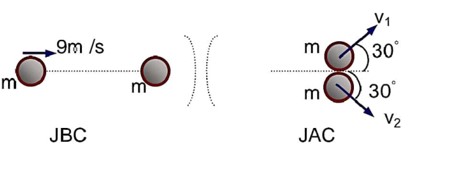
⇒ v 1 v 2 = 1


New answer posted

a year ago

0 Follower 2 Views

A
alok kumar singh

Contributor-Level 10

Quality factor = ω L R = 2 * 3 . 1 4 * 1 0 * 1 0 6 * 2 * 1 0 − 4 6 . 2 8 = 2 0 0 0

New answer posted

a year ago

0 Follower 3 Views

A
alok kumar singh

Contributor-Level 10

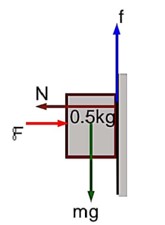
f = W = 0.5 * 10 = 5 N

N = F

For block not to slide,

  f ≤ μ N            

⇒ 5 ≤ 0 . 2 F ⇒ F ≥ 2 5 N


New answer posted

a year ago

0 Follower 5 Views

A
alok kumar singh

Contributor-Level 10

Ratio of masses on two pistons of the hydraulic lift equals to that of their cross- section area.

A 1 A 2 = 1 0 0 m            

Now,   4 2 A 1 A 2 / 4 2 = M m ⇒ M = 2 5 6 A 1 A 2 . m = 2 5 6 0 0 k g .  

New answer posted

a year ago

0 Follower 2 Views

A
alok kumar singh

Contributor-Level 10

Percentage Modulation =   A m A c * 1 0 0 = 2 0 8 0 * 1 0 0 = 2 5 %

New answer posted

a year ago

0 Follower 12 Views

A
alok kumar singh

Contributor-Level 10

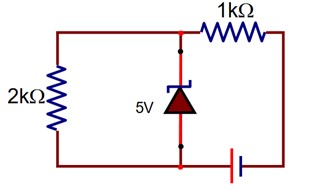
Potential difference across 2k Ω  is 5V, thus current through it,

i = 5 2 * 1 0 3 = 2 5 * 1 0 − 4 A .           

New answer posted

a year ago

0 Follower 3 Views

A
alok kumar singh

Contributor-Level 10

Amplitude is proportional to the slit – width, thus,

A 1 A 2 = 3

l m a x l m i n = ( A 1 + A 2 ) 2 ( A 1 − A 2 ) 2 = ( A 1 A 2 + 1 ) 2 ( A 1 A 2 − 1 ) 2 = ( 3 + 1 ) 2 ( 3 − 1 ) 2 = 4 .

New answer posted

a year ago

0 Follower 3 Views

A
alok kumar singh

Contributor-Level 10

If   μ is Poisson's ratio,

Y = 3K (1 - 2  μ )      ……… (1)

and Y = 2  n ( 1 + μ ) ……… (2)

With the help of equations (1) and (2), we can write

3 Y = 1 η + 1 3 k ⇒ K = η Y 9 η − 3 Y            

New answer posted

a year ago

0 Follower 7 Views

R
Raj Pandey

Contributor-Level 9

F → = 1 0 i ^ + 5 j ^

a → = 1 0 m i ^ + 5 m j ^

= 1 0 0 . 1 k g i ^ + 5 0 . 1 j ^

a → = 1 0 0 i ^ + 5 0 j ^

a x = 1 0 0 , a y = 5 0

S x = u t + 1 2 a t 2

= 0 * 2 + 1 2 * 1 0 0 * 2 * 2

Sx = 200 m

a b = 2 0 0 1 0 0 = 2

New answer posted

a year ago

0 Follower 6 Views

P
Pallavi Pathak

Contributor-Level 10

There are three main processes Isothermal, adiabatic and cyclic process. In isothermal, the system is thermally conductive and the temperature remains constant. In adiabatic process, the system is thermally isolated and there is no change in heat temperature. The system returns to its initial stage in the cyclic process.

Get authentic answers from experts, students and alumni that you won't find anywhere else

Sign Up on Shiksha

On Shiksha, get access to

  • 67k Colleges
  • 1.2k Exams
  • 718k Reviews
  • 1850k Answers

Share Your College Life Experience

×
×

This website uses Cookies and related technologies for the site to function correctly and securely, improve & personalise your browsing experience, analyse traffic, and support our marketing efforts and serve the Core Purpose. By continuing to browse the site, you agree to Privacy Policy and Cookie Policy.