

Physics
Get insights from 5.6k questions on Physics, answered by students, alumni, and experts. You may also ask and answer any question you like about Physics
Follow Ask QuestionQuestions
Discussions
Active Users
Followers
New answer posted
a year agoContributor-Level 10
Let the origin be at the CM of the particles, let the initial positions of the particles be x = a/2 and x = -a/2 and let the instantaneous positions of the particles be x = r and x = -r
Let the instantaneous velocity of each particle be v
Let the time after which the distance between the particles has reduced to a/2 be T
Then, for the particle that was initially at x = -a/2,
(Gm²/ (2r)²) = -m (vdv/dr) ⇒ (Gm/r²) = - (4vdv/dr) ⇒ -4∫vdv = Gm∫ (dr/r²)
[v is negative because the velocity is towards the –X direction]
dr/dt = -√ (Gm/2) (1/r - 2/a)¹? ²
⇒ ∫ (a/2)^ (a/4) (r/√ (a-2r)dr = -√ (Gm/2a) ∫? dt
⇒ ∫ (a/2)^ (a/4
New answer posted
a year agoContributor-Level 10
For permanent magnetic Y is good choice, As it has very high coercivity (comparitively)
New answer posted
a year ago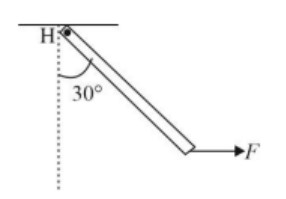
Contributor-Level 10
Taking torque at top pt, mg sin30°*L / 2 = F cos30°*L ⇒ F = mg / 2√3
New answer posted
a year ago
New answer posted
a year agoContributor-Level 10
The time spent in magnetic field (t) is independent of velocity of charge.
t = (1/4) (2πm/qB)
New answer posted
a year agoContributor-Level 10
At minima, I = (√I? - √25I? )² = 16I?
At maxima, I = (√I? + √25I? )² = 36I?
∴ Ratio = 16/36 = 4/9
New answer posted
a year agoContributor-Level 10
Time taken by trains to collide = 300/150 = 2hrs
Speed of bird = 200 km/hr
Total distance travelled by bird = 200 * 2 = 400 km
Taking an Exam? Selecting a College?
Get authentic answers from experts, students and alumni that you won't find anywhere else
Sign Up on ShikshaOn Shiksha, get access to
- 67k Colleges
- 1.2k Exams
- 718k Reviews
- 1850k Answers