

Physics
Get insights from 5.6k questions on Physics, answered by students, alumni, and experts. You may also ask and answer any question you like about Physics
Follow Ask QuestionQuestions
Discussions
Active Users
Followers
New answer posted
a year agoContributor-Level 10
M = φ? /I? = (B? A? )/I? = [ (μ? I? /2R? )πR? ²]/I?
[Diagram of two concentric coils]
M = (μ? πR? ²)/ (2R? )
M ∝ R? ²/R?
New answer posted
a year ago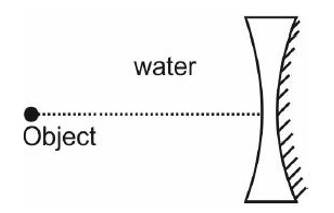
Contributor-Level 10
1/f_lens = (1.5/ (4/3) - 1) ( - 2/15) = f_lens = -60cm
∴ 1/fe = 2/ (-60) + 2/ (-15) => fe = -6 cm
∴ V = (14 * (-6)/ (14 + 6) = 4.2 cm from lens (virtual)
New answer posted
a year agoContributor-Level 10
Velocity just before striking the ground
v? = √2gh
v? = √ (2*10*10) = 10√2 m/s
v? = -10√2?
If it reaches the same height, speed remains same after collision only the direction changes.
v? = 10√2 m/s
v? = 10√2?
|Impulse| = m|Δv|
= m|10√2? - (-10√2? )|
= 0.15 [2 (10√2)]
= 3√2 kg m/s
= 4.2 kg m/s
New answer posted
a year ago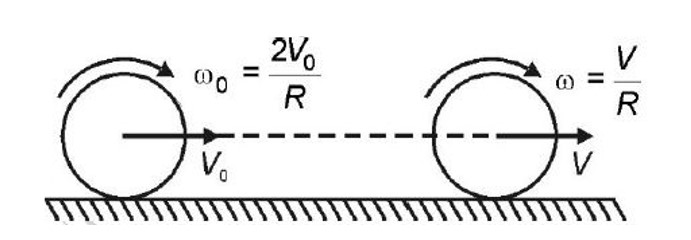
Contributor-Level 10
a = fr/m
∴ V = V? + at? = V? + (fr/m)t?
and α = 2Rfr/mR² = 2fr/mR
∴ ω = ω? - (2fr/mR)t?
∴ V = ωR ∴ v? + (fr/m)t? = ω? R - (2fr/m)t?
= (3fr/m)t? = V? = (fr/m)et?
∴ V = V? + V? /3 = 4V? /3
t? = mV? / (3μmg)
= V? /3μg
New answer posted
a year agoContributor-Level 10
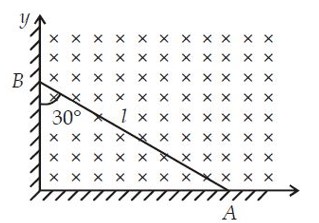
h = R / [ (2gR/V? ²) - 1] = R / [ (V²/K²V? ²) ] = KK² / (1 - K²)
New answer posted
a year agoContributor-Level 10
velocity of car at t = 4sec is
v = u + at
v = 0 + 5 (4)
= 20 m/s
At t = 6sec
acceleration is due to gravity ∴ a = g = 10 m/s
v? = 20 m/s (due to car)
v? = u + at
= 0 + g (2) (downward)
= 20 m/s (downward)
v = √ (v? ² + v? ²)
= √ (20² + 20²)
= 20√2 m/s
New answer posted
a year agoContributor-Level 10
i = (V? /R) (1 - e? /? )
U = ½Li²
dU/dt = Li (di/dt)
(R/2L) * (V? ²/R²) (1 - e? /? )²e? /? = (V? ²/R) (1 - e? /? )
t = (L/R)ln2
New answer posted
a year agoContributor-Level 10
(4/3)πR³ = 27 (4/3)πr³) ⇒ R = 3r (i)
v = Kq/r = V? /r = (q? /q? ) (r? /r? ) (i)
⇒ 220/V? = (q/ (27q) (3r/r) (i)
⇒ 220/V? = 1/9 (i)
⇒ V? = 220 * 9 = 1980 volt (i)
New answer posted
a year ago
Taking an Exam? Selecting a College?
Get authentic answers from experts, students and alumni that you won't find anywhere else
Sign Up on ShikshaOn Shiksha, get access to
- 67k Colleges
- 1.2k Exams
- 718k Reviews
- 1850k Answers