

Physics
Get insights from 5.6k questions on Physics, answered by students, alumni, and experts. You may also ask and answer any question you like about Physics
Follow Ask QuestionQuestions
Discussions
Active Users
Followers
New answer posted
a year agoContributor-Level 9
We know, μ? = 1 + χ?
B? ∝ μ?
B ∝ μ
(ΔB/B? ) = (B-B? )/B? = (μ-μ? )/μ? = μ/μ? - 1 = μ? - 1 = χ?
% (ΔB/B) = χ? * 100 = 2.2 * 10? * 100 = 22/10?
(Note: The value for χ? in the source image appears to have a typo as 2.2 * 10? , it has been corrected to 2.2 * 10? to match the final answer.)
New answer posted
a year ago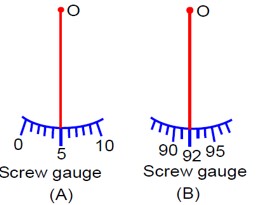
Contributor-Level 9
Difference in Reading = Positive Zero Error - Negative Zero Error
= (+5) - [- (100-92)]
= 5 - [-8]
= 13
New answer posted
a year agoContributor-Level 10
-dT/dt = K [T - Ts]
- (61-59)/4 = K [ (61+59)/2 - 30]
-0.5 = K [60 - 30] = 30K
So, K = -1/60 min? ¹
Again - (51-49)/t = K [ (51+49)/2 - 30]
-2/t = (-1/60) [50-30] = -20/60 = -1/3
t = 6 min
New answer posted
a year agoContributor-Level 10
L = 0.07H and R = 12Ω
Vs = 220V, 50Hz
XL = 2πfL = 2 (22/7) (50) (0.07) = 22Ω
Z = √ (R² + XL²) = √ (12² + 22²) = √ (144+484) = √628 ≈ 25Ω
i = V/Z = 220/25 = 8.8A
tan φ = XL/R = 22/12 = 11/6
φ = tan? ¹ (11/6)
New answer posted
a year agoContributor-Level 9
Given: Power in R_B = 200 W, R_B = 50 Ω, V_source = 200 V
I² R_B = 200
I² (50) = 200
I² = 4 ⇒ I = 2A
Also, I = V_source / (R + R_B)
2 = 200 / (R + 50)
2 (R + 50) = 200
R + 50 = 100
R = 50Ω
New answer posted
a year agoContributor-Level 9
From conservation of momentum:
2*4 = 2v? + mv?
Given v? = 1 m/s (interpreted from intermediate steps)
8 = 2 (1) + mv?
mv? = 6 . (i)
From coefficient of restitution (e=1 for elastic collision):
e = (v? - v? )/ (u? - u? )
1 = (v? - v? )/ (4 - 0)
-1 = (v? - v? )/ (0 - 4) (as written in the image)
⇒ 4 = v? - 1
⇒ v? = 5 . (ii)
Put (2) in (1), m (5) = 6
m = 1.2kg
New answer posted
a year agoContributor-Level 10
E = ½mω²a² . (i)
When KE = 3E/4, PE = E - KE = E/4
E/4 = ½mω²y² . (ii)
Divide eq? (i) by eq? (ii) we get
4 = a²/y² => y = a/2
New answer posted
a year agoContributor-Level 10
h = u²/2g, u = √2gh
Now, S = h/3
S = ut + ½at²
h/3 = √2ght - ½gt²
t² - 2√ (2h/g)t + 2h/3g = 0
Using quadratic formula for t:
t = ( 2√ (2h/g) ± √ (8h/g) - 4 (2h/3g) / 2
t = √ (2h/g) ± √ (2h/g - 2h/3g) = √ (2h/g) ± √ (4h/3g)
t? /t? = (√ (2h/g) - √ (4h/3g) / (√ (2h/g) + √ (4h/3g)
t? /t? = (√2 - √ (4/3) / (√2 + √ (4/3) = (√6 - 2)/ (√6 + 2)
(Note: There is a calculation error in the provided solution. Re-evaluating the physics.)
h/3 = (√2gh)t - ½gt²
(g/2)t² - (√2gh)t + h/3 = 0
t = (√2gh ± √ (2gh - 4 (g/2) (h/3)/g = (√2gh ± √ (4gh/3)/g
t? /t? = (√2gh - 2√gh/√3)/ (√2gh + 2√gh/√3)
New answer posted
a year agoContributor-Level 9
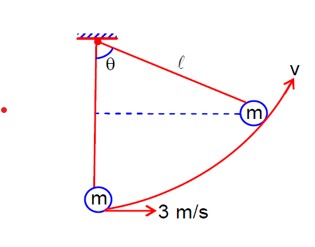
(1/2)mu² = (1/2)mv² + mgl (1-cosθ)
⇒ v² = u² - 2gl (1-cosθ)
⇒ v² = 3² - 2*10*0.5* (1 - 1/2)
⇒ v² = 9 - 5 = 4
v = 2m/s
New answer posted
a year agoContributor-Level 9
I = I? e? /?
= (20/10000) e^- (1*10? / 10*10? ³)
= 2 * 10? ³ e? ¹
The provided solution calculates as:
= 2 * 10? ³ e? ¹
= 2e? ¹ mA
= 2 * 0.37mA
= 0.74 mA = 74/100 mA
(Note: There seems to be a calculation discrepancy in the source image, the steps shown lead to I = 2e? ¹ mA)
Taking an Exam? Selecting a College?
Get authentic answers from experts, students and alumni that you won't find anywhere else
Sign Up on ShikshaOn Shiksha, get access to
- 67k Colleges
- 1.2k Exams
- 718k Reviews
- 1850k Answers