

Physics
Get insights from 5.6k questions on Physics, answered by students, alumni, and experts. You may also ask and answer any question you like about Physics
Follow Ask QuestionQuestions
Discussions
Active Users
Followers
New answer posted
a year agoContributor-Level 10
Polygon law is applicable in both the situation given but the equation given in the reason is not useful in explaining the assertion.
New answer posted
a year agoContributor-Level 10
v = 1/√με = 1/√ (µ? µ? ε? ε? ) = c/√ (µ? ε? )
v = 3*10? / √ (1*81)
v = 3*10? / 9 m/s
= 0.33 * 10? m/s
= 3.33 * 10? m/s
New answer posted
a year ago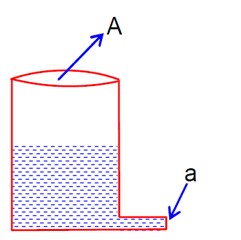
Contributor-Level 10
v = √2gh velocity of efflux.
F = v ( dm/dt ) = v (aρv) = aρv² = 2aρgh
fr = µR = µAhρg
For just sliding, for = F
µAhρg = 2aρgh
or µ = 2a/A
New answer posted
a year ago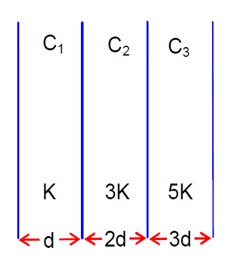
Contributor-Level 10
1/Ceq = 1/C? + 1/C? + 1/C?
1/Ceq = 1/ (K Aε? /d) + 1/ (3K Aε? /2d) + 1/ (5K Aε? /3d)
1/Ceq = d/ (K Aε? ) + 2d/ (3K Aε? ) + 3d/ (5K Aε? )
1/Ceq = (d/K Aε? ) * (1 + 2/3 + 3/5)
1/Ceq = (d/K Aε? ) * (15+10+9)/15) = 34d / (15K Aε? )
Ceq = 15K Aε? / 34d
New answer posted
a year ago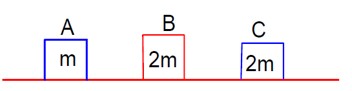
Contributor-Level 10
Let vel of A and B just after collision be VA & VB respectively.
m * 9 + 0 = m * VA + 2mVB
9 = VA + 2VB
again e = (VB - VA)/ (9-0) = 1
9 = VB - VA
From (i) & (ii)
VB = 6 m/s & VA = -3 m/s
Now, for B and C collision (completely inelastic):
2m * 6 + 0 = (2m + 2m)Vc
12m = 4mVc
Vc = 3 m/s
New answer posted
a year agoContributor-Level 9
t? /? = 3 days = 72 hours
dN/dt = λN = (ln2/t? /? ) N
= (0.693 * 6.02*10²³ * 2*10? ³) / (72 * 3600 * 198)
= 1.618 * 10¹³
= 16.18 * 10¹² disintegration/second
New answer posted
a year agoContributor-Level 10
V = E (1 - e? /τ)
Where τ = RC = 100 * 10? = 10? sec
50V = 100V (1 - e? /10? )
1/2 = 1 - e? ¹?
1/2 = e? ¹?
-ln2 = -10? t
t = ln2/10?
t = 0.693 * 10? sec
New answer posted
a year agoContributor-Level 9
dC? = (ε? + kx)A / dx [For 0 < x < d/2]
1/C? = ∫ dx / (ε? + kx)A) from 0 to d/2
= (1/Ak) [ln (ε? + kx)] from 0 to d/2
= (1/kA) ln (1 + kd/ (2ε? )
C? = kA / ln (1 + kd/ (2ε? )
Similarly dC? = (ε? + k (d-x)A / dx [For d/2 ≤ x ≤ d]
C? = kA / ln (1 + kd/ (2ε? )
Clearly, C? = C? = C
For series combination:
C_eq = C? / (C? + C? ) = C/2 = kA / (2ln (2ε? + kd)/2ε? )
New answer posted
a year ago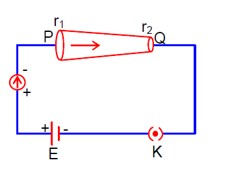
Contributor-Level 10
i = constant
v ∝ E & E ∝ 1/r² So, E increases with decrease in the radius.
also v ∝ E
So, drift speed increases.
Taking an Exam? Selecting a College?
Get authentic answers from experts, students and alumni that you won't find anywhere else
Sign Up on ShikshaOn Shiksha, get access to
- 67k Colleges
- 1.2k Exams
- 718k Reviews
- 1850k Answers