

Physics
Get insights from 5.6k questions on Physics, answered by students, alumni, and experts. You may also ask and answer any question you like about Physics
Follow Ask QuestionQuestions
Discussions
Active Users
Followers
New answer posted
a year agoContributor-Level 10
β = λD/d or β ∝ λ
Also, we know that λ_blue < _orange
So, β_orange > β_blue
So, dist b/w consecutive fringes will decrease.
New answer posted
a year agoContributor-Level 9
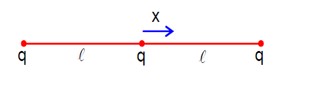
F_net = -kq²/ (l+x)² + kq²/ (l-x)²
= kq² [ (l+x)² - (l-x)² / (l²-x²)² ]
= kq² [ 4lx / (l²-x²)² ]
For x << l,
ma ≈ -4kq²x / l³
a = - (4kq²/ml³)x
ω² = 4kq²/ml³
ω = √ (4kq²/ml³)
= √ (4 * 9*10? * 10 / (1*10? * 1)
= 6 * 10? rad/s
= 6000 * 10? rad/s
New answer posted
a year agoContributor-Level 10
As charge remains same. So,
Initial total charge Q = (2C)V + CV = 3CV
When dielectric is inserted in C, its new capacitance is KC.
The capacitors 2C and KC are in parallel.
Equivalent capacitance C_eq = 2C + KC = (K+2)C
New potential Vc = Q/C_eq = 3CV/ (K+2)C) = 3V/ (K+2)
New answer posted
a year ago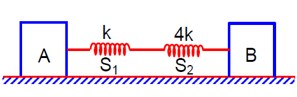
Contributor-Level 9
ω = √k_eq/μ [μ = (m? )/ (m? +m? ) (Reduced mass)]
k_eq = (k * 4k)/ (k+4k) = 4k/5
ω = √ (4k/5) / (m? / (m? +m? )
= √ (4*20/5) / (0.2*0.8)/ (0.2+0.8)
= √ (16/0.16)
= 10 rad/s
New answer posted
a year agoContributor-Level 10
Least count = Pitch / (Total divisions on circular scale)
In 5 revolution, distance travelled = 5mm
? In 1 revolution, distance travelled = 1mm
So least count = 1/50 = 0.02mm = 0.002 cm
So, Assertion is not correct but reason is correct
New answer posted
a year agoContributor-Level 9
r? = 10αt²î + 5β (t-5)?
v? = dr? /dt = 20αtî + 5β?
As L? = m (r? * v? )
So, at t=0, L=0
given L is same at t=t as at t=0
⇒ r? * v? = 0
⇒ (10αt²î + 5β (t-5)? ) * (20αtî + 5β? ) = 0
⇒ 50αβt² (î*? ) + 100αβt (t-5) (? *î) = 0
⇒ 50αβt² k? - 100αβt (t-5) k? = 0
⇒ 50t² - 100t (t-5) = 0
⇒ 50t² - 100t² + 500t = 0
⇒ -50t² + 500t = 0
⇒ 50t (10 - t) = 0
⇒ t = 10 second
New answer posted
a year ago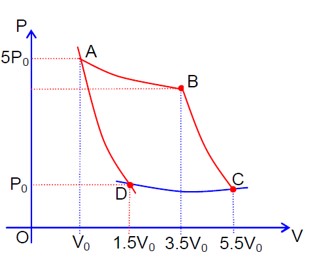
Contributor-Level 10
A→B & D→C (isothermal process)
So, TA = TB & TD = TC. Now B→C & D→A (adiabatic process)
|WBC| = nR/ (γ-1) (TB - TC)
|WAD| = nR/ (γ-1) (TA - TD) = nR/ (γ-1) (TB - TC)
∴ |WBC| = |WAD|
New answer posted
a year agoContributor-Level 10
1 litre, T = 300K, P = 2 atm, KE = 2*10? J/molecule, no of molecule =?
No. of molecules = (no of moles) * NA = nNA
Also, n = PV/RT = PV/ (NAkT)
KE = (3/2)kT = 2*10? J [Given]
kT = (4/3)*10?
P = 2 atm = 2 * 1.013 * 10? N/m²
vol = 1 lit = 10? ³ m³
No. of molecules = PV/kT = (2*1.013*10? * 10? ³)/ (4/3)*10? ) ≈ 1.5 * 10¹¹
New answer posted
a year ago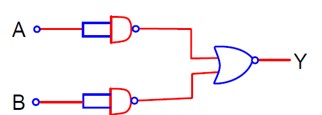
Contributor-Level 9
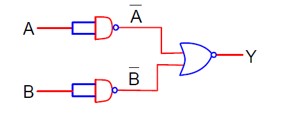
The circuit shown is an or GATE implemented using NAND gates.
Y = A + B
Taking an Exam? Selecting a College?
Get authentic answers from experts, students and alumni that you won't find anywhere else
Sign Up on ShikshaOn Shiksha, get access to
- 67k Colleges
- 1.2k Exams
- 718k Reviews
- 1850k Answers