

Physics
Get insights from 5.6k questions on Physics, answered by students, alumni, and experts. You may also ask and answer any question you like about Physics
Follow Ask QuestionQuestions
Discussions
Active Users
Followers
New answer posted
a year agoContributor-Level 10
This is a Multiple Choice Questions as classified in NCERT Exemplar
Answer – (c)
Explanation – R/S= (l1/100-l1)= 100 (2.9/100-2.9)= 100/97.1=2.98ohm
So he should change S to almost 3 ohm and repeat the experiment.
New answer posted
a year agoContributor-Level 10
This is a long answer type question as classified in NCERT Exemplar
Consider the diagram

let n =number of molecules per unit volume
Vrms= rms speed of gas molecule
When block is moving with speed vo, relative speed of molecules w.r.t front face =v+vo
Coming head on, momentum transferred to block per collision =2m (v+vo)
Number of collisions in time = (v+vo)n A where A is the area of cross section.
So momentum transferred in time =m (v+vo)2nA this is from front surface
Similarly momentum transferred in time = m (v-vo)2nA ) this is from back surface
Drag force = mnA (v+vo)2- (v-vo)2)
= mnA (4wo)=4mnAvvo
= 4 vvo
So =mn/V=M/

New answer posted
a year ago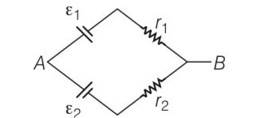
Contributor-Level 10
This is a Multiple Choice Questions as classified in NCERT Exemplar
Answer- (a)
Explanation- eeq=
New answer posted
a year agoContributor-Level 10
This is a Multiple Choice Questions as classified in NCERT Exemplar
Answer- (b)
Explanation- as we know that J=E, and current density is directly proportional to electric field, so electric field produced by charges accumulated on the surface of wire.
New answer posted
a year agoContributor-Level 10
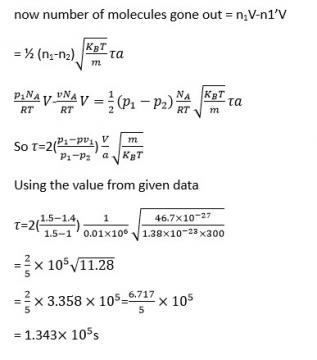
This is a long answer type question as classified in NCERT Exemplar
Given volume V = 1m3
area = 0.01mm2

= 8.01 m2= m2
Temperature both inside and outside are equal
So initial pressure inside the box = 1.50atm
Final pressure inside the box= 0.1atm
Assuming Vx= speed of nitrogen molecule in x direction
ni = number of molecules per unit volume in a time interval of
Let area of the wall, number of particles colliding in time
= i (vx )A , here we use ½ because particle moves both in positive and negative direction.
Vx2+ Vy2+ Vz2= Vrms2
Vx2= Vrms2/3 if all three velocities are equal.
½ mvrms2= 3/2KBT/m

New answer posted
a year agoContributor-Level 10
This is a Short Answer Type Questions as classified in NCERT Exemplar
Explanation- according to ohms law
I=

If voltage and resistance increase
V'= nVeff, R'= nReff
I'= =
New answer posted
a year agoContributor-Level 10
This is a Short Answer Type Questions as classified in NCERT Exemplar
Explanation- R= /A
Resistance of first conductor, RA= 2
Resistance of second conductor, RB=
Now ratio = 3:1
New answer posted
a year agoContributor-Level 10
This is a long answer type question as classified in NCERT Exemplar
Time require to avoid the collision T= l/v where l = mean free path =1/
Where n = N/V
n=number of aeroplanes/volume
= -3
T=
T= =
New answer posted
a year ago
Contributor-Level 10
This is a Short Answer Type Questions as classified in NCERT Exemplar
Explanation- according to ohms law
I=
The potential difference across terminal is
V=e-Ir= E- r1=0
E=
1=
R+r1+r2 = 2r1
R= r1-r2
New answer posted
a year ago
Contributor-Level 10
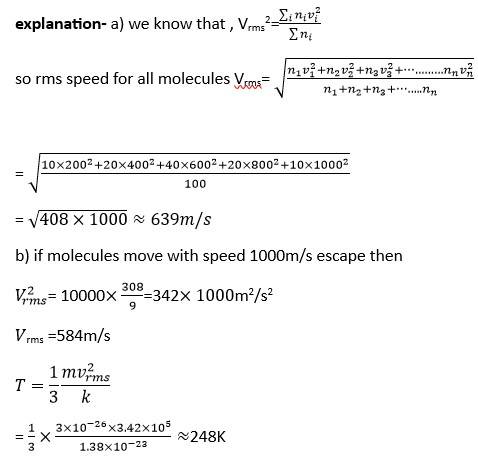
This is a long answer type question as classified in NCERT Exemplar
Taking an Exam? Selecting a College?
Get authentic answers from experts, students and alumni that you won't find anywhere else
Sign Up on ShikshaOn Shiksha, get access to
- 67k Colleges
- 1.2k Exams
- 718k Reviews
- 1850k Answers