

Physics
Get insights from 5.6k questions on Physics, answered by students, alumni, and experts. You may also ask and answer any question you like about Physics
Follow Ask QuestionQuestions
Discussions
Active Users
Followers
New answer posted
a year agoContributor-Level 10
This is a Short Answer Type Questions as classified in NCERT Exemplar
Explanation- when all resistance are in parallel
by multiplying this equation by Rmin we have
But there exist a term in RHS and other terms are positive so we have
>1
This shows that equivalent resistance is less than maximum resistance available.
But when all resistance are in series
Rs =R1+R2………Rn
here must be Rmax value in RHS
Rs= R1+……Rmax+….Rn
And Rs> Rmax
So equivalent resistance is less than Rmax
New answer posted
a year agoContributor-Level 10
This is a long answer type question as classified in NCERT Exemplar
(a) The moon has small gravitational force and hence, the escape velocity is small .
As the moon in the proximity of the earth as seen from the sun, the moonhas the same amount of heat per unit area as that of the earth.
The air molecules have large range of speeds . even though the rms speed of the air molcules is smaller than the escape velocity on the moon, a significant number of molecules have speed grater than the escape velocity.

(b) As the molecules move higher their potential energy increases and hence kinetic energy decreases and hence temperature reduces. At g
New answer posted
a year ago
Contributor-Level 10
This is a Short Answer Type Questions as classified in NCERT Exemplar
Explanation-

total resistance = 2+8= 10 ohm
I= = 0.2A
The direction of flow of current is always from high potential to low potential
If VB VA
VB-4V-0.2 8 = VA
VB-VA= 3.6V
New answer posted
a year agoContributor-Level 10
This is a Short Answer Type Questions as classified in NCERT Exemplar
Explanation – in series combination of resistors current I =e/R+r
10I=
10 = ( )n n=10
New answer posted
a year ago
Contributor-Level 10
This is a multiple choice answer as classified in NCERT Exemplar
(a), (c) Q1= W+Q2
W=Q1-Q2>0
Q1>Q2>0
We can also write Q21
New answer posted
a year ago
Contributor-Level 10
This is a multiple choice answer as classified in NCERT Exemplar
(a) the given process is a cyclic process i.e returns to the original state 1
Hence change in internal energy dU =0
dQ= dU+dW=0+dW
hence total heat supplied is converted to work done by the gas which is not possible by second law of thermodynamics.
(c) When the gas expands adiabatically from 2 to 3 . it is not possible to return to the same state without being heat supplied hence 3 to 1 cannot be adiabatic.
New answer posted
a year ago
Contributor-Level 10
This is a multiple choice answer as classified in NCERT Exemplar
(b), (c) Change in internal energy for process A to B
dU=nCvdT=nCv (dT)=nCv (TB-TA)
work done from A to B = area under the PV curve which is maximum for path I
New answer posted
a year agoContributor-Level 10
This is a multiple choice answer as classified in NCERT Exemplar
(a), (d) For isothermal dT= 0 so T=constant
For an ideal gas dU = change in internal energy = nCvdT=0
From first law of thermodynamics dQ= dU+dW
dQ= dW
New answer posted
a year agoContributor-Level 10
This is a multiple choice answer as classified in NCERT Exemplar
(a), (b), (d) When the rod is hammered the external work is done on the rod which increases its temperature.
Heat is transferred to the gas in the small container by big reservoir at temperature T2
As the weight is added to the cylinder arrangement in the form of external pressure so it cannot reversed.
New answer posted
a year agoContributor-Level 10
This is a Short Answer Type Questions as classified in NCERT Exemplar
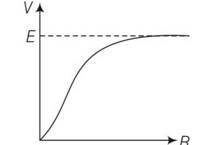
Explanation- according to the relation V=e-Ir and I=e/r+R
The graphical relation between voltage and resistance.
Taking an Exam? Selecting a College?
Get authentic answers from experts, students and alumni that you won't find anywhere else
Sign Up on ShikshaOn Shiksha, get access to
- 67k Colleges
- 1.2k Exams
- 718k Reviews
- 1850k Answers