

Physics
Get insights from 5.6k questions on Physics, answered by students, alumni, and experts. You may also ask and answer any question you like about Physics
Follow Ask QuestionQuestions
Discussions
Active Users
Followers
New answer posted
a year agoContributor-Level 10
This is a multiple choice answer as classified in NCERT Exemplar
(a) Amount of sweat evaporated /minute =
=
New answer posted
a year agoContributor-Level 10
This is a Short Answer Type Questions as classified in NCERT Exemplar
Explanation- In a Wheatstone bridge the main advantage of null point method is that the resistance of galvanometer does not affect the balance point, there is no need to determine current in resistances and the internal resistance of a galvanometer. It is convenient and easy method for observer.
The R unknown can calculated applying Kirchhoff's rules to the circuit. We would need additional accurate measurement of all the currents in resistances and galvanometer and internal resistance of the galvanometer.
The necessary and sufficient condition for balanced Wheatst
New answer posted
a year ago
Contributor-Level 10
This is a multiple choice answer as classified in NCERT Exemplar
(c) For the curve 1 volume is constant so it is isochoric process. But in curve 2 and 3 curve 2 is steeper so 2 is adiabatic and 3 is isothermal.
New answer posted
a year agoContributor-Level 10
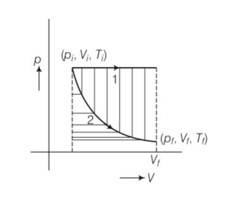
process 1 isochoric and process 2 is isothermal .
Since, work done = area under P-V curve . here area under the pV curve 1 is more . so work done is more when the gas expands in isochoric process.
New answer posted
a year agoContributor-Level 10
This is a short answer type question as classified in NCERT Exemplar
Coefficient of
T1= 27+273=300K
Coefficient of performance
1500-5T2=T2
6T2=1500
T2= 250K
T2= 250-273=-23oC
New answer posted
a year agoContributor-Level 10
This is a short answer type question as classified in NCERT Exemplar
Temperature of the source is 270C
T1= 27+273= 300K
T2= -3+273= 270K
Efficiency of heat engine = 1-T2/T1= 1-270/300=1/10
Efficiency of refrigerator is 50% of a perfect engine
= 0.5 = 1/20
Coefficient of performance of the refrigerator
=
Q2= =19W
= 19 1KW=19KW= 19kJ/s
New answer posted
a year agoContributor-Level 10
This is a Short Answer Type Questions as classified in NCERT Exemplar
Explanation- relaxation time =mean free path/rms velocity of electron
Also = = relaxation time is inversely proportional to velocities
New answer posted
a year agoContributor-Level 10
This is a short answer type question as classified in NCERT Exemplar
For adiabatic change process we know
P1V1y= P2V2y
P (V+ )y = (P+ )Vy
PVy (1+ ) y=p (1+ )Vy
PVy (1+ ) PVy (1+ )
Y
dV=
hence work done increasing the pressure from P1 to P2
W=
=
W=
New answer posted
a year agoContributor-Level 10
This is a Short Answer Type Questions as classified in NCERT Exemplar
Explanation – In the circuit when an electron approaches a junction, in addition to the uniform E that faces it normally (which keep the drift velocity fixed), as drift velocity (vd) is directly proportional to Electric field (E). That's why there are accumulation of charges on the surface of wires at the junction.
These produce additional electric fields. These fields alter the direction of momentum. Thus, the motion of a charge across junction is not momentum conserving
New answer posted
a year agoContributor-Level 10
This is a short answer type question as classified in NCERT Exemplar
Height of stairs h= 10m
Energy produced by burning 1 kg of fat = 7000Kcal
Energy produced by burning 5kg of fat = 5
Energy utilised in going up and down one time
= mgh + =
=
= 9000J= 9000/4.2=3000/1.4cal
Number of times, the person has to go up and down the stairs
= = 16.3 times
Taking an Exam? Selecting a College?
Get authentic answers from experts, students and alumni that you won't find anywhere else
Sign Up on ShikshaOn Shiksha, get access to
- 67k Colleges
- 1.2k Exams
- 718k Reviews
- 1850k Answers