Semiconductor Electronics: Materials, Devices and

Get insights from 121 questions on Semiconductor Electronics: Materials, Devices and, answered by students, alumni, and experts. You may also ask and answer any question you like about Semiconductor Electronics: Materials, Devices and

Follow Ask Question
121

Questions

0

Discussions

4

Active Users

0

Followers

New answer posted

5 months ago

0 Follower 5 Views

V
Vishal Baghel

Contributor-Level 10

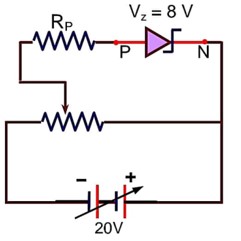
P z = V z l z 0 . 5 = 8 l z l z = l P = 1 1 6 A m p

When zener is connected across a potential divider arranged with maximum potential drop across zener diode, then

V P = V V z = 2 0 8 = 1 2  volt Potential difference across protective resistance RP
R P = V P I P = 1 2 1 6 = 1 9 2 A m p .

New answer posted

5 months ago

0 Follower 5 Views

V
Vishal Baghel

Contributor-Level 10

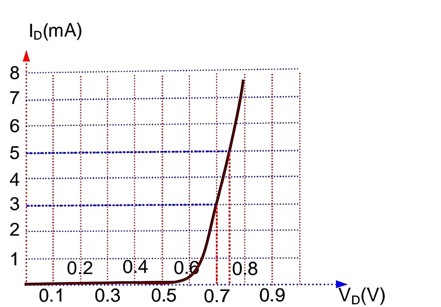
R = Δ V Δ l = 0 . 7 5 0 . 7 0 ( 5 3 ) * 1 0 3 = 0 . 0 5 * 1 0 0 0 2 = 2 5 Ω

New answer posted

5 months ago

0 Follower 3 Views

A
alok kumar singh

Contributor-Level 10

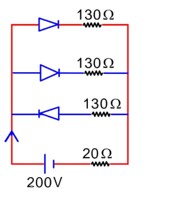
In give diagram Diode 1 and 2 are in forward bias with R = 3 0 Ω and Diode 3 is reverse bias with R = infinite l1 current is flowing through 20 Ω  

So l 1 2 a n d l 1 2 current will flow through Diode 1 and 2. As resistance is same applying KCl in ABCD Loop l 1 2 * 1 3 0 l 1 2 * 1 3 0 l 1 * 2 0 + 2 0 0 = 0

-100l1 + 200 = 0

l1 = 2

New answer posted

5 months ago

0 Follower 2 Views

V
Vishal Baghel

Contributor-Level 10

Capacitor makes potential difference constant.

New answer posted

5 months ago

0 Follower 14 Views

V
Vishal Baghel

Contributor-Level 10

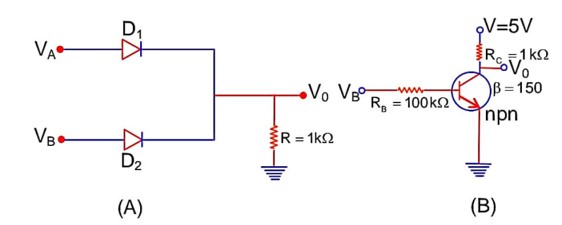
Using truth table

A            B            V0

0            0

0            1            1

1            0            1

1            1

New answer posted

5 months ago

0 Follower 5 Views

A
alok kumar singh

Contributor-Level 10

In give diagram Diode 1 and 2 are in forward bias with R = 3 0 Ω and Diode 3 is reverse bias with R = infinite l1 current is flowing through 20 Ω  

So l 1 2 a n d l 1 2 current will flow through Diode 1 and 2. As resistance is same applying KCl in ABCD Loop l 1 2 * 1 3 0 l 1 2 * 1 3 0 l 1 * 2 0 + 2 0 0 = 0

-100l1 + 200 = 0

l1 = 2

New answer posted

5 months ago

0 Follower 3 Views

R
Raj Pandey

Contributor-Level 9

 0.02i * RG = 0.98i * 5

[in parallel, pot. Diff is same]
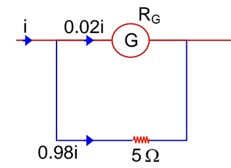
or, RG = 49 * 5

RG = 245 Ω

New answer posted

5 months ago

0 Follower 3 Views

A
alok kumar singh

Contributor-Level 10

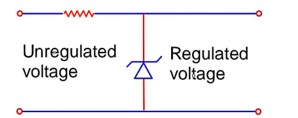
Maximum current through zener diode,

  i = 2 1 0 = 0 . 2 A             

When unregulated voltage is 14V,

Potential difference across Rs,

              VS = 14 – 10 = 4V

R S = V S i = 4 0 . 2 = 2 0 Ω

New question posted

5 months ago

0 Follower 2 Views

New answer posted

5 months ago

0 Follower 2 Views

A
alok kumar singh

Contributor-Level 10

β = I C I E = I C I E I C = I C / I E 1 l C / I E = α 1 α

Get authentic answers from experts, students and alumni that you won't find anywhere else

Sign Up on Shiksha

On Shiksha, get access to

  • 66k Colleges
  • 1.2k Exams
  • 681k Reviews
  • 1800k Answers

Share Your College Life Experience

×
×

This website uses Cookies and related technologies for the site to function correctly and securely, improve & personalise your browsing experience, analyse traffic, and support our marketing efforts and serve the Core Purpose. By continuing to browse the site, you agree to Privacy Policy and Cookie Policy.