
Solutions
Get insights from 211 questions on Solutions, answered by students, alumni, and experts. You may also ask and answer any question you like about Solutions
- 211
Questions
- 0
Discussions
- 28
Active Users
- 0
Followers
Have a question about Solutions? Ask our experts
Keep it short & simple. Type complete word. Avoid abusive language.
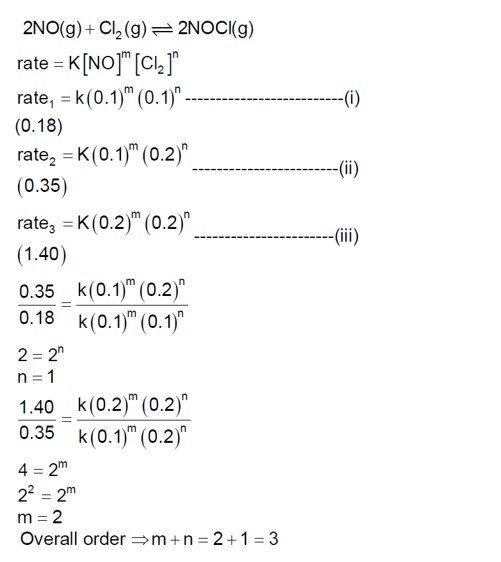
2NO(g) + Cl?(g) ? 2NOCl(s)
This reaction was studied at -10°C and the following data was obtained

[NO]? and [Cl?]? are the initial concentrations and r? is the initial reaction rate. The overall order of the reaction is _____. (Round off to the nearest integer).
2NO(g) + Cl?(g) ? 2NOCl(s)
This reaction was studied at -10°C and the following data was obtained
[NO]? and [Cl?]? are the initial concentrations and r? is the initial reaction rate. The overall order of the reaction is _____. (Round off to the nearest integer).
The number of chlorine atoms in 20 mL of chlorine gas at STP is ______10²¹ (Round off to the nearest integer).
[Assume chlorine is an ideal gas at STP, R = 0.083 L bar mol⁻¹ K⁻¹, NA = 6.023 ×10²³]
The number of chlorine atoms in 20 mL of chlorine gas at STP is ______10²¹ (Round off to the nearest integer).
[Assume chlorine is an ideal gas at STP, R = 0.083 L bar mol⁻¹ K⁻¹, NA = 6.023 ×10²³]
Using the Ideal Gas Law, PV = nRT:
P = 1 bar
V = 20 mL = 0.020 L
R = 0.083 L·bar·mol? ¹·K? ¹
T = 273 K
n = PV / RT = (1 × 0.020) / (0.0831 × 273) = 8.8 × 10? mol of Cl?
Number of Cl? molecules (N) = n × N_A = (8.8 × 10? ) × (6.022 × 10²³) = 5.3 × 10²? molecules.
Number of Cl atoms = 2 × (5.3 × 10²? ) = 1.
 Upvote

The mole fraction of a solute in a 100 molal aqueous solution is _______ ×10-2. (Round off to the nearest integer).
[Given : Atomic masses : H : 1.0u, O : 16.0u]
The mole fraction of a solute in a 100 molal aqueous solution is _______ ×10-2. (Round off to the nearest integer).
[Given : Atomic masses : H : 1.0u, O : 16.0u]
Molality = (mole of solute * 1000) / wt of solvent (gm)
100 = (n_solute * 1000) / [ (1 - n_solute) * 18]
(1 - n_solute) / n_solute = 1000 / (100 * 18) = 10/18
18 (1 - n_solute) = 10 n_solute
18 - 18 n_solute = 10 n_solute
18 = 28 n_solute
n_solute = 18 / 28? 0.6428 = 64.28 * 10? ²
Ans = 64 (Rounded off)
Upvote A soft drink was bottled with a partial pressure of CO? of 3 bar over the liquid at room temperature. The partial pressure of CO? over the solution approaches a value of 30bar when 44 g of CO? is dissolved in 1 kg of water at room temperature. The approximate pH of the soft drink is × 10?¹ /
(First dissociation constant of H?CO? = 4.0 × 10?; log 2 = 0.3; density of the soft drink = 1 g mL?¹)
A soft drink was bottled with a partial pressure of CO? of 3 bar over the liquid at room temperature. The partial pressure of CO? over the solution approaches a value of 30bar when 44 g of CO? is dissolved in 1 kg of water at room temperature. The approximate pH of the soft drink is × 10?¹ /
(First dissociation constant of H?CO? = 4.0 × 10?; log 2 = 0.3; density of the soft drink = 1 g mL?¹)

A set of solutions is prepared using 180 g of water as a solvent and 10 g of different non-volatile solutes A, B and C. The relative lowering of vapour pressure in the presence of these solutes are in the order [Given, molar mass of A = 100 g mol⁻¹; B = 200 g mol⁻¹; C = 10,000 g mol⁻¹ ]
A set of solutions is prepared using 180 g of water as a solvent and 10 g of different non-volatile solutes A, B and C. The relative lowering of vapour pressure in the presence of these solutes are in the order [Given, molar mass of A = 100 g mol⁻¹; B = 200 g mol⁻¹; C = 10,000 g mol⁻¹ ]
Relative lowering in vapour pressure depends on no. of mole of solute greater the no. of mole of solute greater in RLVP and smaller will be vapour pressure. So order of vapour pressure is B > C > A.
Upvote The osmotic pressure of a solution of NaCl is 0.10 atm and that of a glucose solution is 0.20 atm. The osmotic pressure of a solution formed by mixing 1 L of the sodium chloride solution with 2 L of the glucose solution is x × 10⁻³ atm. x is (nearest integer)
The osmotic pressure of a solution of NaCl is 0.10 atm and that of a glucose solution is 0.20 atm. The osmotic pressure of a solution formed by mixing 1 L of the sodium chloride solution with 2 L of the glucose solution is x × 10⁻³ atm. x is (nearest integer)
Π = iCRT = I (n/V)RT
Πfinal = (Π? V? + Π? V? )/ (V? + V? )
Πfinal = [ (0.1 × 1) + (0.2 × 2)]/3
= (0.1 + 0.4)/3 = 0.5/3 = (500/3) × 10? ³ atm
so X = 167
Upvote A 100 mL solution was made by adding 1.43 g of Na₂CO₃ · xH₂O. The normality of the solution is 0.1 N. The value of x is (The atomic mass of Na is 23 g/mol )
A 100 mL solution was made by adding 1.43 g of Na₂CO₃ · xH₂O. The normality of the solution is 0.1 N. The value of x is (The atomic mass of Na is 23 g/mol )
Equivalent of solute = 0.1 × 0.1
Mole of solute (Na? CO? ·xH? O) = [0.1 × 0.1]/2
Mass of Na? CO? ·xH? O = ( [0.1 × 0.1]/2) × [106 + 18x] = 1.43
⇒ 106 + 18x = 286
18x = 180
x = 10
Upvote