
Solutions
Get insights from 211 questions on Solutions, answered by students, alumni, and experts. You may also ask and answer any question you like about Solutions
- 211
Questions
- 0
Discussions
- 28
Active Users
- 0
Followers
Have a question about Solutions? Ask our experts
Keep it short & simple. Type complete word. Avoid abusive language.
Which one of the following 0.06M aqueous solutions has lowest freezing point?
Which one of the following 0.06M aqueous solutions has lowest freezing point?
Depression in freezing point will be maximum for Al2 (SO4)3 since its Van't Hoff factor is the highest. So its solution will have the lowest freezing point.
 Upvote

At 20°C the vapour pressure of benzene is 70 torr and that of methyl benzene is 20 torr. The mole fraction of benzene in the vapour phase at 20°C above an equimolar mixture of benzene and methyl benzene is__________ × 10-2. (Nearest integer)
At 20°C the vapour pressure of benzene is 70 torr and that of methyl benzene is 20 torr. The mole fraction of benzene in the vapour phase at 20°C above an equimolar mixture of benzene and methyl benzene is__________ × 10-2. (Nearest integer)
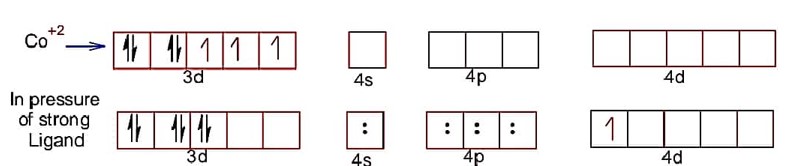
Hence, electronic configuration of CO2+ is
spin magnetic moment =
Upvote The vapour pressures of A and B at 25°C are 90mm Hg and 15mm Hg respectively. If A and B are mixed such that the mole fraction of A in the mixture is 0.6, then mole fraction of B in the vapour phase is x × 10-1. The value x is_________. (Nearest Integer)
The vapour pressures of A and B at 25°C are 90mm Hg and 15mm Hg respectively. If A and B are mixed such that the mole fraction of A in the mixture is 0.6, then mole fraction of B in the vapour phase is x × 10-1. The value x is_________. (Nearest Integer)
Total pressure of mixture =
Mole fraction of B in vapour phase,
Upvote An aqueous KCl solution of density 1.2 mL-1 has a molality of 3.30 mol kg-1. The molarity of the solution in mol L-1 is__________(Nearest integer)
[Molar mass of KCl = 74.5]
An aqueous KCl solution of density 1.2 mL-1 has a molality of 3.30 mol kg-1. The molarity of the solution in mol L-1 is__________(Nearest integer)
[Molar mass of KCl = 74.5]
KCl solution has molality (m) = 3.3, [Means 3.3 mol of KCl dissolved in 1 kg of solved]
Total mass of solution = mass of solute + mass of solvent
= 3.3 * 74.5 + 1000 gm
= 1245.85 gm
Volume of solution =
Ans. = 3 (the nearest integer)
Upvote Of the following four aqueous solutions, total number of those solutions whose freezing point is lower than that of 0.10 M C2H5OH is___________
(Integer answer)
Of the following four aqueous solutions, total number of those solutions whose freezing point is lower than that of 0.10 M C2H5OH is___________
(Integer answer)
All the solution have higher ion production with respect to 0.1 M C2H5OH i.e. 0.1 M Ba3 (PO4)2, 0.1 M Na2SO4, 0.1 M KCl and 0.1 M Li3PO4. Hence all have lowered freezing point than 0.1 M C2H5OH (which is non-ionisable in aqueous medium).
Ans. = 4
Upvote Solute A associate in water. When 0.7g of solute A is dissolved in 42.0g of water it depresses the freezing point by <!-- [if gte mso 9]><xml>
[Given: Molar mass of A = 93 g mol-1. Molal depression constant of water is 1.86 K kg mol-1.]
Solute A associate in water. When 0.7g of solute A is dissolved in 42.0g of water it depresses the freezing point by <!-- [if gte mso 9]><xml>
[Given: Molar mass of A = 93 g mol-1. Molal depression constant of water is 1.86 K kg mol-1.]
2g of a non-volatile non-electrolyte solute is dissolved in 200g of two different solvents A and B whose ebullioscopic constant are in the ratio of 1:8. The elevation in boiling points of A and B are in the ratio <!-- [if gte mso 9]><xml>
2g of a non-volatile non-electrolyte solute is dissolved in 200g of two different solvents A and B whose ebullioscopic constant are in the ratio of 1:8. The elevation in boiling points of A and B are in the ratio <!-- [if gte mso 9]><xml>
or
Upvote Given below are two statements: one is labeled as Assertion (A) and the other is labeled as Reason (R)
Assertion (A): At 10°C, the density of a 5M solution of KCl [atomic masses of K % Cl are 39 & 35.5 g mol-1 respectively is ‘x’ g ml-1. The solution is cooled to -21°C. The molality of the solution will remain unchanged.
Reason (R) : The molality of a solution does not change with temperature as mass remains unaffected with temperature
In the light of the above statements, choose the correct answer from the options given below.
Given below are two statements: one is labeled as Assertion (A) and the other is labeled as Reason (R)
Assertion (A): At 10°C, the density of a 5M solution of KCl [atomic masses of K % Cl are 39 & 35.5 g mol-1 respectively is ‘x’ g ml-1. The solution is cooled to -21°C. The molality of the solution will remain unchanged.
Reason (R) : The molality of a solution does not change with temperature as mass remains unaffected with temperature
In the light of the above statements, choose the correct answer from the options given below.
Molality itself a strength representing terms for solution which does not depend upon the temperature.
Upvote The depression in freezing point observed for a formic acid solution of concentration 0.5 mL L-1 is Density of formic acid is 1.05 g mL-1. The Van’t Hoff factor of the formic acid solution is nearly: (Given for water )
The depression in freezing point observed for a formic acid solution of concentration 0.5 mL L-1 is Density of formic acid is 1.05 g mL-1. The Van’t Hoff factor of the formic acid solution is nearly: (Given for water )
Let we take of solution
Mass of solute = Volume × Density
= 0.5
= 0.525 gram
Mass of solution = 1 kg. [considering very dilute solution]
Mass of solvent = 1000 – 0.525 = 999.475 gram
Upvote