

Solutions
Get insights from 209 questions on Solutions, answered by students, alumni, and experts. You may also ask and answer any question you like about Solutions
Follow Ask QuestionQuestions
Discussions
Active Users
Followers
New answer posted
a year agoContributor-Level 9
Let we take of solution
Mass of solute = Volume * Density
= 0.5
= 0.525 gram
Mass of solution = 1 kg. [considering very dilute solution]
Mass of solvent = 1000 – 0.525 = 999.475 gram
New answer posted
a year ago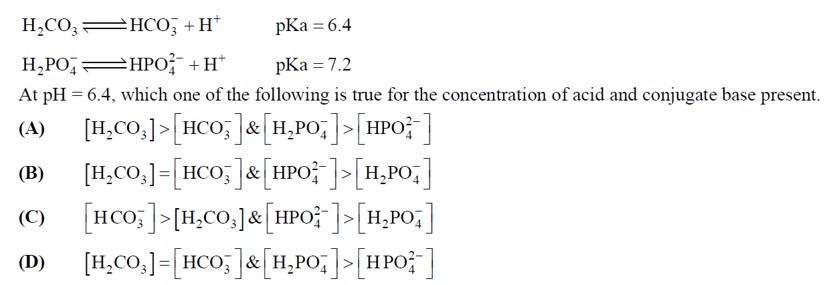
Contributor-Level 10
At pH = 6.4
As in case of H2CO3,
pH = pKa it will be only when
[weak acid] = [conjugate base].
In case of 2
H2PO-4 |HPO2-4
New answer posted
a year agoContributor-Level 10
∴ % of S in the compound
= (32/233) * (mass of BaSO? / mass of compound) * 100 = (32 * 0.35 * 100) / (233 * 0.25) = 19.227 ≈ 19.23
New answer posted
a year agoContributor-Level 10
? Solvent is H? O, which is in excess
So using m ( molality ) = (x? *1000)/ (x? * (M? )? )
? x? = 0.74 (Mol? = 18 g)
x? = 1 – 0.74 = 0.26 ∴ m = (0.26 * 1000)/ (0.74 * 18) = 19.5
New answer posted
a year agoNew answer posted
a year agoContributor-Level 10
ppm of O? = (wt. of O? ) / (wt. of H? O) * 10?
= (10.3 mg) / (1.03 * 10? mg) * 10?
= 10ppm
Taking an Exam? Selecting a College?
Get authentic answers from experts, students and alumni that you won't find anywhere else
Sign Up on ShikshaOn Shiksha, get access to
- 67k Colleges
- 1.2k Exams
- 717k Reviews
- 1850k Answers