
The p -Block Elements
Get insights from 161 questions on The p -Block Elements, answered by students, alumni, and experts. You may also ask and answer any question you like about The p -Block Elements
- 161
Questions
- 0
Discussions
- 0
Active Users
- 0
Followers
Have a question about The p -Block Elements? Ask our experts
Keep it short & simple. Type complete word. Avoid abusive language.
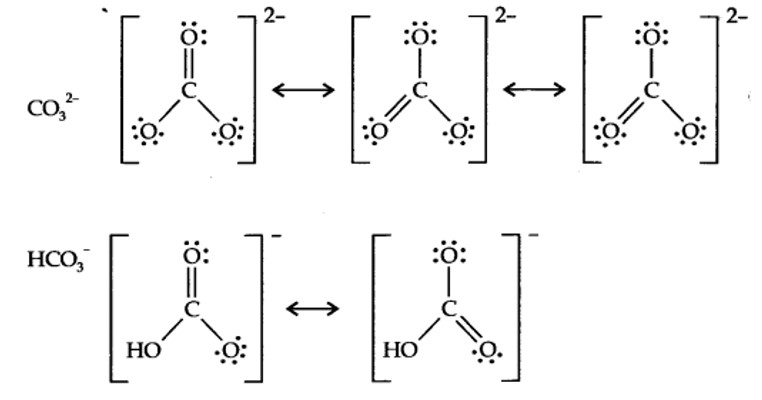
11.10. Write the resonance structures of CO32- and HCO3–.
11.10. Write the resonance structures of CO32- and HCO3–.
11.55 Give the chemical reaction as evidence for each of the following observations.
(i) Tin (II) is a reducing agent whereas lead (II) is not.
(ii) Gallium (I) undergoes disproportionation reaction.
11.55 Give the chemical reaction as evidence for each of the following observations.
(i) Tin (II) is a reducing agent whereas lead (II) is not.
(ii) Gallium (I) undergoes disproportionation reaction.
(i) Due to inert pair effect Pb2+ is more stable than Pb4+. Whereas Sn4+ is more stable than Sn2+.
(ii) 3Ga+ —–> 2Ga + Ga3+
This is because Ga3+ is more stable than Ga+
 Upvote

| Fullerenes are the allotropes of carbon. Its structure is like a soccer ball. They are prepared by heating graphite in electric arc in presence of inert gases such as helium or argon. |
Upvote 11.53 CO2 is gas while SiO2 is solid at room temperature. Give reason.
11.53 CO2 is gas while SiO2 is solid at room temperature. Give reason.
The molecules of CO2 are held together by weak van der Waals forces of attraction which can be easily overcome by collisions of the molecules at room temperature. Consequently, CO2 is a gas.
On the other hand, silicon atom forms four single covalent bonds with O-atom which are tetrahedrally
Upvote Carbon dioxide can be obtained as a solid in the form of dry ice by allowing the liquified CO2 to expand rapidly.
Unlike ordinary ice it does not melt and hence does not wet the surface on which it is kept. Thus, it is called dry ice.
Upvote 11.51 Why does the tendency for catenation decreases in the order C > Si > Ge > Sn?
11.51 Why does the tendency for catenation decreases in the order C > Si > Ge > Sn?
The catenation depends on the strength of the element-element bond. As we move down the group 14, the element-element bond energies decrease rapidly, viz. C–C (355 kJ mol–1), Si–Si (222 kJ mol–1), Ge–Ge (167 kJ mol–1) and Sn–Sn (155 kJ mol–1), so the tendency for catenation decreases in the order C
Upvote Carbon atoms have the tendency to linkwith one another through covalent bonds to form chains and rings. This property is calledcatenation. This is because C—C bonds are very strong.
Upvote Question Answers
Q.11.49 Why Boron differs from aluminium and other members of group 13 in a number of properties?
Question Answers
Q.11.49 Why Boron differs from aluminium and other members of group 13 in a number of properties?
Boron shows anomalous behaviour due to small atomic size, high electronegativity, high ionization energy and absence of d-orbital of B
Upvote 11.48 The basic building unit of all silicates is
(a) SiO24- (b) SiO44- (c) SiO42- (d) SiO-
11.48 The basic building unit of all silicates is
(a) SiO24- (b) SiO44- (c) SiO42- (d) SiO-
(b) SiO44- is the basic unit of all silicates.
Upvote