
Work, Energy and Power
Get insights from 175 questions on Work, Energy and Power, answered by students, alumni, and experts. You may also ask and answer any question you like about Work, Energy and Power
- 175
Questions
- 0
Discussions
- 0
Active Users
- 5
Followers
Have a question about Work, Energy and Power? Ask our experts
Keep it short & simple. Type complete word. Avoid abusive language.
In the given figure, the block of mass m is dropped from the point ‘A’. The expression for kinetic energy of block when it reaches point ‘B’ is
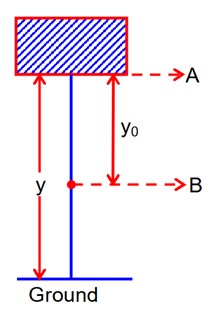
In the given figure, the block of mass m is dropped from the point ‘A’. The expression for kinetic energy of block when it reaches point ‘B’ is
According to conservation of energy, we can write
Gain in kinetic energy = Loss in potential energy
Kf – Kin = Uin - Uf
K - = mgy – mg (y – y0) = mgy0
 Upvote

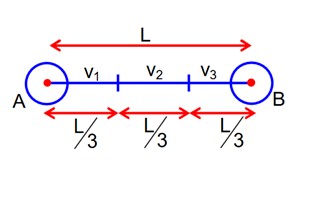
A car cover AB distance with first one-third at velocity second one-third at and last one-third at If <!-- [if gte mso 9]><xml>
A car cover AB distance with first one-third at velocity second one-third at and last one-third at If <!-- [if gte mso 9]><xml>
=
= 3 × b
= 18 m/sec
Upvote Water falls from a 40m height dam at the rate of 9 × 10⁴ kg per hour. Fifty percentage of gravitational potential energy can be converted into electrical energy. Using this hydro electric energy number of 100 W lamps, that can be lit, is:
(Take g = 10 ms-2)
Water falls from a 40m height dam at the rate of 9 × 10⁴ kg per hour. Fifty percentage of gravitational potential energy can be converted into electrical energy. Using this hydro electric energy number of 100 W lamps, that can be lit, is:
(Take g = 10 ms-2)
Given : water flow rate = = 9 × 10⁴ kg/hr
=
Potential energy available on water per unit time
50% of it converts into electrical energy = 50% of
Let be the number of bulbs n = 100 =
n = 50
Upvote A block of mass 2kg moving on a horizontal surface with speed of 4 ms-1 enters a rough surface ranging from x = 0.5m to x = 1.5m. The retarding force in this range of rough surface is related to distance by F = -kx where k = 12Nm-1. The speed of the block as it just crosses the rough surface will be:
A block of mass 2kg moving on a horizontal surface with speed of 4 ms-1 enters a rough surface ranging from x = 0.5m to x = 1.5m. The retarding force in this range of rough surface is related to distance by F = -kx where k = 12Nm-1. The speed of the block as it just crosses the rough surface will be:
A system to 10 balls each of mass 2kg are connected via massless and unstretchable string. The system is allowed to slip over the edge of a smooth in figure. Tension on the string between the 4th and 8th ball is_________N when 6th ball just leaves the table.
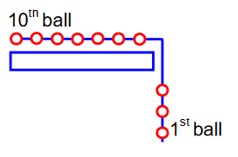
A system to 10 balls each of mass 2kg are connected via massless and unstretchable string. The system is allowed to slip over the edge of a smooth in figure. Tension on the string between the 4th and 8th ball is_________N when 6th ball just leaves the table.
12 g – T = 12 a- (1)
T – T’ = 2a- (2)
T’ = 6a- (3)
From (1) & (2)
12g – 12a – T’ = 2a- (4)
From (4) & (3)
12g – 12a – T’ = 14
Upvote A fighter jet is flying horizontally at a certain with a speed of 200ms-1. When it passes directly overhead ad anti-aircraft gun, a bullet is fired from the gun, at an angle q with the horizontal, to hit the jet. If the bullet speed is 400m/s, the value of q will be _____________.
A fighter jet is flying horizontally at a certain with a speed of 200ms-1. When it passes directly overhead ad anti-aircraft gun, a bullet is fired from the gun, at an angle q with the horizontal, to hit the jet. If the bullet speed is 400m/s, the value of q will be _____________.
B fighter jet
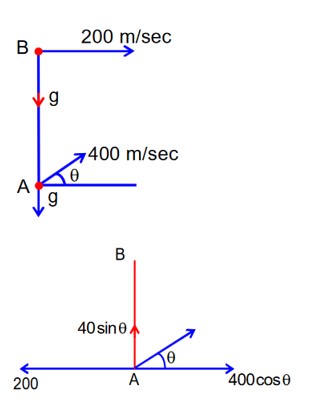
A anti-Air craft gun
Draw velocity diagram of A w.r.t. B
If A hits B
Then Relative velocity perpendicular to the line joining A to B will be zero.
That means 400 cos = 200
Upvote Arrange the four graphs in descending order of total work done; where W1, W2, W3 and W4 are the work done corresponding to figure a, b, c and d respectively.
(a) W3 > W2 > W1 >W4 (b) W3 > W2 > W4 > W1 (c) <!-- [if gte mso 9]><xml>
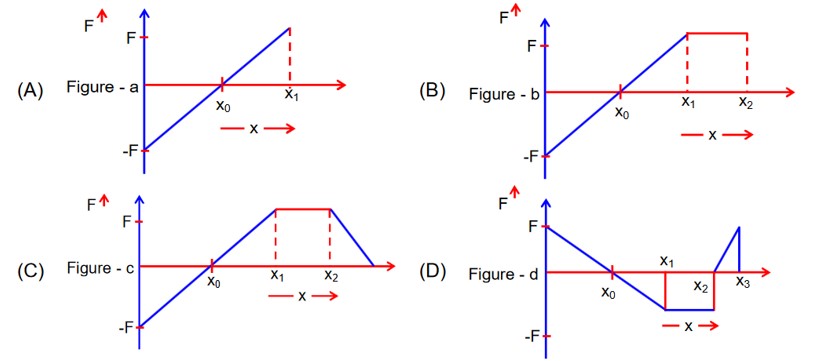
Arrange the four graphs in descending order of total work done; where W1, W2, W3 and W4 are the work done corresponding to figure a, b, c and d respectively.
(a) W3 > W2 > W1 >W4 (b) W3 > W2 > W4 > W1 (c) <!-- [if gte mso 9]><xml>
Work done represents are under
F vs x diagram
w3 > w2 > w1 > w4
Upvote A bullet of mass 200g having initial kinetic energy 90 J is shot inside a long swimming pool as shown in the figure. If it’s kinetic energy reduces to 40 J within 1s, the minimum length of the pool, the bullet has to travel so that it completely comes to rest is
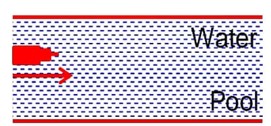
A bullet of mass 200g having initial kinetic energy 90 J is shot inside a long swimming pool as shown in the figure. If it’s kinetic energy reduces to 40 J within 1s, the minimum length of the pool, the bullet has to travel so that it completely comes to rest is
m = 200 g, ki = 90 J kf = 40 J.,
So for complete rest :-
Fx = 90 J
2x = 90 x = 45 m
Upvote