
Aldehydes, Ketones and Carboxylic Acids
Get insights from 184 questions on Aldehydes, Ketones and Carboxylic Acids, answered by students, alumni, and experts. You may also ask and answer any question you like about Aldehydes, Ketones and Carboxylic Acids
- 184
Questions
- 0
Discussions
- 0
Active Users
- 0
Followers
Have a question about Aldehydes, Ketones and Carboxylic Acids? Ask our experts
Keep it short & simple. Type complete word. Avoid abusive language.
The intermolecular potential energy for the molecules A, B, C and D given below suggest that:
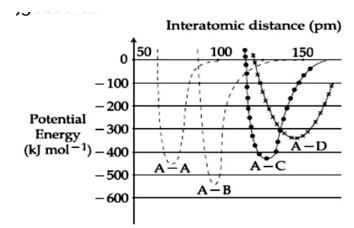
The intermolecular potential energy for the molecules A, B, C and D given below suggest that:
A - B has the lowest potential energy and it means it has stronger bond.
 Upvote

Complex has a composition of <!-- [if gte msEquation 12]>
[Given : atomic mass of and <!-- [if gte msEquation 12]>
<!-- [if !supportLineBreakNewLine]-->
<!--[endif]-->
Complex has a composition of <!-- [if gte msEquation 12]>
[Given : atomic mass of and <!-- [if gte msEquation 12]>
<!-- [if !supportLineBreakNewLine]-->
<!--[endif]-->
Conc. acts as dehydrating agent.
Molar mass of given complex .
On treating with conc. the mass
lost by the complex moles of
Formula of the complex
Upvote 

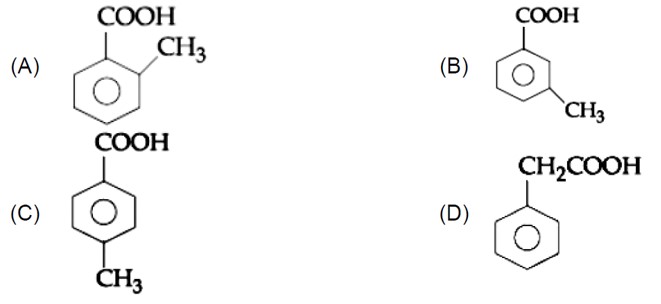
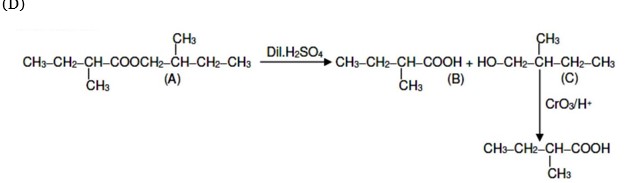
An organic compound [A], molecular formula C?H?O?, was hydrolyzed with dilute sulphuric acid to give a carboxylic acid [B] and an alcohol [C]. Oxidation of [C] with CrO? – H?SO? produced [B]. Which of the following structures are not possible for [A]?
An organic compound [A], molecular formula C?H?O?, was hydrolyzed with dilute sulphuric acid to give a carboxylic acid [B] and an alcohol [C]. Oxidation of [C] with CrO? – H?SO? produced [B]. Which of the following structures are not possible for [A]?
(B) contains eight carbon atoms whereas the molecular formula C? H? O? contains ten carbon atoms.
Upvote