
Block D and F Elements
Get insights from 162 questions on Block D and F Elements, answered by students, alumni, and experts. You may also ask and answer any question you like about Block D and F Elements
- 162
Questions
- 0
Discussions
- 0
Active Users
- 0
Followers
Have a question about Block D and F Elements? Ask our experts
Keep it short & simple. Type complete word. Avoid abusive language.
The oxidation states of transition metal atoms in K₂Cr₂O₇, KMnO₄ and K₂FeO₄, respectively, are x,y and z. The sum of x,y and z is [numerical value].
The oxidation states of transition metal atoms in K₂Cr₂O₇, KMnO₄ and K₂FeO₄, respectively, are x,y and z. The sum of x,y and z is [numerical value].
K? Cr? O? (x=+6), KMnO? (y=+7), K? FeO? (z=+6). x+y+z=19.
 Upvote

<p><strong>Consider the following reactions:</strong></p>
<p><span contenteditable="false"> <math> <mi mathvariant="normal">N</mi> <mi mathvariant="normal">a</mi> <mi mathvariant="normal">C</mi> <mi mathvariant="normal">l</mi> <mo>+</mo> <msub> <mrow> <mrow> <mi mathvariant="normal">K</mi> </mrow> </mrow> <mrow> <mrow> <mn>2</mn> </mrow> </mrow> </msub> <msub> <mrow> <mrow> <mi mathvariant="normal">C</mi> <mi mathvariant="normal">r</mi> </mrow> </mrow> <mrow> <mrow> <mn>2</mn> </mrow> </mrow> </msub> <msub> <mrow> <mrow> <mi mathvariant="normal">O</mi> </mrow> </mrow> <mrow> <mrow> <mn>7</mn> </mrow> </mrow> </msub> <mo>+</mo> <munder> <mrow> <mrow> <msub> <mrow> <mrow> <mi mathvariant="normal">H</mi> </mrow> </mrow> <mrow> <mrow> <mn>2</mn> </mrow> </mrow> </msub> <msub> <mrow> <mrow> <mi mathvariant="normal">S</mi> <mi mathvariant="normal">O</mi> </mrow> </mrow> <mrow> <mrow> <mn>4</mn> </mrow> </mrow> </msub> <mo>?</mo> <mo>(</mo> <mi mathvariant="normal">A</mi> <mo>)</mo> <mo>+</mo> <mtext> </mtext> <mtext>side products</mtext> <mtext> </mtext> </mrow> </mrow> <mrow> <mrow> <mtext> </mtext> <mtext>(Conc.)</mtext> <mtext> </mtext> </mrow> </mrow> </munder> </math> </span><br><strong><!--[endif]--><!--[endif]--></strong></p>
<p><strong>(A) </strong><span class="mathml" contenteditable="false"> <math> <mo>+</mo> <mi mathvariant="normal">N</mi> <mi mathvariant="normal">a</mi> <mi mathvariant="normal">O</mi> <mi mathvariant="normal">H</mi> </math> </span><br><span class="mathml" contenteditable="false"> <math> <mo>(</mo> <mi mathvariant="normal">B</mi> <mo>)</mo> <mo>+</mo> </math> </span><strong> Side products</strong><br><strong>(B) </strong><span class="mathml" contenteditable="false"> <math> <mo>+</mo> <msub> <mrow> <mrow> <mi mathvariant="normal">H</mi> </mrow> </mrow> <mrow> <mrow> <mn>2</mn> </mrow> </mrow> </msub> <msub> <mrow> <mrow> <mi mathvariant="normal">S</mi> <mi mathvariant="normal">O</mi> </mrow> </mrow> <mrow> <mrow> <mn>4</mn> </mrow> </mrow> </msub> <mo>+</mo> <msub> <mrow> <mrow> <mi mathvariant="normal">H</mi> </mrow> </mrow> <mrow> <mrow> <mn>2</mn> </mrow> </mrow> </msub> <msub> <mrow> <mrow> <mi mathvariant="normal">O</mi> </mrow> </mrow> <mrow> <mrow> <mn>2</mn> </mrow> </mrow> </msub> <mo>?</mo> <mo>(</mo> </math> </span><strong> dilute)</strong><br><strong>(C) + Side products</strong></p>
<p><strong>The sum of the total number of atoms in one molecule each of <!-- [if gte msEquation 12]><m:oMath><spanstyle='font-size:11.0pt;font-family:"Cambria Math",serif;mso-fareast-font-family:Calibri;mso-fareast-theme-font:minor-latin;mso-bidi-font-family:"Times New Roman";mso-bidi-theme-font:minor-bidi;mso-ansi-language:EN-US;mso-fareast-language:EN-US;mso-bidi-language:AR-SA'><m:r><m:rPr><m:scr m:val="roman"/><m:sty m:val="p"/></m:rPr>(</m:r><m:r><istyle='mso-bidi-font-style:normal'>A</i></m:r><m:r><m:rPr><m:scr m:val="roman"/><m:stym:val="p"/></m:rPr>),(</m:r><m:r><i style='mso-bidi-font-style:normal'>B</i></m:r><m:r><m:rPr><m:scrm:val="roman"/><m:sty m:val="p"/></m:rPr>)</m:r></span></m:oMath><![endif]--><!-- [if !msEquation]--><!-- [if gte vml 1]><v:shapeid="_x0000_i1025" type="#_x0000_t75" style='width:37pt;height:13pt'><v:imagedata src="file:///C:/Users/ALOK~1.SIN/AppData/Local/Temp/msohtmlclip1/01/clip_image007.png"o:title="" chromakey="white"/>
</v:shape><![endif]--><!-- [if !vml]--><img src="file:///C:/Users/ALOK~1.SIN/AppData/Local/Temp/msohtmlclip1/01/clip_image008.gif" width="49" height="17"><!--[endif]--><!--[endif]--> and <!-- [if gte msEquation 12]><m:oMath><spanstyle='font-size:11.0pt;font-family:"Cambria Math",serif;mso-fareast-font-family:Calibri;mso-fareast-theme-font:minor-latin;mso-bidi-font-family:"Times New Roman";mso-bidi-theme-font:minor-bidi;mso-ansi-language:EN-US;mso-fareast-language:EN-US;mso-bidi-language:AR-SA'><m:r><m:rPr><m:scr m:val="roman"/><m:sty m:val="p"/></m:rPr>(</m:r><m:r><istyle='mso-bidi-font-style:normal'>C</i></m:r><m:r><m:rPr><m:scr m:val="roman"/><m:stym:val="p"/></m:rPr>)</m:r></span></m:oMath><![endif]--><!-- [if !msEquation]--><!-- [if gte vml 1]><v:shapeid="_x0000_i1025" type="#_x0000_t75" style='width:16pt;height:13pt'><v:imagedata src="file:///C:/Users/ALOK~1.SIN/AppData/Local/Temp/msohtmlclip1/01/clip_image009.png"o:title="" chromakey="white"/>
</v:shape><![endif]--><!-- [if !vml]--><img src="file:///C:/Users/ALOK~1.SIN/AppData/Local/Temp/msohtmlclip1/01/clip_image010.gif" width="21" height="17"><!--[endif]--><!--[endif]--> is </strong></p>
Number of electrons present in 4f orbital of Ho³? ion is __________.
(Given atomic number of Ho = 67)
Number of electrons present in 4f orbital of Ho³? ion is __________.
(Given atomic number of Ho = 67)
? Ho = [Xe] 4f¹¹ 6s²
∴ Ho? ³ = [Xe] 4f¹? 6s?
Number of electrons in 4f- subshell = 10
Upvote The spin only magnetic moments (in BM) for free Ti³?, V²? and Sc³? ions respectively are
(At. No. Sc: 21; Ti:22; V:23)
The spin only magnetic moments (in BM) for free Ti³?, V²? and Sc³? ions respectively are
(At. No. Sc: 21; Ti:22; V:23)
Using, µ = √n (n+2) B.M, n = number of unpaired electrons.
? Ti? ³ = 4s? 3d¹, unpaired electron = 1
µ = 1.73 B.M
? V? ² = 4s? 3d³, unpaired electron = 3
µ = 3.87 B.M
? Sc? ³ = 4s? 3d? , unpaired electron = 0
µ = 0 B.M
Upvote Dichromate ion is treated with base, the oxidation number of Cr in the product formed is-----------.
Dichromate ion is treated with base, the oxidation number of Cr in the product formed is-----------.
Dichromate ion converted to chromate ion in basic medium and oxidation number of Cr in is +6.
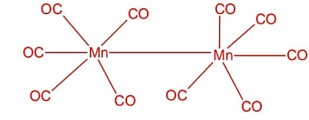
Upvote [Mn2 (CO)10]
 Upvote