
Block D and F Elements
Get insights from 162 questions on Block D and F Elements, answered by students, alumni, and experts. You may also ask and answer any question you like about Block D and F Elements
- 162
Questions
- 0
Discussions
- 0
Active Users
- 0
Followers
Have a question about Block D and F Elements? Ask our experts
Keep it short & simple. Type complete word. Avoid abusive language.
Octahedral complexes of copper (II) undergo structural distortion (Jahn- Teller). Which one of the given copper (II) complexes will show the maximum structural distortion? (en-ethylenediamine; H2N-CH2-CH2-NH2)
Octahedral complexes of copper (II) undergo structural distortion (Jahn- Teller). Which one of the given copper (II) complexes will show the maximum structural distortion? (en-ethylenediamine; H2N-CH2-CH2-NH2)
According to the John-Tollen distortion, there is a unsymmetrical filling of eq set of Cu+= ions but there is symmetrical filling of t2g set of ions.
 Upvote

Which of the following 3d- metal ion will give the lowest enthalpy of hydration <!-- [if gte mso 9]><xml>
Which of the following 3d- metal ion will give the lowest enthalpy of hydration <!-- [if gte mso 9]><xml>
Following are the
Cr2+ - 1926 KJ/mole
Mn2+ - 1860 KJ/mole
Fe2+ - 2000 KJ/mole
Co2+ - 2078 KJ/mole
Upvote The reaction of H2O2 with potassium permanganate in acidic medium leads to the formation of mainly.
The reaction of H2O2 with potassium permanganate in acidic medium leads to the formation of mainly.
The IUPAC nomenclature of an element with electronic configuration [Rn] 5f146d17s2 is:
The IUPAC nomenclature of an element with electronic configuration [Rn] 5f146d17s2 is:
IUPAC nomenclature of element with atomic no. 103 is uniltrium.
Upvote Match the List-I with List-II
List-I
List-II
(A) N2(g) + 3H2(g) -> 2NH3(g)
(I) Cu
(B) CO(g) + 3H2(g) -> CH4(g) + H2O(g)
(II) Cu/ZnO – Cr2O3
(C) CO(g) + H2(g) -> HCOH(g)
(III) FexOy + K2O + Al2O3
(D) CO(g) + 2H2(g) -> CH3OH(g)
(IV) Ni
Choose the correct answer from the options given below:
Match the List-I with List-II
|
List-I |
List-II |
|
(A) N2(g) + 3H2(g) -> 2NH3(g) |
(I) Cu |
|
(B) CO(g) + 3H2(g) -> CH4(g) + H2O(g) |
(II) Cu/ZnO – Cr2O3 |
|
(C) CO(g) + H2(g) -> HCOH(g) |
(III) FexOy + K2O + Al2O3 |
|
(D) CO(g) + 2H2(g) -> CH3OH(g) |
(IV) Ni |
Choose the correct answer from the options given below:
Uses of catalyst is very specific for a particular reaction.
Upvote The total number of Mn = O bonds in Mn2O7 is________.
The total number of Mn = O bonds in Mn2O7 is________.
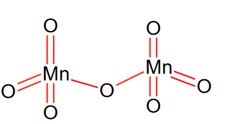
Given below are two statements.
Statement I: Iron (III) catalyst, acidified K2Cr2O7 and neutral KMnO4 have the ability to oxidize I- to I2 independently.
Statement II: Magnate ion is paramagnetic in nature and involves pp-pp bonding
In the light of the above statements, choose the most appropriate answer from the options given below.
Neutral KMnO4 oxidises I- to
Upvote Match List-I with List-II
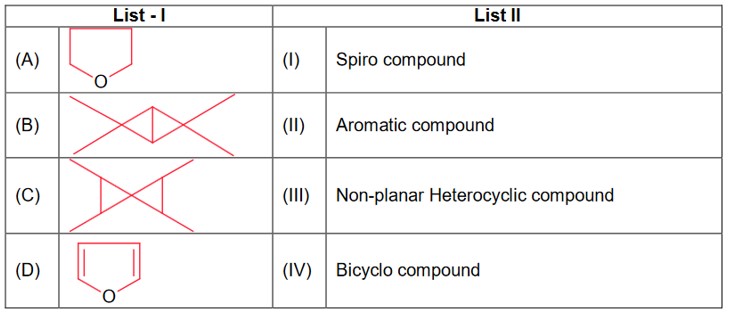
Choose the correct answer from the options given below
Match List-I with List-II
Choose the correct answer from the options given below
Kindly consider the following figure
Upvote Which of the following 3d- metal ion will give the lowest enthalpy of hydration <!-- [if gte mso 9]><xml>
Which of the following 3d- metal ion will give the lowest enthalpy of hydration <!-- [if gte mso 9]><xml>
Following are the
Cr2+ - 1926 KJ/mole
Mn2+ - 1860 KJ/mole
Fe2+ - 2000 KJ/mole
Co2+ - 2078 KJ/mole
Upvote