

Chemistry NCERT Exemplar Solutions Class 11th Chapter Eleven
Get insights from 115 questions on Chemistry NCERT Exemplar Solutions Class 11th Chapter Eleven, answered by students, alumni, and experts. You may also ask and answer any question you like about Chemistry NCERT Exemplar Solutions Class 11th Chapter Eleven
Follow Ask QuestionQuestions
Discussions
Active Users
Followers
New answer posted
8 months ago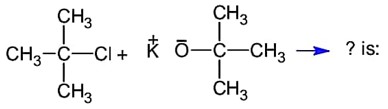
Contributor-Level 10
Base is tert-butoxide thus favours elimination with 3° alkyl halide and gives alkene
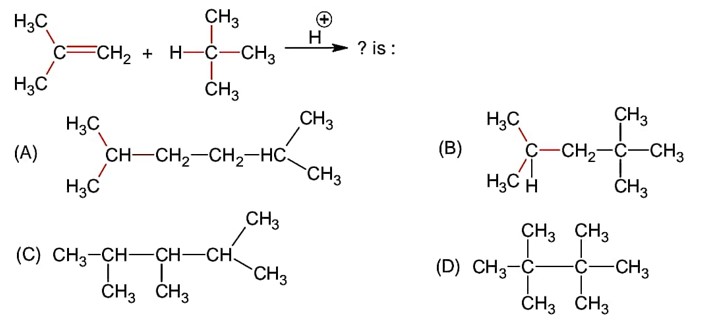
New answer posted
8 months ago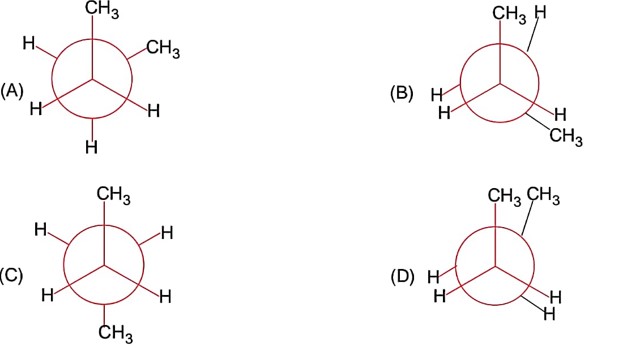
Contributor-Level 10
(A) and (C) are staggered conformation. In (A) dihedral angle is 60° and in (C) dihedral angle is 180°.
Dihedral angle is angle between two specified groups.
In (C) it has maximum angle.
New answer posted
10 months agoContributor-Level 10
This is a Assertion and Reason Type Questions as classified in NCERT Exemplar
(B)
Silicones are a class of silicon polymers that contain the repeating unit (-R 2 SiO-). Silicones are water repellent in nature because they are surrounded by non-polar alkyl groups, so A and R are both correct, but R is not the correct explanation of A.
New answer posted
10 months agoContributor-Level 10
This is a Assertion and Reason Type Questions as classified in NCERT Exemplar
(A)
In aluminium silicate, silicon is doped with group 13 elements and as aluminium is trivalent and silicon is tetravalent so, on replacing aluminium by Silicon, a negatively charged structure will be obtained. Both the statements assertion and reason are correct and reason is the correct explanation of assertion.
New answer posted
10 months agoContributor-Level 10
This is a Matching Type Questions as classified in NCERT Exemplar
(i)→ (b), (ii) → (c), (iii) → (b), (iv) → (a) (v)→ (b) (vi)→ (c)
New answer posted
10 months agoContributor-Level 10
This is a Matching Type Questions as classified in NCERT Exemplar
(i)→ (c) (ii)→ (d) (iii)→ (a) (iv)→ (e) (v)→ (b)
New answer posted
10 months agoContributor-Level 10
This is a Matching Type Questions as classified in NCERT Exemplar
(i)- (e), (ii)- (c), (iii)- (d), (iv)- (a) & (b)
Taking an Exam? Selecting a College?
Get authentic answers from experts, students and alumni that you won't find anywhere else
Sign Up on ShikshaOn Shiksha, get access to
- 66k Colleges
- 1.2k Exams
- 687k Reviews
- 1800k Answers