
The P Block Elements
Get insights from 57 questions on The P Block Elements, answered by students, alumni, and experts. You may also ask and answer any question you like about The P Block Elements
- 57
Questions
- 0
Discussions
- 0
Active Users
- 0
Followers
Have a question about The P Block Elements? Ask our experts
Keep it short & simple. Type complete word. Avoid abusive language.
Assertion (A): Silicones are water repelling in nature.
Reason (R): Silicones are organosilicon polymers, which have (-R2SiO-) as repeating unit.
(A) Both A and R are true and R is the correct explanation of A.
(B) Both A and R are true but R is not the correct explanation of A.
(C) Both A and R are not correct.
(D) A is not correct but R is correct.
This is a Assertion and Reason Type Questions as classified in NCERT Exemplar
(B)
Silicones are a class of silicon polymers that contain the repeating unit (-R 2 SiO-). Silicones are water repellent in nature because they are surrounded by non-polar alkyl groups, so A and R are both correct, but R is
 Upvote

Assertion (A): If aluminium atoms replace a few silicon atoms in three dimensional network of silicon dioxide, the overall structure acquires a negative charge.
Reason (R): Aluminium is trivalent while silicon is tetravalent.
(A) Both A and R are true and R is the correct explanation of A.
(B) Both A and R are true but R is not the correct explanation of A.
(C) Both A and R are not correct.
(D) A is not correct but R is correct.
This is a Assertion and Reason Type Questions as classified in NCERT Exemplar
(A)
In aluminium silicate, silicon is doped with group 13 elements and as aluminium is trivalent and silicon is tetravalent so, on replacing aluminium by Silicon, a negatively charged structure will be obtained. Both the st
Upvote Match the species given in Column I with the hybridisation given in Column II.
(i) Boron in [B(OH)4]−
(a) sp2
(ii) Aluminium in [Al(H2O)6]3+
(b) sp3
(iii) Boron in B2H6
(c) sp3d2
(iv) Carbon in Buckminsterfullerene
(v) Silicon in SiO44−
(vi) Germanium in [GeCl6]2−
Match the species given in Column I with the hybridisation given in Column II.
|
(i) Boron in [B(OH)4]− |
(a) sp2 |
|
(ii) Aluminium in [Al(H2O)6]3+ |
(b) sp3 |
|
(iii) Boron in B2H6 |
(c) sp3d2 |
|
(iv) Carbon in Buckminsterfullerene |
|
|
(v) Silicon in SiO44− |
|
|
(vi) Germanium in [GeCl6]2− |
This is a Matching Type Questions as classified in NCERT Exemplar
(i)→ (b), (ii) → (c), (iii) → (b), (iv) → (a) (v)→ (b) (vi)→ (c)
Upvote Match the species given in Column I with properties given in Column II.
Column I
Column II
(i) Diborane
(a) Used as a flux for soldering metals
(ii) Gallium
(b) Crystalline form of silica
(iii) Borax
(c) Banana bonds
(iv) Aluminosilicate
(d) Low melting, high boiling, useful for measuring high temperatures
(v) Quartz
(e) Used as catalyst in petrochemical industries.
Match the species given in Column I with properties given in Column II.
|
Column I |
Column II |
|
(i) Diborane |
(a) Used as a flux for soldering metals |
|
(ii) Gallium |
(b) Crystalline form of silica |
|
(iii) Borax |
(c) Banana bonds |
|
(iv) Aluminosilicate |
(d) Low melting, high boiling, useful for measuring high temperatures |
|
(v) Quartz |
(e) Used as catalyst in petrochemical industries. |
This is a Matching Type Questions as classified in NCERT Exemplar
(i)→ (c) (ii)→ (d) (iii)→ (a) (iv)→ (e) (v)→ (b)
Upvote Match the species given in Column I with the properties mentioned in Column II.
Column I
Column II
(i) BF4−
(a) Oxidation state of central atom is +4
(ii) AlCl3
(b) Strong oxidising agent
(iii) SnO
(c) Lewis acid
(iv) PbO2
(d) Can be further oxidised
(e) Tetrahedral shape
Match the species given in Column I with the properties mentioned in Column II.
|
Column I |
Column II |
|
(i) BF4− |
(a) Oxidation state of central atom is +4 |
|
(ii) AlCl3 |
(b) Strong oxidising agent |
|
(iii) SnO |
(c) Lewis acid |
|
(iv) PbO2 |
(d) Can be further oxidised |
|
(e) Tetrahedral shape |
This is a Matching Type Questions as classified in NCERT Exemplar
(i)- (e), (ii)- (c), (iii)- (d), (iv)- (a) & (b)
Upvote Identify the correct resonance structures of carbon dioxide from the ones given below:
(A) O−C≡O
(B) O=C=O
(C) −O≡C−O+
(D) −O−C≡O+
Identify the correct resonance structures of carbon dioxide from the ones given below:
(A) O−C≡O
(B) O=C=O
(C) −O≡C−O+
(D) −O−C≡O+
This is a Multiple Choice Questions as classified in NCERT Exemplar
(B) & (D)
The following is the resonance structure of CO2.
 Upvote
Which of the following statements are correct? Answer on the basis of figure.
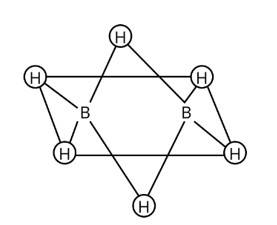
(A) The two bridged hydrogen atoms and the two boron atoms lie in one plane.
(B) Out of six B - H, bonds two bonds can be described in terms of 3 centre 2-electron bonds.
(C) Out of six B- H bonds four B- H bonds can be described in terms of 3 centre 2 electron bonds.
(D) The four terminal B - H bonds are two centre-two electron regular bonds.
Which of the following statements are correct? Answer on the basis of figure.

(A) The two bridged hydrogen atoms and the two boron atoms lie in one plane.
(B) Out of six B - H, bonds two bonds can be described in terms of 3 centre 2-electron bonds.
(C) Out of six B- H bonds four B- H bonds can be described in terms of 3 centre 2 electron bonds.
(D) The four terminal B - H bonds are two centre-two electron regular bonds.This is a Multiple Choice Questions as classified in NCERT Exemplar
(A), (B) & (D)
Two hydrogens forming bridge in B2H6 are peculiar in bonding and can be termed as 3 -centered-2-electron bond or banana bond. 1 s orbital of each hydrogen overlaps with the hybrid orbital of one of the boron
Upvote Which of the following statements are correct?
(A) Fullerenes have dangling bonds.
(B) Fullerenes are cage-like molecules.
(C) Graphite is thermodynamically most stable allotrope of carbon.
(D) Graphite is slippery and hard and therefore used as a dry lubricant in machines.
Which of the following statements are correct?
(A) Fullerenes have dangling bonds.
(B) Fullerenes are cage-like molecules.
(C) Graphite is thermodynamically most stable allotrope of carbon.
(D) Graphite is slippery and hard and therefore used as a dry lubricant in machines.
This is a Multiple Choice Questions as classified in NCERT Exemplar
(B) & (C)
(B) Fullerene is an allotrope of carbon consisting of 60 carbon atoms bonded together through single and double bonds in such a manner that they form a hollow sphere like shape or a cage-like structure.
(C) In graphite, ea
Upvote Me3SiCl is used during polvmerisation of grgane silicones because
(A) The chain length of orange silicone polymers can be controlled by adding Me3
(B) Me3SiCl blocks, the end terminal of silicone polymer.
(C) Me3SiCl improves the quality and yield of the polymer.
(D) Me3SiCl acts as a catalyst during polymerization.
Me3SiCl is used during polvmerisation of grgane silicones because
(A) The chain length of orange silicone polymers can be controlled by adding Me3
(B) Me3SiCl blocks, the end terminal of silicone polymer.
(C) Me3SiCl improves the quality and yield of the polymer.
(D) Me3SiCl acts as a catalyst during polymerization.
This is a Multiple Choice Questions as classified in NCERT Exemplar
(A) & (B)
Me3SiCl is a soleuless liquid and is stable in anhydrous condition. When added in the process of polymerization, it blocks the end terminal of the silicone polymer and determines its chain length.
Upvote The linear shape of CO2 is due to
(A) sp3 hybridisation of carbon
(B) sp hybridisation of carbon
(C) n- p π bonding between carbon and oxygen
(D) sp2 hybridisation of carbon
The linear shape of CO2 is due to
(A) sp3 hybridisation of carbon
(B) sp hybridisation of carbon
(C) n- p π bonding between carbon and oxygen
(D) sp2 hybridisation of carbon
This is a Multiple Choice Questions as classified in NCERT Exemplar
(B) & (C)
Hybridisation of any atom in a molecule corresponds to the number or σ bonds it is making covalently with other atoms.
In CO2, carbon is attached to two oxygen atoms through double bonds. Out of which two are σ bonds and the
Upvote