

Chemistry
Get insights from 6.9k questions on Chemistry, answered by students, alumni, and experts. You may also ask and answer any question you like about Chemistry
Follow Ask QuestionQuestions
Discussions
Active Users
Followers
New answer posted
a year agoContributor-Level 10
The process of moving sodium and potassium ions across the cell membrane is an active transport process involving the hydrolysis of ATP to provide the necessary energy.
New answer posted
a year agoContributor-Level 10
The given value of µ (spin only)
2.84 = √n (n + 2) BM, So, n = 2
Among the given configurations, d? system in strong field ligand will have 2-unpaired e? in t? g set of orbitals as shown below.
New answer posted
a year agoContributor-Level 9
Fe+2 undergoes reduction & I2 undergoes oxidation.
= (0.77 – 0.54) V = 0.23 V
= 23 * 10-2 V
x = 23

New answer posted
a year ago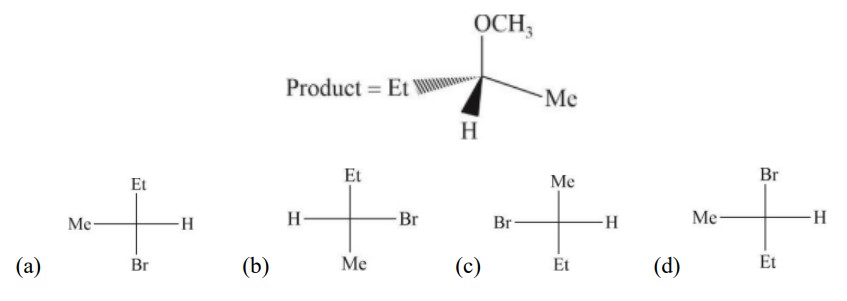
Contributor-Level 10
In S?2 reaction, inversion takes place, so configuration get reversed.
New answer posted
a year agoContributor-Level 10
As Zn (OH)? , BeO, Al? O? are amphoteric, so they can react with both HCl and NaOH.
New answer posted
a year agoContributor-Level 10
When Ferric chloride reacts with potassium thiocyanate a blood red colour of Ferric thiocyanate is formed
FeCl? + 3KSCN → Fe (SCN)? + 3KCl
New answer posted
a year agoContributor-Level 9
1000 ml solution contains 0.02 milli mole (mm)
500 ml solution contains 0.02 m.m
Solution made 1000 ml with H2O
m.m in final solution = 0.01 mm
Solution (A) + 0.01 m. m H2SO4
= 0.01 + 0.01
= 0.02 m.m
= 0.00002 * 103 mm
Taking an Exam? Selecting a College?
Get authentic answers from experts, students and alumni that you won't find anywhere else
Sign Up on ShikshaOn Shiksha, get access to
- 67k Colleges
- 1.2k Exams
- 716k Reviews
- 1850k Answers