

Chemistry
Get insights from 6.9k questions on Chemistry, answered by students, alumni, and experts. You may also ask and answer any question you like about Chemistry
Follow Ask QuestionQuestions
Discussions
Active Users
Followers
New answer posted
a year agoContributor-Level 9
p- toluenesulphonyl chloride
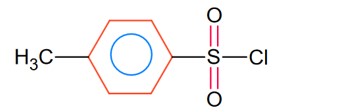
Only gives soluble product with alkali for 1° amine and for 2°- amine it gives insoluble product.


New answer posted
a year ago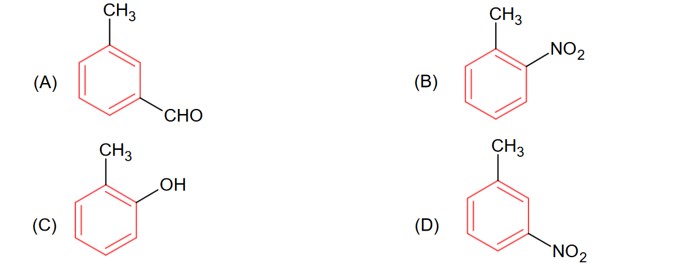
Contributor-Level 9
OH group is the more activating group and ortho-para director, hence ortho position attach will provide meta substituted product with respect to – CH3 in option (C).
New answer posted
a year agoContributor-Level 10
Tautomerism is a dynamic equilibrium between 2 isomers, also known as tautomers, where a compound exists in 2 different structures. The most common form is keto enol tautomerism. It is mainly of two types:
- Keto Form: Contains a C=O (carbonyl) group
- Enol Form: Contains a C=C double bond and an –OH group
New answer posted
a year ago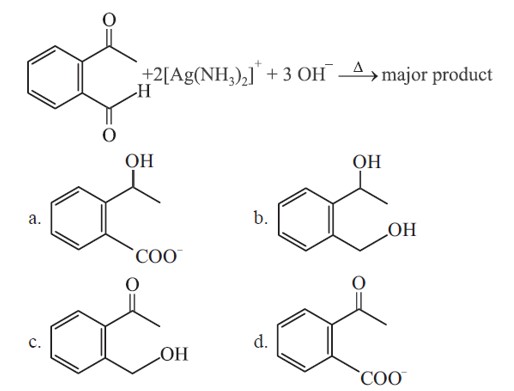
Contributor-Level 10
Tollen's reagent oxidises aldehydes into carboxylate ion whereas ketone is not oxidised by tollen's reagent.
New answer posted
a year ago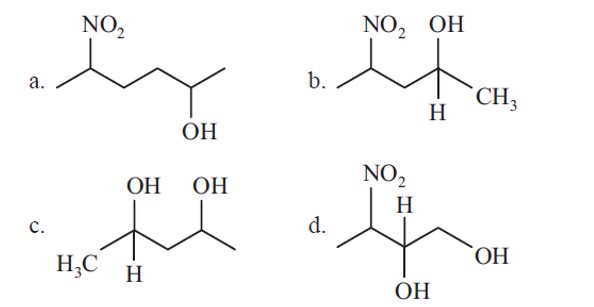
Contributor-Level 10
Formation of Conjugated diene in option 3 make the given reactant most reactive towards dehydration in acidic conditions.
New answer posted
a year agoContributor-Level 10
Ethylene diamine, en is bidentate, chelating ligand. Chelating ligands increase stability due to higher entropy factor.
New answer posted
a year agoContributor-Level 10
The highest oxidation number corresponding to the group number in transition metal oxides is attained in Sc? O? to Mn? O? CrO is basic but Cr? O? is amphoteric.
Note: All the transition metals except scandium form MO oxides which are ionic (Only for 3d series, this statement is true)
Hence, (A), (C) and (D) are incorrect. But not given in the options.
Taking an Exam? Selecting a College?
Get authentic answers from experts, students and alumni that you won't find anywhere else
Sign Up on ShikshaOn Shiksha, get access to
- 67k Colleges
- 1.2k Exams
- 716k Reviews
- 1850k Answers