

Chemistry
Get insights from 6.9k questions on Chemistry, answered by students, alumni, and experts. You may also ask and answer any question you like about Chemistry
Follow Ask QuestionQuestions
Discussions
Active Users
Followers
New answer posted
12 months agoContributor-Level 10
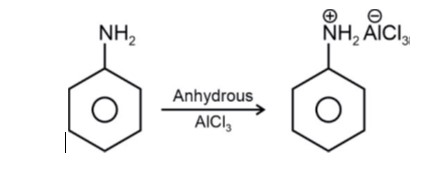
In aniline –NH2 is strong activating group due to presence of lone pair in nitrogen.
Aniline does not show Friedel-Craft alkylation reaction, because anhydrous AlCl3 and aniline form salt together
New answer posted
12 months agoContributor-Level 10
Suspension of slaked lime in water is known as milk of lime
Crude sodium chloride obtained by crystallisation of brine solution contains CaSO4, Na2SO4 and MgCl2
Beryllium salts are easily hydrolysed
Gypsum : CaSO4 * 2H2O

New answer posted
12 months agoContributor-Level 10
Potassium hydrogen phthalate is used to standardize NaOH solutions.
Phenolphthalein is used as an indicator to detect completion of titrations.
New answer posted
12 months agoContributor-Level 10
[Ni (H2O)6]2+ Þ Ni2+ is octahedral and [Ni (CN)4]2– is square planar.
In [Ni (H2O)6]2+ Þ Ni2+ has two unpaired electrons and in [Ni (CN)4]2– Þ Ni2+ has no unpaired electrons. [Ni (H2O)6]2+ is coloured as it absorbs red light due to suitable d-d transition and complementary light emitted is green.
[Ni (CN)4]2– has strong field ligand so the electrons of Ni2+ pair up and it is colourless as it cannot absorb light from visible region.
New answer posted
12 months agoContributor-Level 10
Work depends on the path followed by the system so work is path function.
New answer posted
12 months agoContributor-Level 10
Kindly go through the solution
Since VReal > Videal
So, Z = VReal > 1. Videal
New answer posted
12 months agoContributor-Level 10
KCN
R – X + KCN
R – X + AgCN
KCN is ionic therefore ionised and attack occurs through carbon.
AgCN is covalent therefore attack starts with Nitrogen.
Taking an Exam? Selecting a College?
Get authentic answers from experts, students and alumni that you won't find anywhere else
Sign Up on ShikshaOn Shiksha, get access to
- 67k Colleges
- 1.2k Exams
- 716k Reviews
- 1850k Answers